Sunday, January 30, 2011

Iraq - Tasbreeb Bigilla


Background
Finding information on Iraqi breakfast was actually very simple. I found an article online about breakfast before the 1990 Gulf War and the subsequent embargo. It provided a fantastic list of recipes.
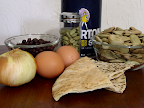
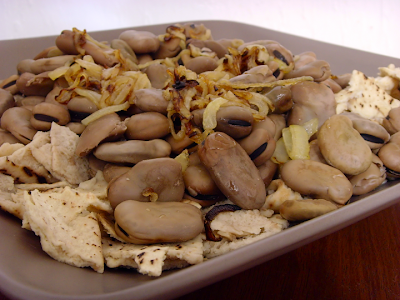
As Iraq is probably the first place wheat was domesticated, it comes as no surprise that bread is a staple of the diet. Other ideas included gaymer, a buffalo cheese sometimes served with date syrup, and kahi, a dish brought to Iraq with Babylonian Jews. It is very closely related to baklava and requires many folded layers of pastry dough. Bigilla is a fava bean dish eaten in northern and central Iraq. I located a variation of this dish called tasbreeb bigilla in The Iraqi Cookbook. It consists of fava beans served with pita bread topped with fried onion and peppermint powder, and is traditionally served on Fridays. We were unable to find peppermint powder specifically so we used crushed dried mint.

Tasbreeb Bigilla
  • 1 lb fava beans
  • 1 packet of pita bread (ours had six pitas)
  • 1 medium onion, thinly sliced
  • Olive oil
  • Salt
  • Dry mint
  1. Soak fava beans overnight in cold water.
  2. Cut pita bread into pieces and leave them out overnight so they dry out. (Alternatively, put the bread pieces in an oven at 200 for 30 minutes.)
  3. Bring the beans and water to a boil at medium heat, and boil them for 45 minutes.
  4. Add salt and continue to boil for 15 minutes. Make sure there is enough liquid remaining to soak the bread.
  5. While the beans are cooking, heat oil in a pan, add the onions to the hot oil and fry them until browned.
  6. Remove the cooked beans from the water.
  7. Soak the bread pieces in the bean liquid for 1 minute. Then remove them from the water and place them in a big shallow bowl.
  8. Put the beans on top of the bread and then pour the onions and hot oil over the beans.
  9. Sprinkle the dry mint to taste over your plate.
Results and Discussion
This recipes makes a lot of food. We could have easily halved it and still had lots of food. It was suggested to serve this with fried eggs, but we had to leave them out or we would have been eating the leftovers all week!
The pita bread pieces had an interesting texture. Being soaked in the bean juice infused them with flavor. Getting the bread pieces in and out quickly lets the flavor soak in while preventing the bread from becoming soggy.
The fried onions in the oil added lots of taste and the next time I make this I am going to add more onions. The oil itself provides the same flavor enhancement and texture contrast as in the previous breakfast.
In Iraq they add cardamom to the coffee for flavor, which is probably quite good when done properly. We were not paying attention and completely screwed this up—getting the ratio of water to coffee wrong and ending up with a very weak brew. We're now on an 0-for-2 beverage streak, and will have to pay more attention from now on!

Sunday, January 23, 2011

Morocco - Beyssara


Background
Moroccan cuisine reflects its multiple interactions with different culture through trade and conquest. It is in the Mediterranean tradition. The Berbers brought influences from just west of Egypt (their best known contribution is couscous). The Moors conquered Spain and Spanish influence flowed back across the straight of Gibraltar.
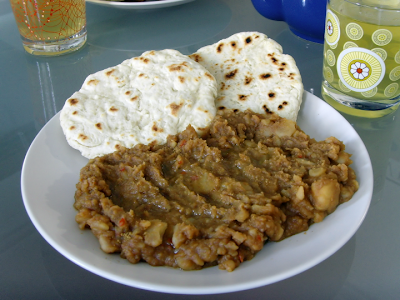
We found lots of different options for breakfast. Lassida is a porridge made of semolina or couscous and flavored with honey and butter. But it is traditionally eaten to break the fast during Ramadan, which has long since past. Baghrirs are a pancake made with semolina and only cooked on one side. The batter has the consistency of a crepe. Beyssara is a spiced fava bean stew served with bread. We found a recipe for this in Mediterranean Street Food which looked simple and tasty, and so decided to make the beyssara.
The national drink is green tea with mint. Making it is considered an art and has ritual associated with it. We had some trouble with the mint tea. Though we did have an errand at the Burlington Mall yesterday and would have bought some at Teavana, it took us 40 minutes (!) to get into and out of the parking lot and so we ran out of Zipcar time. The grocery store was also out of mint of any kind, so we made regular green tea.
The one difficulty in making beyssara was finding split, peeled fava beans. The best option available were a pickled peeled bean and I did not know how they would effect the test. I give a method of peeling the beans in the recipe.

To peel dried fava beans
  • 1 cup dried fava bean
  • 3 cups water
  • 1 tbsp oil
  1. Put fava beans, water, and oil into a pressure cooker.
  2. Cook at high pressure for 15 minutes.
  3. Quick-release the pressure.
  4. Open the pressure cooker, tilting the lid to that the steam is released away from you.
  5. Drain the beans and put them into a ice water bath. Let them sit for 20 minutes.
  6. The skin around the bean should now be loose and can be removed using your finger nails or started with a paring knife.
  7. Discard the skin and keep the bean. Split the beans if you can.
  8. Refrigerate the beans until you use them.
Beyssara
  • 1 cup peeled split broad beans, soaked overnight in hot water with 1 tsp baking soda
  • 2 gloves garlic, unpeeled
  • 1½ tsp ground cumin
  • ½ tsp red pepper flakes
  • 1½ tsp paprika
  • Salt
  • Extra virgin olive oil
  1. Put the beans in a sauce pan with the garlic, cumin, red pepper flakes, and 1 quart of water.
  2. Bring to a boil on medium high heat.
  3. Cover the pan and cook for 30 minutes or until they are mush.
  4. Reduce the heat to low and simmer for 10 to 15 minutes.
  5. Add the paprika and salt to taste.
  6. Serve in a shallow bowl and garnish with a drizzle of olive oil and cumin.
  7. Eat with Moroccan bread.
Results and Discussion
This recipe takes a while, but that is in the nature of cooking dried beans. The cooking time could also be reduced by cooking them longer in the pressure cooker. Most of the water boils off or is absorbed by the beans, but you can easily control how moist the beans are by adjusting the cooking time. The end result is nicely spiced with an enjoyable rough texture. I think ours was a bit drier than it was supposed to be as we ended up with more of a paste than a soup but it still pretty good.
The drizzle of olive oil added a nice flavor. It also provided a strong contrast of textures with the beans.

Sunday, January 16, 2011

Uganda - Ugali and Chapati


Background
Ugandan cuisine has an East African base, modified by the influence of the conquering Arabs and English. The biggest influence the English brought to our breakfast was really Indian influence. I always had a scope of the British Empire in my mind but I never realized how much influence the Indian citizens of the Empire had as they migrated out.
The biggest problem searching for information on Ugandan breakfast is that President Obama made an appearance at a prayer breakfast about Uganda's proposed anti-homosexual laws. This made it impossible to search by "Ugandan breakfast" and we had to get more creative with our query.
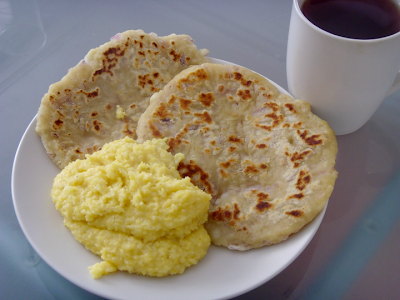
We found that Ugandan breakfast consists of ugali and chapati. It is basically the same as Tanzania. I was unable to find a Ugandan cookbook so I used online resources to try and find recipes specific to Uganda. The ugali recipe can be found here and the chapati recipe we used is here. The chapati recipe is a little free form our more detailed interpretation is follows.

Chapati
  • 2 cups flour
  • 1 tsp salt
  • 2 cloves garlic, minced
  • 1/4 red onion, finely diced
  • 1/2 cup warm water
  • oil for frying
  1. Mix dry ingredients, onion, and garlic in a bowl.
  2. Slowly add the warm water (I would start with 1/4 cup) and mix it into a doughy consistency.
  3. Add more water as needed—the onions and garlic are going to contribute some moisture to the dough, so add the water slowly.
  4. Knead until you have a tough doughy consistency.
  5. Let the dough rest for 30 minutes.
  6. Break the dough into tangerine-sized balls, then roll the dough into pancakes 6 inches in diameter. (Put flour in between the chapatis when stacking them to prevent sticking.)
  7. Heat a frying pan and spray a thin layer of oil into the pan.
  8. Fry one side of the chapati until it starts to brown, then apply oil to the uncooked side of the chapati, flip it, and cook the other side.
Serve with the ugali on top of the chapati

Results and Discussion
This breakfast was very filling and pretty easy. The only really involved part was constantly stirring the ugali while it cooked. I am not a big fan of ugali. The first taste is really nice; it has a good salty taste and is a little creamy. As I eat more of it it just becomes bland and thick. For Tanzania I thought it might have been undercooked, but I know that was not the case here. Ugali is food for quick energy and not for taste.
The chapatis were very dense and chewy. The red onion and garlic were nice additions and added some subtle flavors. I would like to try it cooking the onions and garlic prior to putting them in to the dough to enhance this.