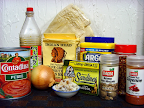
Showing posts with label dumplings. Show all posts

Sunday, September 18, 2011

Ecuador - Quimbolitos and Coffee


Background
Ecuador straddles the equator on the west coast of South America. Its major regions are the coastal lowlands, the Andes mountains, the Amazon, and the Galapagos Islands. The cuisine of the lowlands is heavier in seafood with lots of ceviche. The mountain regions tend to have more grains and farmed meats. The mountain regions are also known for eating guinea pig. Yuca is the major staple in the Amazon region.
We chose to make sweet tamales, called quimbolitos, which we found in The South American Table. They are served as snacks, desserts, or for breakfast with a cup of coffee. The recipe varies from region to region, most often in the proportion of cornmeal to wheat flour. The ratio of lard to butter also varies.  We decided to skip the raisins since we forgot to buy any Kitty doesn't really like them.
The exotic ingredient for this week is the banana leaf. We are using it a wrapper for the tamale dough. Banana leaves can be found in the produce or frozen section of most market that carry Latin foods. They are also used as serving dishes across tropical and equatorial regions. The leaves are very large!
Quimbolitos
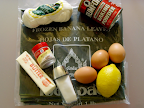
  • 2 sticks unsalted butter, softened
  • ¾ cup + 2 tbsp sugar
  • 6 eggs, separated
  • 6 oz chihuahua cheese, shredded
  • ½ cup cornmeal
  • 1 cup flour
  • 1 tsp baking powder
  • 1 tbsp lemon zest
  • ½ tsp anise seeds
  • 2 tbsp brandy or anise liquor
  • banana leaves, thawed if frozen and cut into 10x14 inch rectangles
  1. Cream butter and ¾ cup of sugar.
  2. Add egg yolks one at a time, beat until the mixture is light and fluffy.
  3. Stir in cheese, cornmeal, flour, baking powder, zest, and anise.
  4. Mix egg whites with a pinch of salt.
  5. Beat the eggs until you have soft peaks, then add 2 tbsp of sugar and continue to beat until you get glossy, stiff peaks.
  6. Fold 1/3 of the egg whites into the butter and cheese mixture to lighten, then gently fold in the remaining egg whites.
  7. Spread ¾ cup of the mixture onto the middle of the banana leaf to a thickness of ¾ inch.
  8. Fold the long sides of the leaf together over the filling. Fold short ends under the leaf.
  9. If the leaves seem flimsy or have holes you can then wrap the packets again in aluminum foil. Otherwise tie them up using kitchen twine.
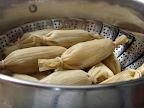
  10. Steam for about 20 minutes.

Results and Discussion
These turn out really well. A lump of butter, cheese, and flour goes into the banana leaf and very moist, puffy cake comes out. The shredded cheese adds texture and the lemon and anise give a really nice flavor. If you want to cook a lot of these at once a multi-level bamboo steamer basket might work very well.
The banana leaves are not eaten but we were trying to describe their smell. Kitty thought they smelled like tea. The smell reminded me of artichoke. In the end we decided they had the general vegetable-y leaf smell. They are not edible, probably because the leaves are so tough and fibrous.
You will probably have lots of leftover banana leaves as they are commonly sold in one pound bags. They can be used like a natural tinfoil to wrap things that you want to roast or steam, or as serving "dishes." If you leaves have not already been frozen you can also just freeze them, otherwise they last 1-3 weeks in the fridge.

Sunday, June 12, 2011

Côte d'Ivoire - Foutou


Background
Côte d'Ivoire is a West African country and a former French colony. After independence, the economy was built on cocoa and coffee. The society is still largely agrarian. Like most West African countries, they have a heavy reliance on grains and tubers.
My research for an Ivorian breakfast when down lots of weird paths, including lots of information on the current election turmoil and a BBC article of a French style breakfast on a military helicopter in the country. I eventually turned to The World Cookbook for Students. This is a five volume cookbook that gives a general overview of every country in the world. It had been given in the search results on many previous searches but I had never used it as resource before now. It described breakfast as a porridge made using either cassava or maize. The best recipe we could find that fits the porridge is foutou, which is a mash of cassava and plantains serves with a peanut sauce.
We have used cassava flour in previous meals but we have never started with a whole cassava. Cassava is a major source of carbohydrate throughout Africa. Its prevalence on the continent would make one assume it is indigenous, but cassava is native to South America and was brought to Africa by the Portuguese.

Peanut Sauce
  • ½ cup creamy peanut butter
  • 1 cup hot chicken stock
  1. Beat peanut butter in a bowl.
  2. Slowly add add the chicken stock until you get a creamy, smooth sauce.

Foutou
  • 1 ½ cups peeled and chopped cassava
  • 3 plantains, peeled and sliced
  • Salt to taste
  1. Cover the cassava and plantains in water.
  2. Boil for 20-25 minutes until the cassava is very soft. (Add more water if necessary.)
  3. Drain and reserve some cooking liquid.
  4. Beat the mixture using an electric mixer. Add more cooking liquid as needed. You want a consistency similar to mashed potatoes.
  5. Roll mixture into small balls and serve with peanut sauce.

Results and Discussion
The hardest part of this dish was making the peanut sauce. Getting the stock mixed in with the peanut butter took much longer than I anticipated and required quite a bit of work. Next time we will use the electric beaters. The foutou would benefit from the electric mixer as well; our original recipe suggested a blender, which we used only to get a rather sticky, gummy result. We expect the good old Kitchen-Aid will give this the same fluffy texture it lends to your mashed potatoes.
The foutou has a slightly sweet, banana-y flavor from the plantains. The slightly lumpy, very sticky texture made it easy to eat by hand (though the fluffier texture we expect from the electric beater method would make it neater). The peanut sauce is much smoother is a delicious, savory counter point.

Monday, April 4, 2011

Ghana - Kenkey


Background
Ghanian cuisine consists of a lot of stews with cassava, yam, and corn as major starches. The protein sources are lots of smoked and dried fish. Spicy condiments are very popular. Ghana has over 100 ethnic groups so a diversity of cuisines is expected.
I found two choices for our breakfast. The first dish option was ampesi, a mixture of boiled starchy vegetables served with boiled onions and fish. The second choice was a dish made of fermented cornmeal called kenkey. I was able to find two recipes for both dishes in A West African Cookbook and A Good Soup Attracts Chairs. My initial leaning was towards the ampesi because the kenkey seemed a little too close to ugali. After getting my hands on the recipes for both, one factor in the kenkey recipe from two different sources jumped at me. The instructions tell you to remove any mold that might have grown on the dough during the fermentation process. This warning was slightly scary. Kitty then reminded me that part of this project was to try the slightly scarier things. We went with the kenkey.
As we did further research online looking into the appropriate sauce to serve with kenkey. Ga Kenkey, also called komi, is eaten in the coastal areas. It is fermented for 2-3 days and steamed in corn husks. The name is taken from the Ga-Adangbe people who inhabit the south east coast. Fanti kenkey is fermented for 5-6 days and is steamed in a plantain leaf. This version takes its name from the Fanti people who live on the southwestern coast. We chose to make ga kenkey because we really did not have enough fermentation time (or ambition) for the other.
Our next step was tracking down a recipe for the a chili sauce called shito. Shito is essentially the ketchup or the barbeque sauce of Ghana. It is made from tomatoes, dried shrimp and fish, oil and chili powder. More of the recipes describe how the fish smell fills the house and one recipe involving a slow cooker recommends doing it all outside. The scale of these recipes were also huge. We decided to make a spicy tomato sauce with onion, chili powder, and fish sauces to approximate shito.
We also chose to use a pressure cooker in order to speed up the cooking time. Traditionally kenkey is steamed and takes 60 to 90 minutes. We based on timing for this on pressure cooker recipes for vegetarian tamales. We include both pressure and steaming directions in the recipe below.

Kenkey
  • 3 cups white stone-ground cornmeal (not de-germinated)
  • 1 tbsp corn starch
  • 3 cups warm water (105-115°F)
  • 1 tsp salt
  • dry corn husks
  1. Put cornmeal and cornstarch into a bowl.
  2. Add the warm water and stir until you get a smooth batter/dough.
  3. Loosely cover the bowl the bowl with a cloth or wax paper and set in a warm out of the way place for 2 days.
  4. When you are ready to use the dough start by scraping off and discarding any mold that might have formed. *see note in discussion
  5. Divide the dough in half.
  6. Bring 2 cups of water to a boil in large sauce pan. Once the water is boiling, add the salt and reduce to medium heat.
  7. Add half the dough to the water and mix it in. Let it cook for 10 minutes and stir to prevent scorching.
  8. Remove the pan from the heat, stir in the remaining dough, and mix thoroughly.
  9. Divide the dough into 3 or 4 large portions and put them onto corn husks.
  10. Shape the dough into balls.
  11. Wrap the corn husk around the ball tying it at the top.
  12. Steam or pressure cook as follows:
    1. Steaming
      1. Pour hot water into a steamer pot and put a rack on top of it.
      2. Put the wrapped kenkey on the rack and bring the water to a boil using high heat.
      3. Reduce to low heat and steam for around 90 minutes.
    2. Pressure Cooking
      1. Put the wrappers into the pressure cooker, elevated on a rack.
      2. Add enough water to the pressure cooker to meet the minimum safe level given by the manufacturer.
      3. Cook for 20 minutes at 15 psi.
      4. Quick release the pressure, then open the pressure cooker so the steam releases way from your face.
  13. Let them cool for ten minutes.
  14. Serve with shito and lightly cooked sardines.
Results and Discussion
A quick summary of this meal is expressed mathematically as Kenkey > Ugali. The fermentation process gives the kenkey its own flavor. The finished kenkey is a large spongy unit very similar to a tamale. Our ersatz shito was a very nice sauce that provides some additional moisture and lots of taste. I see why various websites describe it as the ketchup or BBQ sauce of Ghana.
The fermentation process was pretty interesting to watch. The mixture starts as cornmeal suspended in water. The book described it as a dough after the mixing step. I mixed for several minutes but I never got beyond a runny batter. I covered the batter and put into a cooled oven. That evening I checked on it and saw a water with the cornmeal settled out. I put my hand in the batter and felt that a dough-ish substance had formed below the water. A day later it looked the same. On the morning we made the breakfast I pulled away the cloth and found that a dough had formed. (We didn't get any mold, by the way. Frankly, I would be pretty leery of eating anything soft that had mold on it, mycotoxins can be pretty evil. —Kitty)
I proceeded to divide the dough and found that lots of water was beneath it. I think that the gas released by the fermentation caused the dough beneath the surface to fracture allowing the water to drain to the bottom. A sour smell had started to develop. I though the dough might be too watery as I added it to the boiling water. The dough quickly thickened and the problem went away.
When wrapping the dough we tried a mix of corn husks and aluminum foil. Tying off the corn husks and finding husks large enough were difficult. Wrapping the dough in aluminum foil was really easy. Kenkey was much easier to remove from the husks. In the future we decided that we would go with a double wrap using corn husks on the inside and foil on the outside.

Sunday, June 6, 2010

Mexico - Tamales de Anis, Salsa de Cacahuate, Atole


Background
Today's breakfast was brought to you by masa, corn flour, a staple of Mexican cooking. The main course of our breakfast were sweet anise-seed tamales with peanut and chipotle salsa. These recipes were taken from Culinary Mexico by Daniel Hoyer. Our drink was raspberry atole based on a recipe from Zarela's Veracruz by Zarela Martinez.

Tamales de Anis
  • 12 cornhusks
  • 1½ cups instant masa mix (e.g. Maseca)
  • 1½ cups warm water (110-130° F)
  • 2 tbsp butter
  • 2 tbsp lard
  • 3 tbsp water
  • 1 tbsp anise seeds, toasted
  • 1 tsp salt
  • 2 tbsp sugar
  • 1/4 cup chopped prunes
  1. Cover corn husks with hot water and soak for 1 hour.  Drain and pat dry.
  2. Mix masa and warm water stir until you get a crumbly texture. The amount of water to achieve this texture varies so add water slowly.  Let sit for 30 minutes, then weigh out 12 ounces of this mixture (reserve the rest for atole).
  3. Whip butter and lard in a mixing bowl until they are fluffy.
  4. Gradually add masa alternating with the three tablespoons of water.
  5. Mix in anise seeds, salt, sugar, and prunes and beat for 2 minutes until smooth.
  6. Put 2 tbsp of the mixture on the edge of a corn husk and roll it up.
  7. Tie the ends with kitchen twine, trimming any excess.
  8. Steam for 1 hour and 15 minutes, making sure that the steamer does not go dry.
  9. Let cool for 10 minutes before serving.

Salsa de Cacahuate
  • ½ cup unsalted dry roasted peanuts
  • 1 small onion
  • 3 garlic cloves, peeled
  • 1 medium tomato
  • 2 chipotles in adobo
  • 1½ tsp apple vinegar
  • 3 tbsp chopped cilantro
  1. Slice onions and tomatoes.
  2. Roast onions, tomatoes, and garlic under a broiler.
  3. Mix all ingredients, except cilantro, in a blender leaving a coarse texture.
  4. Stir in cilantro and salt to taste just before serving.

Raspberry Atole
  • 1 cup of raspberries
  • 4½ cups of water
  • ¼ cup masa left over from tamales (use more for thicker atole)
  • ¼ cup grated piloncillo sugar
  1. Boil 4 cups of water.
  2. Puree the raspberries and masa with the remaining ½ cup of water.
  3. Push the raspberry puree through a sieve into the boiling water (this removes the seeds).
  4. Add the piloncillo and stir.
  5. Maintain a low boil for 30 minutes as the drink thickens.

Results and Discussion
This breakfast easily took the longest of any of the others. Most of the time was spend making and steaming the tamales. The tamales were firm and moist with the plum providing a sweetness that was an excellent counter point to the heat of salsa. Roasting the vegetables prior to making the salsa provided additional flavor and really enhanced the taste. The recommendation of leaving the salsa "gritty" also gives an excellent texture to the salsa. The raspberry atole was a tasty drink and could be flavored with any berry of your choosing.
For advice on how to roll tamales we consulted How To Cook Everything by Mark Bittman which has excellent illustration.
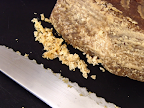
Cutting the piloncillo presented a special challenge. The block of sugar is very hard and it is impossible to break of parts. We resorted to using a serrated knife to shave off the sugar as needed. In Columbia a stone is common used to break the block apart but we live in an apartment.