Showing posts with label things on toast. Show all posts

Saturday, September 3, 2011

Kazakhstan - Nan, Baursaki, Sausage, & Tea


Background
Kazakhstan is an ethnically diverse country in central Asia. Much of this diversity is a result of Stalin's prison camps and other forced migration policies of the Soviet Union. Kazakhs are traditionally nomadic and their cuisine reflects this with lots of preserved food and protein sources that range well. The prominent protein sources are horse and lamb, and much of the dairy is preserved or fermented. The only breakfast information I found online was that Russian influence have made kasha more prevalent. I looked for Kazakh restaurants in the Boston area to get some better information. I found Cafe Assorti in Washington D.C. They got back to me immediately with information and suggestions. So if you are in the D.C. Metro area please go eat there. We are looking forward to trying them the next time we are in the area.
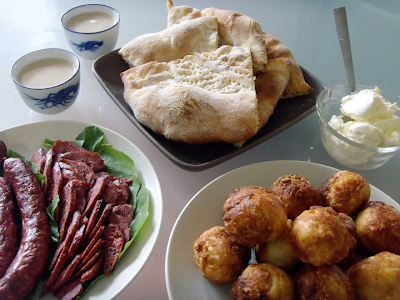
According to our source, Kazakhs are tending towards a more western breakfast as they are less nomadic. Our contact at Cafe Assorti gave us a break down of what they would consider a traditional breakfast: an assortment of thinly sliced sausages made from lamb or horse meat, served with taba-nan and/or baursak (a flat bread and a fried dough respectively). The bread is eaten with a type of sour cream called kaymak. Kaymak is also used in a tea made with cardamom and fennel.
Taba-nan requires special equipment (two oven-proof frying pans), so we adapted an Uighur flatbread from nearby western China. We chose it because it the base of the recipe was quite simple and seemed to be a good approximation of a nonspecific central Asian flatbread. We found the original recipe in Flatbreads & Flavors. We got our baursak recipe from Food by Country (originally published in Junior Worldmark Encyclopedia of Foods & Recipes of the World). We made some substitutions to reduce the size of the recipe to something two people can eat.  The tea recipe is from The World Cookbook for Students.
Kaymak is not readily available in the United States, but can be made at home by steaming a mixture of milk and cream for eight hours. Kitty tried a homemade recipe but it did not work for us. Instead, we bought clotted cream as the closest available substitute.
Even setting aside any ethical concerns, horse meat was not an option as it is simply not available in the United States. The last horse slaughterhouse closed in 2007 and it existed mostly to provide zoos with meat. We decided to purchase beef or lamb sausage instead. One of the sausages is called shuzhuk, and given the histroical Turkish influence in the region, we assume it to be related sujuk. I got the sujuk from a local halal market and proceeded to pseudo-smoke it using a 200°F oven and waiting until it got to 150°F internally. I then refrigerated it overnight. I got the technique from a summer sausage recipe that can be found here.

Basic Nan (6 pieces)
  • 2 tsp dry yeast
  • 2 ½ cups warm water (105-115°F)
  • 5-6 cups white flour
  • 2 tsp salt
  • Ceramic baking tile/pizza stone (optional)
  1. Place warm water in a mixing bowl and add yeast.
  2. Mix in 3 cups of flour one cup at a time.
  3. Stir the mixture 100 times in the same direction to develop the gluten.
  4. Add 2 teaspoons of salt, then continue to add flour until you cannot stir the dough.
  5. Flip the dough onto a floured surface and knead until it smooth and elastic.
  6. Lightly oil a bowl, put the dough in, and let it rise until it has doubled in size.
  7. Break the dough into 6 pieces. Roll out the pieces into 4-5 inch disks. Cover the disks and working one at a time roll them out into 10 inch disks (Note: Avoid making the dough too thin as it will easily burn. Think thin crust pizza for the correct thickness.)
  8. Let the disks rest for 10 minutes, then prick the dough with a fork (traditionally, a specialized bread stamp is used to apply a pricked design). Leave a two inch boundary unpricked around the edge of the dough.
  9. Place dough on a stone in a 500°F oven. Bake for 7 minutes or until golden brown on top. (Monitor it closely.) Let it cool for 5 minutes before serving.

Baursaki
  • 1 cup flour
  • 1½ tsp yeast
  • 2 tbsp water (105-115°F)
  • 2 tbsp yogurt
  • 1 egg white
  • 2 tsp butter
  • 1½ tsp salt
  • Oil for frying
  1. Mix water and yeast and wait for the yeast to bubble.
  2. Mix in the remaining ingredients, knead until it forms a dough.
  3. Let the dough rise for 30 minutes.
  4. Break off tablespoon sized pieces of dough and roll them into balls.
  5. Heat the oil in a deep skillet over high heat.
  6. Carefully add the balls and fry them until they are golden brown. Drain on a paper towel.
  7. Roll in sugar before serving, if desired.

Kazakh Tea
  • 4 cups water
  • 5 tsp black tea leaves
  • 4 cardamom pods
  • 1 tsp fennel seeds
  • 2 cups milk
  • Sugar/honey, salt, and cream to taste.
  1. Bring water to a simmer.
  2. Simmer tea and seeds for 3 minutes.
  3. Add milk and simmer for 2 minutes more.
  4. Remove from heat and strain tea.
  5. Add sugar or honey, salt, and cream as desired.

Results and Discussion
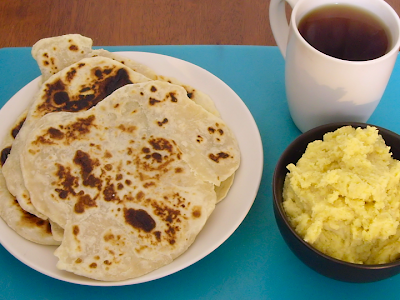
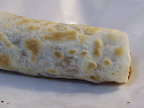
The bread had a nice crispy texture with very puffed outer crust. The puff comes from the fork pricks (or rather, the lack of them around the outer edges) and gives a pretty cool bread bowl effect. It might be fun to try this on pizza crust.
Fried dough continues to taste good. I am curious if there exists a civilization that practices agriculture that does not have some form of fried dough. This particular dough was not as fluffy as some of the recipes but it had a nice dense texture and felt more substantial. It was also a slightly drier dough which makes getting the dough from your fingers to the hot oil much safer.
The tea is basically chai with salt. I added more salt with each until I noticed its effect. I would estimate I topped out around 1/8 teaspoon with 1/2 teaspoon of sugar. As I drank it I realized the only drink I am used to tasting this much salt in is a sports drink. The clotted cream gave the tea a rich texture. (Clotted cream is nearly butter, very rich and creamy. It tastes great, but you can feel your arteries clogging.)
The suzhuk was nicely spiced with what tasted like garlic and black pepper which is matches my understanding of Kazakh version. The oven-smoking process gave decent results but it is no substitute for the flavor of a proper smoking.

Sunday, July 10, 2011

Chile - Chirimoya Alegre, Jam & Manjar Blanco on Toast


Background
Breakfast in Chile is very low key and continental. Every description we read online said it was bread, jam, and coffee. Kitty found that a usual spread is manjar blanco. It is very like dulce de leche, a type of milk caramel very popular in Latin America. I also found a recipe in The South American Table for cherimoya marinated in orange juice and rum, which the author notes is served every day when the fruit is in season.
Cherimoya is native to the Chilean highlands and can grow in colder temperatures. It belongs to the family Annonceae which includes flowering plant shrubs and trees with a mostly tropical distribution. It was domesticated around 1000 BC and has seven varieties under cultivation.

Chirimoya Alegre
  • 2 ripe but firm cherimoyas
  • Juice of 1 lemon
  • ½ cup fresh-squeezed orange juice
  • Sugar to taste (optional)
  • 2 tbsp rum (optional)
  1. Slice the cherimoyas in half, and scrape the flesh from the inside of the skin.
  2. Pick the out the large black seeds and cut the flesh into tiny pieces. (The act of picking out the seeds takes care of a lot of the shredding process.)
  3. Mix in the lemon juice, then add the orange juice, and sugar and rum to taste.
  4. Marinate until chilled and serve.

Results and Discussion
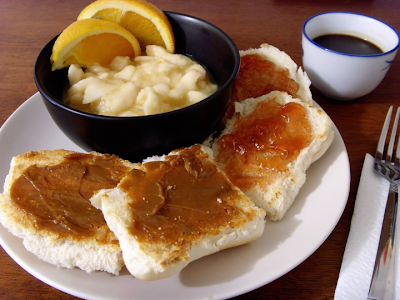
There did not seem to be much consensus on the type of jam, so we chose guava since they are also grown in Chile. But the jam was greatly overshadowed by the manjar. Though we had only dulce de leche available; from varying descriptions it is either a good substitute or exactly the same (our jar in fact had "manjar" amongst the various descriptions on the label). Either way the stuff is pure caramel goodness and delicious on toast. Our can of La Lechera brand dulce de leche also had a great recipe on the back for a flan-like desert.
The cherimoya was nice. Before we marinated it had a pulpy texture and it was slightly sweet. It also had a slight lemon flavor and a bit of a coconut aroma. But the marinade's flavor over powered the cherimoya. We had prepared it the night before and left it in the fridge until morning, which seems to be much too long. Some research into other recipes suggest a marinade time of around 2 hours. I will definitely try playing with this fruit in the future or just eat it plain. (Not so much, I don't think, they're about $5 apiece at Market Basket! –Kitty)

Monday, May 30, 2011

Australia - Vegemite plus some Other Stuff


Background
Australian breakfast is pretty similar to English and American breakfast, which makes sense given cultural background. I emailed several friends who were Australian and a cousin who had lived there, and they confirmed this as well.
I looked for books online to supplement my research, and I found lots of books on Australian food, including one specifically dedicated to breakfast. Thanks to the World Catalog website I was able locate many of these books. They were all in Australia.
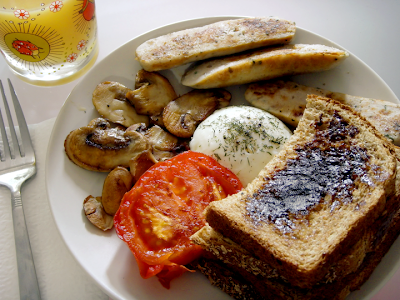
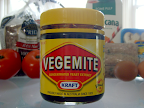
The basic menu is going to be the sausage we made a couple of weeks ago. In addition to that we are going to have fried mushrooms, tomatoes, poached eggs, and toast. On the toast we will have the ingredient that will mark is as Australian: Vegemite. Vegemite is a dark brown spread made from yeast extract left over from brewing beer.
My first experience with vegemite/marmite was in New Zealand. My sister told me it was really good and to pile it up my toast. I had no idea what it would taste like and it was really strong and I spit the toast out. I have been a little wary of the stuff ever since. Kitty's first experience was on a train with some Australians while touring in Asia. They told her to take a bite with the secret expectation she would find it gross. She liked it, to the great disappointment of her traveling companions. (Nothing grosses you out after sannakji. –Kitty)
The beverages are juice and coffee or tea. A drink called the flat white is a local variation on cafe latte that uses the microfoamed milk. Some people claim it is not any different from cafe latte and others that it was created in New Zealand. In any case, it was very hot the morning we had this breakfast and we decided to go for the juice.

Breakfast Fry
Like the English breakfast, grease management will be important here. We are fortunate to have a jar of bacon fat leftover from making homemade bacon. I will show how to cure bacon at a future date, but rest assured it is both awesome and easy.
  • Bacon grease
  • Sausage
  • Mushrooms
  • Tomatoes
  1. Heat a flat bottomed pan over medium low heat and add enough fat to thinly cover the bottom.
  2. Add the sausages to the middle of the pan.
  3. Add the mushrooms around the sausage.
  4. Let the mushrooms brown by letting them sit still and occasionally checking their color. Flip side when they have sufficiently browned.
  5. Turn the sausages regularly to brown all sides and let them cook evenly.
  6. When the mushrooms are done remove them from the pan.
  7. Remove the sausages, cut them lengthwise, and cook the inside part face-down in the pan. This gives them a nice color and looks good in presentation.
  8. Cut the tomato in half, remove the core and fry the halved cut-side-down in the greased pan. Add more grease to the pan if necessary.

Poached Eggs
  • Eggs
  • Salt
  • Silicone egg poacher (optional)
  1. Bring water to a boil in a pan large enough for the poachers to float freely.
  2. Crack each egg into an individual poacher, if using.
  3. Place the eggs/poachers into the boiling water, cover, and simmer for 7 minutes.
  4. Remove from molds and season with salt, pepper, and dill

Toast with Vegemite
  1. Spread a layer of soft butter onto your toast.
  2. Spread a thin layer of Vegemite over the butter.

Results and Discussion
The sausage was excellent. The the sage and ginger give it a light taste which is a great contrast to the dense sausage texture. The mushrooms and tomatoes came out really well. The bacon grease did a great job browning the mushrooms and cooking the tomatoes.
I found the Vegemite much more palatable this time. The major change is that there was much less of it. Vegemite has a very strong taste and is quite salty. I was trying to think of a taste to compare it to and I could not think of anything. Kitty pointed out that is probably closest to miso and I agree with her. The butter mellows the Vegemite a bit and rounds out the flavor. I am less scared of Vegemite now that I have had it in proper proportions.

Monday, April 18, 2011

Yemen - Fasoolia and Malooga


Background
Yemen is located on the southern coast of the Arabian Pennisula, making it a key port in the spice trade. Most sources credit the Ottoman Empire as the only outside influence on the cuisine, but they do not give any specifics. The major protein sources are chicken, lamb, and beans. Dairy is not common in the diet except for ghee.
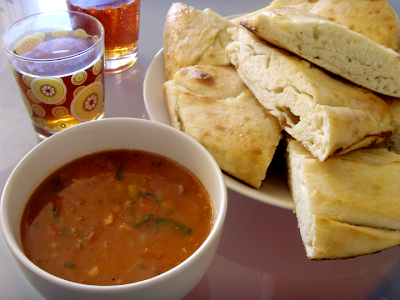
We didn't have much trouble finding out what dishes are served at breakfast, but finding recipes proved difficult as spellings are not standardized. The only book I found on Yemeni cuisine focused specifically on a small Jewish community in the country. Looking online, there are several recipes available for fasoolia, a bean and tomato dish. It is traditionally eaten with a massive piece of flat bread called malooga. The bread is made by folding semn into the dough. Semn is a darkened ghee and is easily made at home.
It is served with sweet tea flavored with cardamom.

Fasoolia
We went online for our recipes this week. The same fasoolia recipe is found all over the internet and can be found here.
Using the masher did not break up the beans very well and I would use a stick blender in future attempts.

Malooga
The malooga and semn instruction can be found here.
1 stick of butter gives you a little more than 1/3 cup of useful semn while keeping the burned pieces on the bottom.
The recipe made one piece according to the measurements suggested; we did not divide it into smaller parts as directed. When baking the malooga, be sure to use an edged cookie sheet: the semn is very lubricating, and the higher oven temperature may cause your baking sheet to warp and your malooga to slide off!

Results and Discussion
The fasoolia was a really nice dish and comes together very quickly. The combination of cumin, tomato, and cilantro is classic. It is also very warm and filling.
The real treat for this breakfast was the malooga. Most of our previous flat breads are pretty simple and created as almost an after though. The malooga was much more involved than previous flat breads. Not rolling the dough after each fold, and then making a ball leads to the creation of irregular layers. They flake off very nicely for dipping and scooping. The bread keeps well over night. I would like to use this recipe for pizza dough. (I am sure Yemenis do this already and call it something else! –Kitty)

Sunday, February 27, 2011

Afghanistan - Roht, Yogurt, Apricots, and Pistachios


Background
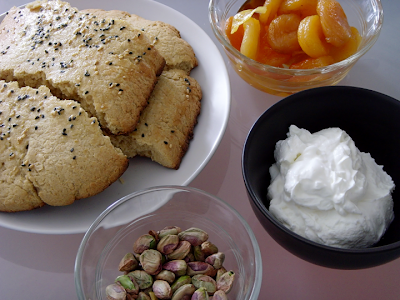
As is typical of old countries with steep terrain, Afghanistan has a wide number of ethnic groups. Its history of being along the silk road has brought in many outside spices and influences in the urban centers. Afghan breakfast, though, is very simple: roht (bread), apricots, pistachios, and yogurt. It is accompanied with tea flavored with cardamon. Roht is a sweet flat bread made chapati flour sprinkled with sesame and kalonji seeds. Kalonji is a seed from a south Asian flower. It is in the same family as buttercups, and is also called black onion seed or black cumin seed. It is not closely related to onion or cumin. We got out roht recipe from Afghan Food and Cookery.

Roht
  • 8 oz chapati flour
  • 2 oz sugar
  • 2 tsp yogurt
  • 2 fl oz milk
  • 2 oz butter
  • 2½ g dry active yeast
  • ¾ tsp baking powder
  • sesame seeds
  • kalonji seeds
  • 1 egg, beaten
  1. Melt the butter.
  2. Mix the flour, sugar, yogurt, milk, butter, yeast, and baking powder in a bowl.
  3. Mix in half the egg. Reserve the rest for glazing the bread for baking.
  4. Knead the mixture until you get a doughy consistency. Add more flour to prevent sticking.
  5. Let the dough rise for 1 hour in a warm place.
  6. Preheat the oven to 500°F.
  7. Roll the dough into a loaf shape 1-2 cm thick.
  8. Brush the dough with the remaining egg and sprinkle with seeds.
  9. Place the dough on a lightly oiled baking sheet.
  10. Bake for 5 minutes at 500°F to brown the bread.
  11. Reduce oven to 250°F and bake until it is done, about 10-15 minutes.
Eat with the yogurt, lightly chopped pistachios, and apricots.

Results and Discussion
Preparation was very simple and quick other than the bread. The roht has a crumbly, cakey quality with a slightly sweet taste. I think our yeast might have been dead as the bread did not rise as much as we expected. I think it would be fluffier and more cakelike if the rise had worked as planned. Still, it was very tasty. It could easily be served as a light desert or a snack at a coffee shop.
We used straned yogurt (often labeled Greek yogurt), which is thick, creamy and not as sour as the lebna. It serves as a nice base for the sweetness of the apricots and the salt of the pistachios.

Sunday, February 13, 2011

Saudi Arabia - Egg Kebab & Small Plates with Bread


Background
Tracking down information and recipes on Saudi Arabia was unexpectedly involved. Finding information on the actual menu was pretty easy, thanks to AmericanBedu, where we learned that breakfast consists of many little dishes eaten with bread.  They gave several good examples, but finding recipes for the dishes involved a trip through many books. Cookbooks dedicated to Saudi Arabia seem to be nonexistent; most of the emphasis is on Arab cuisine as a whole. Many of the books I encountered leaned toward Lebanon, but using several sources we were able to piece it together. We finally used three cookbooks to make the meal: Arabian Delights, The Arab Table, and the Arab World Cookbook.
One problem with the many-small-plates concept is that there are usually only two of us for breakfast, and it's very easy to end up with much too much food. In addition to the dishes we chose, our research suggested things like ful and chickpea dishes, honey and fruit preserves, which we decided to omit in order to have a reasonable quantity for two diners.
For our meal we prepared apricots in syrup, as a compromise of honey and fruit preserves, and we made egg kebab, fried hard-boiled eggs with cinnamon and white pepper.  To accompany these we had olives from the pantry, and purchased some lebna (yogurt cheese), bread, and halwa.  The halwa is a sweet eaten in many places throughout the Middle East and South Asia. Today we had halwa made from sesame seeds, but it is pretty much the same idea as the soojir (semolina) halwa we made for Bangladesh.
We had intended to make the bread ourselves, but finding a recipe turned out to be impossible. A flat bread called fatir seemed really good, but the only recipe we could find called for using frozen white bread dough. The reason they gave for this was the inability to find barley wheat in the states(??). What made this recipe even more frustrating was that it has been copied verbatim all over the Internet. As we read further we learned that a wide variety breads are served, so we decided to just pick a bread when we went shopping.
We shopped at Sevan Bakery, actually an Armenian grocery, but they had fresh bread and most of the other materials we needed. We expect to be visiting them often as we continue in the Middle East.
Our assumption going into this breakfast was that we would be drinking coffee, since coffee was discovered around Mecca. It turns out that coffee is not a breakfast drink and Saudis prefer tea instead, which is drunk from glasses.

Dried Apricots in Clove Syrup (Qamr din helw bil qurunfil)
  • 1½ cups sugar
  • 1 strip of lemon peel
  • 2 tsp fresh lemon juice
  • 11 oz dried apricots
  • 1 tsp whole cloves, in a spice bag
  • 1 cinnamon stick
  1. Mix sugar, ½ cup water, lemon peel, and lemon juice in a sauce pan.
  2. Dissolve sugar over medium heat.
  3. Add apricots, cloves, and cinnamon stick.
  4. Simmer the syrup for 5 minutes, or until apricots are plumped, and remove it from the heat.
  5. Let the mixture cool, remove cinnamon stick and cloves, and then transfer into a storage container.
Egg Kebab (Aijet Beythat)
  • ¾ tsp salt
  • ¾ tsp paprika
  • ¾ tsp white pepper
  • ¾ tsp cinnamon
  • 8 hard boiled eggs
  • 4 tbsp butter
  1. Mix the spices and set aside
  2. Peel the hard boiled eggs.
  3. Prick each egg a couple of times to release heat when frying.
  4. Melt the butter in a frying pan over low heat.
  5. Add the eggs and brown them on all sides.
  6. When the eggs are browned, dust them with the spices and serve.
To serve everything, we put the bread out on a platter with the various small plates on the side. The bread is eaten with the lebna which can then be topped with olive oil, olives, the eggs, or the apricots. The halwa is pretty much perfect all by itself.

Results and Discussion
This was a very nice and filling breakfast. It had a lot of parts, which can seem overwhelming, but in reality it was pretty simple. We chose to make the syrup and boil the eggs the night before to have them ready, which left only a little bit of preparation for the morning. The only tricky cooking was of the eggs, which presented a novel challenge: trying to evenly brown an egg-shaped object on a flat frying pan is pretty much impossible!
The spice mixture on the eggs tastes very familiar, with the salt and white pepper. The paprika reminds one of deviled eggs, but the cinnamon takes it in a really different direction. (I also realized a general problem that I have with hard boiled eggs: I typically eat them cold and I find the texture unpleasant. Heating the eggs improve the texture.)
The lebna is like a much smoother cream cheese, just a little more sour. It served as a lovely base for all of the other toppings.
Halwa is seriously amazing. The texture is very dense but crumbly. I would almost call it chalky but not in a dry way. The taste is a little hard to describe but it would go really well with chocolate. (Kitty says: it tastes like the center of a peanut butter cup, only sesame instead of peanut.) Learning how to make this is high on my priority list.

Saturday, February 5, 2011

Peru - Chicharrones Sandwich with Salsa Criolla


Background
The major influences on Peruvian cuisine are the Inca and the Spanish. Japanese and Chinese influence came later, a result of immigration in the 19th century. Potatoes are native to this region (1,000 varieties) and are a cornerstone of the cuisine. Quinoa is the other major starch contributed by this region. The Spanish conquest brought in European flora and fauna, greatly increasing the variety in the diet. The collapse of the Spanish Empire and Peru's independence resulted in an open immigration policy and growth in diversity in metropolitan areas. In addition to the ethnic diversity, Peru has a large quantity of regional variation.

Finding recipes Peruvian recipes was very easy. We found three fantastic books that provide great recipes and information. The Art of Peruvian Cuisine has great background reading and a wonderful section explaining and showing novel ingredients. Eat Smart in Peru is a compact guide to the cuisine with a balance of information and recipes. We ended up using The Exotic Kitchens of Peru because it had the recipes we needed.

None of the books mentioned breakfast directly, so I asked a Peruvian friend for her advice. She recommended a few dishes, and we settled on sandwiches of chicharrones served with salsa criolla. Chicharrones are fried pork, and salsa criolla contains hot peppers and aji amarillo chilies. We were unable to locate whole aji amarillos, but we found them as jarred paste which we could substitute. I was not able to find any specific information on the sandwich bread but photos I saw online had rolls with thick crusts. The drink for breakfast is coffee.

Chicharrones de Chancho (Crispy Pork Cubes)
  • 1 lb pork spare ribs, cut into 2 inch sections
  • 1 tsp salt
  • ½ tsp ground cumin
  • 1 tbsp lime juice
  • 1 tsp oil
  1. Mix all ingredients except oil in a bowl and let marinate for 15 minutes.
  2. Heat oil in a skillet on low.
  3. Add the pork and fry at low temperatures for about 30 minutes.
  4. The pork is done then the meat is brown and crisp with all of the fat cooked off.
  5. Drain pieces over paper towels and serve as soon as possible.
Salsa Criolla
  • 2 cups red onion, coarsely chopped
  • 1 tsp chopped/paste aji amarillo, remove seeds if chopping.
  • 3-4 tbsp lime juice
  • 1 tsp salt
  • 1 tbsp chopped cilantro
  1. Combine all ingredients by hand, or
  2. Pulse all ingredients in a food processor to make a coarse salsa.
  3. Serve immediately.
Results and Discussion
The red onions give the salsa a very sharp taste. The lime adds a sour flavor and the cilantro gives a nice accent. The heat and sweet flavor from the aji amarillo were subtle but nice. The peppers added less heat than I expected. The paste eaten raw packs real punch.
And fried pork is plain good. Pork fried to the point that the fat becomes really crispy and has that concentrated blast of salt is even better. In the future I might cook them at a slightly higher heat as some of the fat did not get as crispy as it could have been. We used pork spare ribs but pork roast was another option. I would use pork roast in the future since it was much easier to cut up. (OK, again, Kitty totally disagrees, rib meat is way better than pork roast for this.) Getting meat off the ribs was a little annoying. (Whatever.)

Sunday, January 30, 2011

Iraq - Tasbreeb Bigilla


Background
Finding information on Iraqi breakfast was actually very simple. I found an article online about breakfast before the 1990 Gulf War and the subsequent embargo. It provided a fantastic list of recipes.
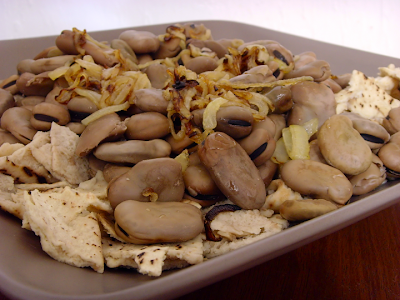
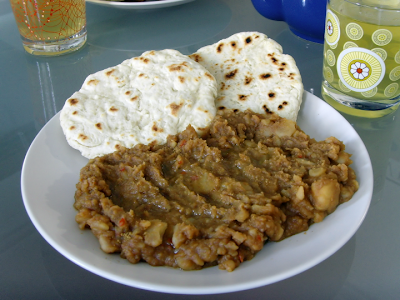
As Iraq is probably the first place wheat was domesticated, it comes as no surprise that bread is a staple of the diet. Other ideas included gaymer, a buffalo cheese sometimes served with date syrup, and kahi, a dish brought to Iraq with Babylonian Jews. It is very closely related to baklava and requires many folded layers of pastry dough. Bigilla is a fava bean dish eaten in northern and central Iraq. I located a variation of this dish called tasbreeb bigilla in The Iraqi Cookbook. It consists of fava beans served with pita bread topped with fried onion and peppermint powder, and is traditionally served on Fridays. We were unable to find peppermint powder specifically so we used crushed dried mint.

Tasbreeb Bigilla
  • 1 lb fava beans
  • 1 packet of pita bread (ours had six pitas)
  • 1 medium onion, thinly sliced
  • Olive oil
  • Salt
  • Dry mint
  1. Soak fava beans overnight in cold water.
  2. Cut pita bread into pieces and leave them out overnight so they dry out. (Alternatively, put the bread pieces in an oven at 200 for 30 minutes.)
  3. Bring the beans and water to a boil at medium heat, and boil them for 45 minutes.
  4. Add salt and continue to boil for 15 minutes. Make sure there is enough liquid remaining to soak the bread.
  5. While the beans are cooking, heat oil in a pan, add the onions to the hot oil and fry them until browned.
  6. Remove the cooked beans from the water.
  7. Soak the bread pieces in the bean liquid for 1 minute. Then remove them from the water and place them in a big shallow bowl.
  8. Put the beans on top of the bread and then pour the onions and hot oil over the beans.
  9. Sprinkle the dry mint to taste over your plate.
Results and Discussion
This recipes makes a lot of food. We could have easily halved it and still had lots of food. It was suggested to serve this with fried eggs, but we had to leave them out or we would have been eating the leftovers all week!
The pita bread pieces had an interesting texture. Being soaked in the bean juice infused them with flavor. Getting the bread pieces in and out quickly lets the flavor soak in while preventing the bread from becoming soggy.
The fried onions in the oil added lots of taste and the next time I make this I am going to add more onions. The oil itself provides the same flavor enhancement and texture contrast as in the previous breakfast.
In Iraq they add cardamom to the coffee for flavor, which is probably quite good when done properly. We were not paying attention and completely screwed this up—getting the ratio of water to coffee wrong and ending up with a very weak brew. We're now on an 0-for-2 beverage streak, and will have to pay more attention from now on!

Sunday, January 23, 2011

Morocco - Beyssara


Background
Moroccan cuisine reflects its multiple interactions with different culture through trade and conquest. It is in the Mediterranean tradition. The Berbers brought influences from just west of Egypt (their best known contribution is couscous). The Moors conquered Spain and Spanish influence flowed back across the straight of Gibraltar.
We found lots of different options for breakfast. Lassida is a porridge made of semolina or couscous and flavored with honey and butter. But it is traditionally eaten to break the fast during Ramadan, which has long since past. Baghrirs are a pancake made with semolina and only cooked on one side. The batter has the consistency of a crepe. Beyssara is a spiced fava bean stew served with bread. We found a recipe for this in Mediterranean Street Food which looked simple and tasty, and so decided to make the beyssara.
The national drink is green tea with mint. Making it is considered an art and has ritual associated with it. We had some trouble with the mint tea. Though we did have an errand at the Burlington Mall yesterday and would have bought some at Teavana, it took us 40 minutes (!) to get into and out of the parking lot and so we ran out of Zipcar time. The grocery store was also out of mint of any kind, so we made regular green tea.
The one difficulty in making beyssara was finding split, peeled fava beans. The best option available were a pickled peeled bean and I did not know how they would effect the test. I give a method of peeling the beans in the recipe.

To peel dried fava beans
  • 1 cup dried fava bean
  • 3 cups water
  • 1 tbsp oil
  1. Put fava beans, water, and oil into a pressure cooker.
  2. Cook at high pressure for 15 minutes.
  3. Quick-release the pressure.
  4. Open the pressure cooker, tilting the lid to that the steam is released away from you.
  5. Drain the beans and put them into a ice water bath. Let them sit for 20 minutes.
  6. The skin around the bean should now be loose and can be removed using your finger nails or started with a paring knife.
  7. Discard the skin and keep the bean. Split the beans if you can.
  8. Refrigerate the beans until you use them.
Beyssara
  • 1 cup peeled split broad beans, soaked overnight in hot water with 1 tsp baking soda
  • 2 gloves garlic, unpeeled
  • 1½ tsp ground cumin
  • ½ tsp red pepper flakes
  • 1½ tsp paprika
  • Salt
  • Extra virgin olive oil
  1. Put the beans in a sauce pan with the garlic, cumin, red pepper flakes, and 1 quart of water.
  2. Bring to a boil on medium high heat.
  3. Cover the pan and cook for 30 minutes or until they are mush.
  4. Reduce the heat to low and simmer for 10 to 15 minutes.
  5. Add the paprika and salt to taste.
  6. Serve in a shallow bowl and garnish with a drizzle of olive oil and cumin.
  7. Eat with Moroccan bread.
Results and Discussion
This recipe takes a while, but that is in the nature of cooking dried beans. The cooking time could also be reduced by cooking them longer in the pressure cooker. Most of the water boils off or is absorbed by the beans, but you can easily control how moist the beans are by adjusting the cooking time. The end result is nicely spiced with an enjoyable rough texture. I think ours was a bit drier than it was supposed to be as we ended up with more of a paste than a soup but it still pretty good.
The drizzle of olive oil added a nice flavor. It also provided a strong contrast of textures with the beans.

Sunday, January 16, 2011

Uganda - Ugali and Chapati


Background
Ugandan cuisine has an East African base, modified by the influence of the conquering Arabs and English. The biggest influence the English brought to our breakfast was really Indian influence. I always had a scope of the British Empire in my mind but I never realized how much influence the Indian citizens of the Empire had as they migrated out.
The biggest problem searching for information on Ugandan breakfast is that President Obama made an appearance at a prayer breakfast about Uganda's proposed anti-homosexual laws. This made it impossible to search by "Ugandan breakfast" and we had to get more creative with our query.
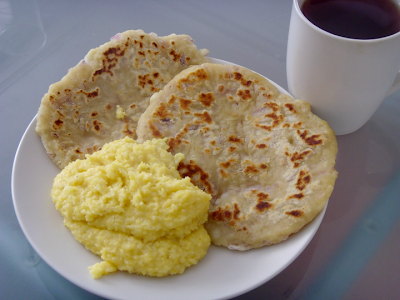
We found that Ugandan breakfast consists of ugali and chapati. It is basically the same as Tanzania. I was unable to find a Ugandan cookbook so I used online resources to try and find recipes specific to Uganda. The ugali recipe can be found here and the chapati recipe we used is here. The chapati recipe is a little free form our more detailed interpretation is follows.

Chapati
  • 2 cups flour
  • 1 tsp salt
  • 2 cloves garlic, minced
  • 1/4 red onion, finely diced
  • 1/2 cup warm water
  • oil for frying
  1. Mix dry ingredients, onion, and garlic in a bowl.
  2. Slowly add the warm water (I would start with 1/4 cup) and mix it into a doughy consistency.
  3. Add more water as needed—the onions and garlic are going to contribute some moisture to the dough, so add the water slowly.
  4. Knead until you have a tough doughy consistency.
  5. Let the dough rest for 30 minutes.
  6. Break the dough into tangerine-sized balls, then roll the dough into pancakes 6 inches in diameter. (Put flour in between the chapatis when stacking them to prevent sticking.)
  7. Heat a frying pan and spray a thin layer of oil into the pan.
  8. Fry one side of the chapati until it starts to brown, then apply oil to the uncooked side of the chapati, flip it, and cook the other side.
Serve with the ugali on top of the chapati

Results and Discussion
This breakfast was very filling and pretty easy. The only really involved part was constantly stirring the ugali while it cooked. I am not a big fan of ugali. The first taste is really nice; it has a good salty taste and is a little creamy. As I eat more of it it just becomes bland and thick. For Tanzania I thought it might have been undercooked, but I know that was not the case here. Ugali is food for quick energy and not for taste.
The chapatis were very dense and chewy. The red onion and garlic were nice additions and added some subtle flavors. I would like to try it cooking the onions and garlic prior to putting them in to the dough to enhance this.

Friday, December 24, 2010

Algeria - Chakchouka


Background
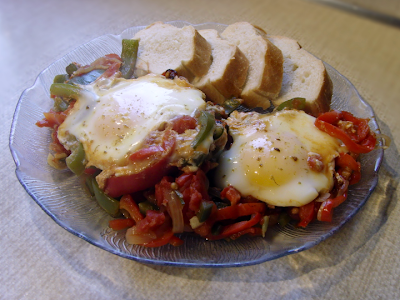
I was only able to find two dishes in my search for Algerian breakfast. The first meal I found was makrout, which is a fried cookie made with semolina flour and flavored with almonds or dates. This week was our first time taking the IBP on the road and we were unsure how our host was equipped deep frying, so we went in another direction. We settled on making chakchouka which consists of peppers and onions in a tomato sauce and then poaching eggs in the sauce. The chakchouka is then eaten with either a local flat bread or a baguette. The recipe we used was from a very comprehensive cookbook of vegetarian cuisine from the Mediterranean called Mediterranean Harvest. It has over 500 recipes and seems pretty well written from what I have read of it. We went with a purchased baguette for simplicity, and we substituted poblano peppers for the recommended anaheims because we could not find them.

Chakchouka
  • 2 tbsp extra virgin olive oil
  • 1 large onion, sliced thin
  • 2 green peppers, sliced
  • 2 red peppers, sliced
  • 2 poblano peppers, diced
  • 4 cloves of garlic, minced
  • 2 tsp of harissa (we used more)
  • 1 tsp tabil (recipe follows)
  • 1 (28oz) can diced tomatoes, drained
  • ¼ cup chopped parsley (optional)
  • 4 eggs
  1. Heat oil in pan and add the onions.  Cook until golden, about 10 minutes.
  2. Add the peppers and cook until they are soft, about 5 minutes.
  3. Add the garlic and cook until fragrant (just a few seconds), then stir in harissa, tabil, and salt & pepper to taste.
  4. Add the tomatoes and cook until thickened.
  5. Add most of the parsley, reserving some to add with the eggs.
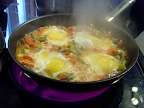
  6. Use a spoon a make 4 depressions into sauce, and crack an egg into each depression.  Cover the pan with a lid or tin foil if a lid is not available.
  7. The eggs will poach in about 5 to 6 minutes and they should still have runny yolks.
  8. Flavor the eggs with harisa, tabil, parsley, and salt & pepper to taste.
  9. Eat with baguette or flatbread.
Tabil
  • 4 tbsp coriander seeds
  • 1 tbsp caraway seeds
  • 2 tsp garlic salt
  • 2 tsp cayenne pepper
  1. Grind whole seeds using a spice mill.
  2. Mix this with the garlic salt and cayenne pepper and keep in a jar. (It makes enough to fit in an average spice jar.)
Results and Discussion
This meal was a big success. It comes out as a very flavorful and spicy tomato sauce with eggs in it. I added a couple more teaspoons of harissa to make it spicier and this was really nice. The baguette soaks up the juices really well and quickly takes on the chakchouka flavor. The cookbook mentions making the sauce a day or so before hand and adding the eggs before serving to let flavor mingle. I will use this as a pasta sauce in the future.

Sunday, November 21, 2010

Tanzania - Ugali and Chapati


Background
Tanzania was founded in 1964 when the states of Tanganyika and Zanzibar merged. Zanzibar consisted of two islands off the eastern coast and Tanganyika was on the mainland. Zanzibar has a history as a trading port which gave it contact with cultures from all over the Indian Ocean. Its major assets were spices and slaves. Zanzibar's cuisine is based around rice, and coconut and seems very similar to Indian food. The mainland diet is based around bean, cassava, and corn which is closer to its neighbors.
I was surprised when I came across Tanzania Traditional Cookery in the library. It is basically a pamphlet bound in card-stock. The pages are inconsistently photocopied and the table of contents is only a rough guide on where to find the recipes. It also provided an entire section of breakfast food. Upon further examination all of the meals were listed under breakfast. This made me doubt the credibility of the categories given.
The second book we found was Tanzania Cookbook which had a far more credible table of contents. It fails to provide any information about when the dishes are usually served or the cultural heritage of the dishes. What makes this even stranger is that the blurb on the back of the book says that the book is for educational purposes. One of the major annoyances I have encountered in this project is books that purport to extol the virtues of a country's cuisine but give no cultural context about the dishes.
Given the absence of contextual and cultural information I went to the Internet. The Tanzanian Embassy webpage provided us with contextual information and a list of breakfast dishes. Once we had a list of dishes the cookbooks became useful.
We decided to go with ugali and chapatis served with chai tea. Ugali is a corn porridge that was compared to polenta in many recipes that I read. The chapatis use coconut milk which is different from past recipes.

Coconut Chapatis
  • 8 oz flour
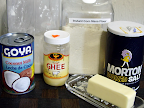
  • ½ cup coconut milk
  • 1½ oz ghee or oil
  • ¼ tsp salt
  1. Mix flour and salt in a bowl.
  2. Add coconut milk and mix until it is doughy. Slowly add more coconut milk if required.
  3. Add ½ tablespoon of ghee to the dough and knead until it is smooth.
  4. Divide the dough into 6 evenly sized balls.
  5. Roll out a ball into a large flat circle.
  6. Cover circle with ½ tsp of ghee/oil.
  7. Make a slit along the radius of the dough and roll it into a cone.
  8. Seal the edges of the cone and squash it flat.
  9. Let them rest for 20 minutes.
  10. Heat a non-stick pan.
  11. Roll out the dough flat until it is about 1//8 of an inch thick.
  12. Melt some ghee in the pan put the flattened dough into the heated pan.
  13. As the uncooked side starts to puff spread some ghee and flip it.

Ugali
  • 120 g fine corn meal
  • ½ cup milk
  • ½ cup water
  • ½ tbsp butter (optional)
  • salt (optional)
  1. Make a paste with the corn meal and milk.
  2. Bring the water to a boil, add the butter and salt.
  3. Stir in paste and then add the remaining maize flour.
  4. Continue to stir until it becomes stiff.
  5. Serve on top of warm chapatis.

Results and Discussion
The coconut milk in the chapatis gave the dough a much softer texture than previous recipes we had used. The layering technique used in making them gave them a flaky texture and the oil kept them very soft.
The ugali was very simple and a little bland. We also think it might have been under done. We halved the recipe from the one given in the cookbook and quantity of water and milk may have been too small to properly cook it. Another problem might have been our choice of corn meal. The recipe called for maize flour which according to my research is corn meal. Many recipes for ugali compare it to polenta for its texture. Fine corn flour may be too fine for our needs and using polenta might be a better substitute in the future.

Sunday, November 14, 2010

Sudan - Fool Medamas


Background
The history of Sudan is closely linked to Egypt's. Both countries have conquered one another and both were under British and Ottoman rule. I had difficulty finding a published source on the Sudan and in the end I decided to use the web site Sudan.net. This site listed fool medamas and tamayya as possible breakfasts. We made fool medamas as our breakfast for Egypt, though we spelled it differently. Tamayya is another word for falafel and it is eaten at any time of the day.
After we made our Egyptian breakfast I ran across an article in the paper listing the best dishes in Boston. One of these dishes was the fool medamas from Falafel Palace. We were not very thrilled with our recipe so I wanted to try a much different version. Falafel Palace makes a great version more like a bean salad with fresh vegetables and a yogurt dressing. It made a great light lunch and is really cheap. The new recipe is very different than the one we used for Egypt so I decided we should do a comparison.

Fool Medamas
  • 1 (16 oz) can of fava beans
  • 1 large onion, chopped
  • 1 large tomato, diced
  • 1½ tbsp olive oil
  • 1 tsp ground cumin
  • ¼ cup chopped parsley,
  • 4 tbsp lemon juice
  • salt, pepper, and chili powder to taste
  • pita bread
  1. Pour fava beans and juice into a sauce pan and bring them to a boil.
  2. Mix all other ingredients—except lemon juice—in a bowl.
  3. When the bean juice has almost evaporated add the remaining ingredients to the pot along with the lemon juice.
  4. Cook uncovered for about 5 minutes, until most of the water is gone but the mixture is not dry.
  5. Eat with pita bread along with hard boiled eggs and tahini.
Results and Discussion
This recipes was much better than the one we used for Egypt. The first major improvement was the inclusion of spices so that I actually tasted something. Not mashing the fava beans was also key. When the beans are mashed they suck up all the moisture and the result is a very dry paste with some vegetables mixed into it. Not mashing the beans keeps the fool medamas moist and much more palatable.

Saturday, September 4, 2010

United Kingdom - Full English Breakfast


Background
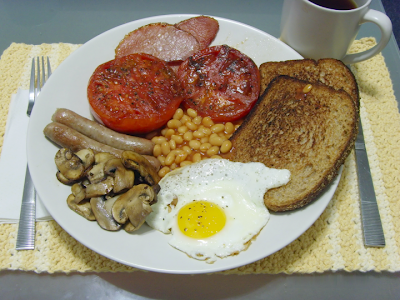
The full English breakfast is a well-known meal, so our research was a simple Google search. The BBC Food site provided an excellent menu and a preferred sequencing of ingredients to best use the grease produced by the sausage and bacon. The basics of the English breakfast are sausage, bacon, baked beans in tomato sauce, browned mushrooms, toast, tomatoes, a fried egg, and black pudding. Naturally, you serve the breakfast with tea.

One element of the English breakfast we omitted was the black pudding (a type of blood sausage) mostly because it was by far the most difficult item to procure, and we already had enough meat for two people. Kitty has also eaten plenty of tasty blood sausages in Asia and feels that we were not shirking our duties by skipping over it here.  Should you also be unable to find black pudding, these other blood sausages are available at Asian markets; the idea being similar though the taste rather different.

(In U.K. English, the word pudding also describes a bready or milk-based dessert. I became interested in how the same word came to describe two very different dishes. Fortunately the country that posed this etymological challenge also created the solution in the Oxford English Dictionary. The word's first appearance in Latin is in the context of sausage in 1287. The first time it describes a dessert is in 1543. The shared use of the word comes from both dishes being cooked in water while encased in something.)

Recipe
Please see the BBC Food site for the recipe.

Results and Discussion
“Full” is a very accurate modifier for English breakfast. I was not really hungry again until dinner. It also covers a full range of flavors and textures. You have have the savory, dense, and flavorful sausages with the golden casing giving them a wonderful snap. We got these at Savenor's in Cambridge and they were spectacular and reasonably priced. The sweet fresh and moist tomatoes have an excellent contrast of being warm on the surface but still a little cool in the middle; the mushy beans and lightly crunchy toast provide a nice contrast
The sequencing of the elements and grease management are also important for getting the right results. Under optimal condition one would have a griddle and some slightly fattier bacon so we could spread the grease around and have more things cooking at the same time. The bacon we chose was much too lean and as a consequence we had to supplement with a lot of olive oil. The single pan approach does help cut down on dishes which is very nice.
This breakfast is very similar to the southern breakfast I learned growing up watching my grandfather. It is exactly what he would make minus the beans and mushrooms. He also taught me the importance of good grease management.
We will be making its counterpart, the full Irish breakfast, in about 2 years.

Saturday, July 31, 2010

Turkey - Gozleme with Sausage or Cheese & Jam


Background
For this breakfast we were fortunate to have two sources.  The first was a friend from college, Tolga, whose parents are from Turkey and he was ale to provide an outline of the meal.  Classic Turkish Cooking by Ghillie Basan provided the recipes.  Living in a diverse metropolitan area also gave us access to the Turkish grocery store Turkuaz Market.
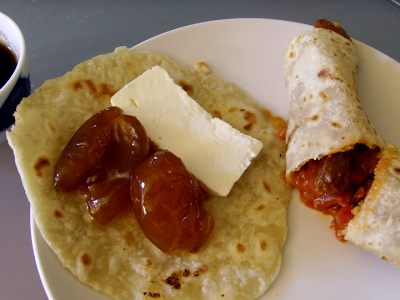
The breakfast is a bread wrap of sucuk (pronouced sujuk) and tomato recommended by the owner of Turkuaz Market.  On other pieces of flat bread we had a farmer's cheese called piknik ciftlik peyniri and an interesting jam containing whole apricots.  The cookbook contains a recipe for a similar cheese but the preparation involves several 6 hour waiting periods and we did not have time.

Gozleme

  • 4 oz flour
  • 1.2 tsp salt
  • 1 tbsp olive oil
  • 2-3 fl oz warm water
  1. Mix together flour and salt.
  2. Make a small divot in the flour and add the oil and half the water.
  3. Mix ingredients and add more water to make a dough.
  4. Divide into 4 balls and cover with a damp towel for 20 minutes.
  5. Roll out into disks 5-6 inches wide.
  6. Spray one side with olive oil and cook on a skillet over medium heat.
  7. Spray the top side with olive oil, turn, and cook until done.
  8. Eat with jam and cheese, or topping below. 
Tomato and Sucuk Topping
(for four gozleme)
  • 1 large tomato, chopped
  • 8 oz sucuk
  • olive oil
  • flour

  1. Remove casing from sucuk and lightly chop it.
  2. Heat a little olive oil in a pan and add sucuk and tomatoes.
  3. Cook until you get a saucy consistency.  Add flour to thicken the sauce if needed.
  4. Spread the sauce on a gozleme as the second side is cooking.
  5. Place gozleme onto wax paper and roll into a cone.
  6. Keep in a warm oven until ready to serve.
An attempt at Turkish coffee
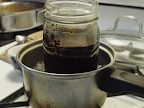
The brewing process is very specific and different from other methods of brewing coffee. The use of a cezve is the major hallmark of Turkish coffee. It resembles an erlenmeyer flask.
We attempted to make the coffee without this tool. The method was a lot of effort for normal tasting coffee with grounds in it. We briefly document this method so that others can avoid it.
In order to simulate the narrow mouth of the cezve we chose a 1 pint canning jar and made a jury rigged double boiler using a sauce pan as illustrated. After that we made an attempt to follow a recipe we found on line of simmering the grounds on the top of the water and creating a froth.

Results and Discussion
The star of this breakfast was the sucuk. The sausage is made of beef, lamb and seasoned with a variety of spices. The moment I took it out of the wrapper the smell was amazing and I got to enjoy the smell the entire time.  In this recipe I think that the sausage would have benefited from being put through a food processor before cooking, as it would have made it much easier to spread on the gozleme.  Some further research showed that this sausage is eaten in many of the countries in Eastern Europe, the Middle East and Central Asia. We look forward using future projects and it will take self control to not use it in each one.
The gozleme is a less heart-stopping version of the puri we made for Pakistan—they could probably be used interchangeably without a lot of difference.  I think a better result would be achieved brushing on the oil instead of simply spraying it.  The recipe also scales up and down to fit the needed sizes very easily.
The piknik ciftlik peyniri has a texture similar to feta but less crumbly.  The apricot jam's sweetness provided an excellent counterpoint to the cheese's salt.  The jam also had an unusual texture.  In most jams the fruit is in pieces.  This was more whole apricots in a syrup.  We kept the left over syrup to use as we see fit in the future.

Sunday, July 25, 2010

Egypt - Ful Midamess


Background
The menu for this meal was taken from Egyptian Cooking by Samia Abdennour. This book provided a long list of dishes. Most of the dishes involved fava beans, eggs, and bread. We chose to make the dish ful midamess as it is a national dish in a nation whose cuisine has been influenced by being the center of trade routes since time immemorial.

Abdennour also describes a bread called aish baladi, which simply means local bread. A simple description of the bread was given in the cookbook but no actual recipe was given. Some further research showed that local bread changes with location so a list of comprehensive recipes could not be put in a small cookbook. Fortunately someone had gathered many recipes and created a website that lists them.  A major consideration when making this bread is a 1 to 3 hour rising period. We made our bread the night before and it kept fine overnight.

Ful Midamess
  • 1 cup fava beans
  • 1/4 cup split lentils
  • 1 tomato, chopped
  • 1 medium onion, coarsely grated
  • 1 medium carrot, finely grated
  • 2 cloves garlic, crushed
  • Olive oil
  • Lemon juice
  • Salt
  1. Cook fava beans in pressure cooker for 10 minutes at 10 lbs of pressure.
  2. Boil lentils until they are soft.
  3. Mash the fava beans and lentils together until they are a paste.
  4. Mix in the carrot, tomato and onion, then add salt, olive oil, and lemon to taste.
  5. Serve on top of bread.
Results and Discussion
This breakfast was a simple and hardy.  My only major complaint with this meal was that was bland. In the future I would look for variations with more flavor.
For our readers without pressure cookers the same recipe can be repeated with a slow cooker and simply cook overnight.

Sunday, May 9, 2010

Bangladesh - Luchi, Aloor Dum, and Soojir Halvah


Honestly, I did not think we were going to have so much trouble with cookbooks this early in! But this is week three where neither the local library or the BPL were any help to us. I suppose this is inevitable given how recently Americans started eating even westernized Indian food, but still, it's cramping our style.

Anyway, we were further complicated by a scarcity of Bangladeshi recipes online. In the end, we have decided to cheat a bit and use some Indian Bengali recipes.  This isn't a perfect solution; my limited research says that there is plenty of diversity in Bengali cuisine, plus what divergence has occurred since partition, but given the lack of proper source material, we must call it close enough to our basic purpose of eating a lot of things that are not french toast.

Menu
  • Aloor Dum (Spicy Potato Curry) - We cut these into smaller cubes as I was Ready To Eat before we even started cooking.  This got them cooked in about twenty minutes as we were preparing the other two dishes.  I think we used too much potato for the spices called for, but all in all very good and rather different from our breakfast potatoes last week.
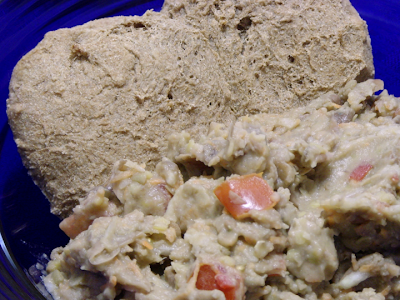
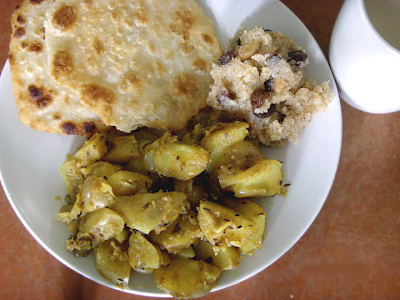
  • Luchi (Deep-fried Flatbread) - My husband is becoming an expert in fry breads. :)  They do not look as pretty and white as they are supposed to; this is because we are still too scared to deep-fry our bread for breakfast!  But shallow-fried they are still rich and flaky.
  • Soojir Halvah (Semolina Pudding) - This was definitely the star of the show!  I could eat this every day.  Very easy to put together too.  I used one cup of water where the recipe did not specify and it turned out beautifully.  I should like to try these with cranberries and pecans in the fall.

Today's recipes are by Jayashree Mandal of Spice and Curry, who we sincerely hope does not mind our culinary border-crossing here.  For our part, after tasting her Soojir Halvah, we have lost any frustration we had this week!

Sunday, May 2, 2010

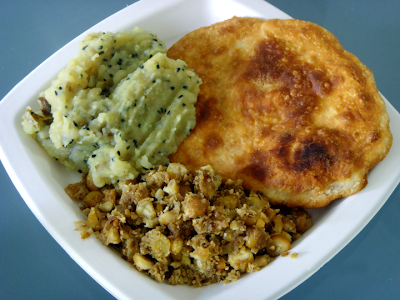
Pakistan - Cholay, Aloo ki Bhujya, and Puri


Background
We should start by stating that we did this breakfast on the Sunday after a major water main in Boston broke. Fortunately for us lots of these recipes require us to boil water.

The breakfast was three very simple dishes we got from an amazing recipe depositor The Desi Cookbook. [We did skip the fourth dish, the halva, as we were reluctant to dirty a pan with sugar given the water restrictions. -Kitty]

Menu
  • Cholay (Chick Peas)
  • Aaloo Ki Bhujya (Spiced Mashed Potato)
  • Puri (Deep-fried Flatbread)

Results and Discussion
We were fortunate in that our recipes required lots of boiling water. All and all this was a success. The chick peas had a great texture and are well spiced. Put the chick peas into a food processor and you would get an excellent hummus. The Aaloo ki bhujya is a much more flavorful variation on mashed potatoes. The puri is best served warm and is a fragrant and crispy version of toast.