Background
Kazakhstan is an ethnically diverse country in central Asia. Much of this diversity is a result of Stalin's prison camps and other forced migration policies of the Soviet Union. Kazakhs are traditionally nomadic and their cuisine reflects this with lots of preserved food and protein sources that range well. The prominent protein sources are horse and lamb, and much of the dairy is preserved or fermented. The only breakfast information I found online was that Russian influence have made kasha more prevalent. I looked for Kazakh restaurants in the Boston area to get some better information. I found Cafe Assorti in Washington D.C. They got back to me immediately with information and suggestions. So if you are in the D.C. Metro area please go eat there. We are looking forward to trying them the next time we are in the area.
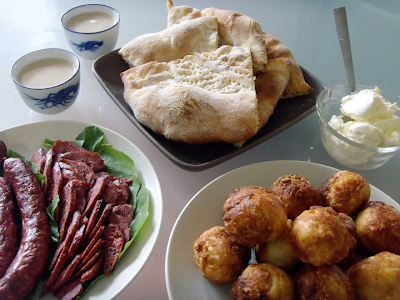
According to our source, Kazakhs are tending towards a more western breakfast as they are less nomadic. Our contact at Cafe Assorti gave us a break down of what they would consider a traditional breakfast: an assortment of thinly sliced sausages made from lamb or horse meat, served with taba-nan and/or baursak (a flat bread and a fried dough respectively). The bread is eaten with a type of sour cream called kaymak. Kaymak is also used in a tea made with cardamom and fennel.
Taba-nan requires special equipment (two oven-proof frying pans), so we adapted an Uighur flatbread from nearby western China. We chose it because it the base of the recipe was quite simple and seemed to be a good approximation of a nonspecific central Asian flatbread. We found the original recipe in Flatbreads & Flavors. We got our baursak recipe from Food by Country (originally published in Junior Worldmark Encyclopedia of Foods & Recipes of the World). We made some substitutions to reduce the size of the recipe to something two people can eat. The tea recipe is from The World Cookbook for Students.
 Kaymak is not readily available in the United States, but can be made at home by steaming a mixture of milk and cream for eight hours. Kitty tried a homemade recipe but it did not work for us. Instead, we bought clotted cream as the closest available substitute.
Even setting aside any ethical concerns, horse meat was not an option as it is simply not available in the United States. The last horse slaughterhouse closed in 2007 and it existed mostly to provide zoos with meat. We decided to purchase beef or lamb sausage instead. One of the sausages is called shuzhuk, and given the histroical Turkish influence in the region, we assume it to be related sujuk. I got the sujuk from a local halal market and proceeded to pseudo-smoke it using a 200°F oven and waiting until it got to 150°F internally. I then refrigerated it overnight. I got the technique from a summer sausage recipe that can be found here.
Basic Nan (6 pieces)
- 2 tsp dry yeast
- 2 ½ cups warm water (105-115°F)
- 5-6 cups white flour
- 2 tsp salt
- Ceramic baking tile/pizza stone (optional)

- Place warm water in a mixing bowl and add yeast.
- Mix in 3 cups of flour one cup at a time.
- Stir the mixture 100 times in the same direction to develop the gluten.
- Add 2 teaspoons of salt, then continue to add flour until you cannot stir the dough.
- Flip the dough onto a floured surface and knead until it smooth and elastic.
- Lightly oil a bowl, put the dough in, and let it rise until it has doubled in size.
- Break the dough into 6 pieces. Roll out the pieces into 4-5 inch disks. Cover the disks and working one at a time roll them out into 10 inch disks (Note: Avoid making the dough too thin as it will easily burn. Think thin crust pizza for the correct thickness.)
- Let the disks rest for 10 minutes, then prick the dough with a fork (traditionally, a specialized bread stamp is used to apply a pricked design). Leave a two inch boundary unpricked around the edge of the dough.
- Place dough on a stone in a 500°F oven. Bake for 7 minutes or until golden brown on top. (Monitor it closely.) Let it cool for 5 minutes before serving.
Baursaki
- 1 cup flour
- 1½ tsp yeast
- 2 tbsp water (105-115°F)
- 2 tbsp yogurt
- 1 egg white
- 2 tsp butter
- 1½ tsp salt
- Oil for frying
- Mix water and yeast and wait for the yeast to bubble.
- Mix in the remaining ingredients, knead until it forms a dough.
- Let the dough rise for 30 minutes.
- Break off tablespoon sized pieces of dough and roll them into balls.
- Heat the oil in a deep skillet over high heat.
- Carefully add the balls and fry them until they are golden brown. Drain on a paper towel.
- Roll in sugar before serving, if desired.
Kazakh Tea
- 4 cups water
- 5 tsp black tea leaves
- 4 cardamom pods
- 1 tsp fennel seeds
- 2 cups milk
- Sugar/honey, salt, and cream to taste.
- Bring water to a simmer.
- Simmer tea and seeds for 3 minutes.
- Add milk and simmer for 2 minutes more.
- Remove from heat and strain tea.
- Add sugar or honey, salt, and cream as desired.
Results and Discussion
The bread had a nice crispy texture with very puffed outer crust. The puff comes from the fork pricks (or rather, the lack of them around the outer edges) and gives a pretty cool bread bowl effect. It might be fun to try this on pizza crust.
Fried dough continues to taste good. I am curious if there exists a civilization that practices agriculture that does not have some form of fried dough. This particular dough was not as fluffy as some of the recipes but it had a nice dense texture and felt more substantial. It was also a slightly drier dough which makes getting the dough from your fingers to the hot oil much safer.
The tea is basically chai with salt. I added more salt with each until I noticed its effect. I would estimate I topped out around 1/8 teaspoon with 1/2 teaspoon of sugar. As I drank it I realized the only drink I am used to tasting this much salt in is a sports drink. The clotted cream gave the tea a rich texture. (Clotted cream is nearly butter, very rich and creamy. It tastes great, but you can feel your arteries clogging.)
The suzhuk was nicely spiced with what tasted like garlic and black pepper which is matches my understanding of Kazakh version. The oven-smoking process gave decent results but it is no substitute for the flavor of a proper smoking.