Showing posts with label eggs. Show all posts

Monday, May 2, 2011

Romania - Mamaliga and Goat's Milk


Background
Romanian cuisine is typical of eastern Europe with notable outside influences from the Ottoman empire. I quickly found a report on the subject of Romanian breakfast online from an environmental sustainability program in the European Union. The first breakfast mentioned is mamaliga as it is eaten by a character in Bram Stoker's Dracula on his way to be the Count's breakfast. Mamaliga is Romanian polenta. Balmos is mamaliga made with sheep's milk. Another interesting dish is called slanina. It is made of pork fat from the back or belly. The fat is sliced and pickled in salt liquor with garlic for 2-3 weeks. The fat is then smoked for 2-3 days. I am unable to to smoke for several days and I was unable to determine what salt liquor is.
I really wanted to make balmos, so I tried to get some sheep's milk. I was able to locate a Greek grocery store that makes its own sheep's milk yogurt. Unfortunately they are not allowed to sell me the raw milk and getting to New Hampshire for fresh milk was not viable. This left us with mamaliga.

Mamaliga is a staple in Romania so a wide variety of recipes exist. The two basic forms for breakfast can be broken into the categories porridge and cornbread. The cornbread variety comes in two basic forms. The first variety involves cooking the cornmeal mixture on the stove and then transferring it to a baking dish for baking. The second option involves cooking it longer on the stove and then turning the cornmeal out onto a cutting board and slice it using string. The porridge variety is made using various ratios of milk and water. Our source gave a porridge recipe so we are going with a porridge.
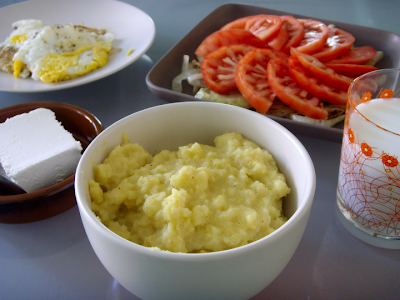
The mamaliga is served with farmer's cheese, lightly fried onion, sliced tomatoes, and fried eggs. Goat's milk is the beverage of choice so I get some variety of exotic milk.

Mamaliga cu lapte
  • 1 qt water
  • 2 tsp salt
  • 2 cups cornmeal
  1. Boil water and salt in a pot of water.
  2. Whisk in the cornmeal and mix thoroughly.
  3. Simmer for 10-15 minutes.
  4. Serve with sides mentioned above.
Results and Discussion
Mamaliga is pretty much polenta. The texture was not as porridge-like as I thought it would be. Less cornmeal is probably the solution to this. It was a little salty, but not too salty when served with other toppings; it is a nice base for the other flavors. The cheese was especially good because of the contrast of temperature and texture.
The goat's milk was very tasty. It has a subtle creaminess that is a bit richer than whole milk. (Meh. Tastes like milk, except milkier. Not a fan. –Kitty) I now need to find a use for the rest of it; I plan on making pancakes with some of it and probably just drinking the rest.

Sunday, February 13, 2011

Saudi Arabia - Egg Kebab & Small Plates with Bread


Background
Tracking down information and recipes on Saudi Arabia was unexpectedly involved. Finding information on the actual menu was pretty easy, thanks to AmericanBedu, where we learned that breakfast consists of many little dishes eaten with bread.  They gave several good examples, but finding recipes for the dishes involved a trip through many books. Cookbooks dedicated to Saudi Arabia seem to be nonexistent; most of the emphasis is on Arab cuisine as a whole. Many of the books I encountered leaned toward Lebanon, but using several sources we were able to piece it together. We finally used three cookbooks to make the meal: Arabian Delights, The Arab Table, and the Arab World Cookbook.
One problem with the many-small-plates concept is that there are usually only two of us for breakfast, and it's very easy to end up with much too much food. In addition to the dishes we chose, our research suggested things like ful and chickpea dishes, honey and fruit preserves, which we decided to omit in order to have a reasonable quantity for two diners.
For our meal we prepared apricots in syrup, as a compromise of honey and fruit preserves, and we made egg kebab, fried hard-boiled eggs with cinnamon and white pepper.  To accompany these we had olives from the pantry, and purchased some lebna (yogurt cheese), bread, and halwa.  The halwa is a sweet eaten in many places throughout the Middle East and South Asia. Today we had halwa made from sesame seeds, but it is pretty much the same idea as the soojir (semolina) halwa we made for Bangladesh.
We had intended to make the bread ourselves, but finding a recipe turned out to be impossible. A flat bread called fatir seemed really good, but the only recipe we could find called for using frozen white bread dough. The reason they gave for this was the inability to find barley wheat in the states(??). What made this recipe even more frustrating was that it has been copied verbatim all over the Internet. As we read further we learned that a wide variety breads are served, so we decided to just pick a bread when we went shopping.
We shopped at Sevan Bakery, actually an Armenian grocery, but they had fresh bread and most of the other materials we needed. We expect to be visiting them often as we continue in the Middle East.
Our assumption going into this breakfast was that we would be drinking coffee, since coffee was discovered around Mecca. It turns out that coffee is not a breakfast drink and Saudis prefer tea instead, which is drunk from glasses.

Dried Apricots in Clove Syrup (Qamr din helw bil qurunfil)
  • 1½ cups sugar
  • 1 strip of lemon peel
  • 2 tsp fresh lemon juice
  • 11 oz dried apricots
  • 1 tsp whole cloves, in a spice bag
  • 1 cinnamon stick
  1. Mix sugar, ½ cup water, lemon peel, and lemon juice in a sauce pan.
  2. Dissolve sugar over medium heat.
  3. Add apricots, cloves, and cinnamon stick.
  4. Simmer the syrup for 5 minutes, or until apricots are plumped, and remove it from the heat.
  5. Let the mixture cool, remove cinnamon stick and cloves, and then transfer into a storage container.
Egg Kebab (Aijet Beythat)
  • ¾ tsp salt
  • ¾ tsp paprika
  • ¾ tsp white pepper
  • ¾ tsp cinnamon
  • 8 hard boiled eggs
  • 4 tbsp butter
  1. Mix the spices and set aside
  2. Peel the hard boiled eggs.
  3. Prick each egg a couple of times to release heat when frying.
  4. Melt the butter in a frying pan over low heat.
  5. Add the eggs and brown them on all sides.
  6. When the eggs are browned, dust them with the spices and serve.
To serve everything, we put the bread out on a platter with the various small plates on the side. The bread is eaten with the lebna which can then be topped with olive oil, olives, the eggs, or the apricots. The halwa is pretty much perfect all by itself.

Results and Discussion
This was a very nice and filling breakfast. It had a lot of parts, which can seem overwhelming, but in reality it was pretty simple. We chose to make the syrup and boil the eggs the night before to have them ready, which left only a little bit of preparation for the morning. The only tricky cooking was of the eggs, which presented a novel challenge: trying to evenly brown an egg-shaped object on a flat frying pan is pretty much impossible!
The spice mixture on the eggs tastes very familiar, with the salt and white pepper. The paprika reminds one of deviled eggs, but the cinnamon takes it in a really different direction. (I also realized a general problem that I have with hard boiled eggs: I typically eat them cold and I find the texture unpleasant. Heating the eggs improve the texture.)
The lebna is like a much smoother cream cheese, just a little more sour. It served as a lovely base for all of the other toppings.
Halwa is seriously amazing. The texture is very dense but crumbly. I would almost call it chalky but not in a dry way. The taste is a little hard to describe but it would go really well with chocolate. (Kitty says: it tastes like the center of a peanut butter cup, only sesame instead of peanut.) Learning how to make this is high on my priority list.

Friday, December 24, 2010

Algeria - Chakchouka


Background
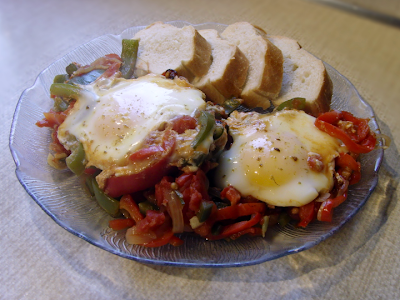
I was only able to find two dishes in my search for Algerian breakfast. The first meal I found was makrout, which is a fried cookie made with semolina flour and flavored with almonds or dates. This week was our first time taking the IBP on the road and we were unsure how our host was equipped deep frying, so we went in another direction. We settled on making chakchouka which consists of peppers and onions in a tomato sauce and then poaching eggs in the sauce. The chakchouka is then eaten with either a local flat bread or a baguette. The recipe we used was from a very comprehensive cookbook of vegetarian cuisine from the Mediterranean called Mediterranean Harvest. It has over 500 recipes and seems pretty well written from what I have read of it. We went with a purchased baguette for simplicity, and we substituted poblano peppers for the recommended anaheims because we could not find them.

Chakchouka
  • 2 tbsp extra virgin olive oil
  • 1 large onion, sliced thin
  • 2 green peppers, sliced
  • 2 red peppers, sliced
  • 2 poblano peppers, diced
  • 4 cloves of garlic, minced
  • 2 tsp of harissa (we used more)
  • 1 tsp tabil (recipe follows)
  • 1 (28oz) can diced tomatoes, drained
  • ¼ cup chopped parsley (optional)
  • 4 eggs
  1. Heat oil in pan and add the onions.  Cook until golden, about 10 minutes.
  2. Add the peppers and cook until they are soft, about 5 minutes.
  3. Add the garlic and cook until fragrant (just a few seconds), then stir in harissa, tabil, and salt & pepper to taste.
  4. Add the tomatoes and cook until thickened.
  5. Add most of the parsley, reserving some to add with the eggs.
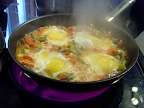
  6. Use a spoon a make 4 depressions into sauce, and crack an egg into each depression.  Cover the pan with a lid or tin foil if a lid is not available.
  7. The eggs will poach in about 5 to 6 minutes and they should still have runny yolks.
  8. Flavor the eggs with harisa, tabil, parsley, and salt & pepper to taste.
  9. Eat with baguette or flatbread.
Tabil
  • 4 tbsp coriander seeds
  • 1 tbsp caraway seeds
  • 2 tsp garlic salt
  • 2 tsp cayenne pepper
  1. Grind whole seeds using a spice mill.
  2. Mix this with the garlic salt and cayenne pepper and keep in a jar. (It makes enough to fit in an average spice jar.)
Results and Discussion
This meal was a big success. It comes out as a very flavorful and spicy tomato sauce with eggs in it. I added a couple more teaspoons of harissa to make it spicier and this was really nice. The baguette soaks up the juices really well and quickly takes on the chakchouka flavor. The cookbook mentions making the sauce a day or so before hand and adding the eggs before serving to let flavor mingle. I will use this as a pasta sauce in the future.

Saturday, September 4, 2010

United Kingdom - Full English Breakfast


Background
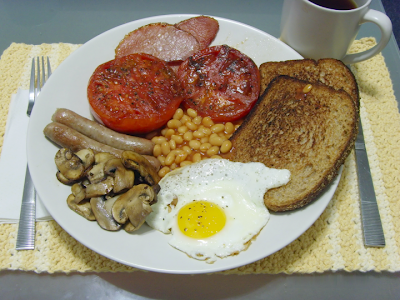
The full English breakfast is a well-known meal, so our research was a simple Google search. The BBC Food site provided an excellent menu and a preferred sequencing of ingredients to best use the grease produced by the sausage and bacon. The basics of the English breakfast are sausage, bacon, baked beans in tomato sauce, browned mushrooms, toast, tomatoes, a fried egg, and black pudding. Naturally, you serve the breakfast with tea.

One element of the English breakfast we omitted was the black pudding (a type of blood sausage) mostly because it was by far the most difficult item to procure, and we already had enough meat for two people. Kitty has also eaten plenty of tasty blood sausages in Asia and feels that we were not shirking our duties by skipping over it here.  Should you also be unable to find black pudding, these other blood sausages are available at Asian markets; the idea being similar though the taste rather different.

(In U.K. English, the word pudding also describes a bready or milk-based dessert. I became interested in how the same word came to describe two very different dishes. Fortunately the country that posed this etymological challenge also created the solution in the Oxford English Dictionary. The word's first appearance in Latin is in the context of sausage in 1287. The first time it describes a dessert is in 1543. The shared use of the word comes from both dishes being cooked in water while encased in something.)

Recipe
Please see the BBC Food site for the recipe.

Results and Discussion
“Full” is a very accurate modifier for English breakfast. I was not really hungry again until dinner. It also covers a full range of flavors and textures. You have have the savory, dense, and flavorful sausages with the golden casing giving them a wonderful snap. We got these at Savenor's in Cambridge and they were spectacular and reasonably priced. The sweet fresh and moist tomatoes have an excellent contrast of being warm on the surface but still a little cool in the middle; the mushy beans and lightly crunchy toast provide a nice contrast
The sequencing of the elements and grease management are also important for getting the right results. Under optimal condition one would have a griddle and some slightly fattier bacon so we could spread the grease around and have more things cooking at the same time. The bacon we chose was much too lean and as a consequence we had to supplement with a lot of olive oil. The single pan approach does help cut down on dishes which is very nice.
This breakfast is very similar to the southern breakfast I learned growing up watching my grandfather. It is exactly what he would make minus the beans and mushrooms. He also taught me the importance of good grease management.
We will be making its counterpart, the full Irish breakfast, in about 2 years.

Sunday, June 13, 2010

Phillippines - Longsilog


Background
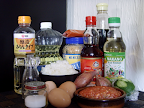
The title of this week's breakfast is longsilog. The name comes from a portmanteau of the three main dishes: longganisa (sausage), sinangág (fried rice), and itlog (eggs). This method of naming meals is common in the Philippines. The fried rice recipe was found in The Food of the Philippines by Reynaldo G. Alejandro. The sausage recipe was found in Memories of Philippine Kitchens by Amy Besa and Romy Dorotan.

Longganisa (Sausage)
  • 1 ½ lbs ground pork
  • 1 tbsp annato coloring (powder, available at Latin markets)
  • 1 tbsp chili oil
  • 1 tbsp rice wine
  • ½ tbsp rice winegar
  • 1 tsp minced garlic
  • 1 tsp lime zest
  • ½ tbsp salt
  • ½ tsp fresh ground pepper
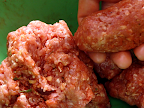
  1. Combine all of the ingredients in a mixing bowl, being careful not to pulverize the meat too much.
  2. Divide the mixture into 10 balls all of the same size.
  3. Shape these balls into sausages 3 inches long and about an inch in diameter.
  4. Refrigerate the sausages overnight to give the flavor time to blend and to make handling easier.
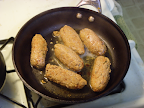
  5. Heat a frying pan to medium and put a thin layer of water in the pan. This helps to prevent sticking.
  6. The sausages cook in about 5-7 minutes.
  7. Place done sausages on a plate and keep warm in an oven.


Philippine Fried Rice
  • 4 tbsp vegetable oil
  • 2 tbsp minced garlic
  • ¼ cup minced shallots
  • 4 cups of cooked medium-grain rice mashed lightly with ½ cup water
  • 1 tbsp soy sauce
  • ¼ tsp ground black pepper
  1. Cook garlic in oil until golden brown.
  2. Add all remaining ingredients and cook, stirring, for 10 minutes to ensure the rice is evenly heated.
  3. Serve hot.

Scrambled Eggs
Scramble eggs in some of the grease left over from the sausages, top with crushed red pepper.

Results and Discussion
The original recipe for the sausages called for wild boar meat and pork fatback. Clearly the sausages would have been much more awesome had they been made of wild boar meat. I am a city dweller and wild boar hunting season in Somerville city limits is not until the fall. We were left with the choice of lean ground pork. The lean option left the sausages with too little fat and they were a little dry. I would recommend adding some fat back to help prevent this problem.
We used short-grain sticky rice in the fried rice. The stickiness of the rice caused lumps to developed as we fried it. In future attempts at fried rice the medium-grain variety will be used with the hope of minimizing the stickiness.
This was a pretty simple breakfast except for some challenges in finding certain ingredients. The most difficult was the annatto oil called for in the original sausage recipe.  We only required a small amount and all of the recipes yielded 2 cups.  It is because of this that we used annato powder to give the sausages the correct color. I really enjoyed making sausages from scratch and hope to some day be in a position where I can grind my own meat. I hope that will line up with boar season.

Sunday, May 30, 2010

Japan - Rice, Miso Soup, Tamago, and Tsukemono


Background
We found a good reference for Japanese breakfasts in a New York Times article by David Kahn from 1992. It provided a lot of ideas about what the meal should include. We chose not to include fish because we could not find any that was reasonably priced and fresh.
We used recipes from Japanese Cooking: A Simple Art by Shizuo Tsuji for the miso soup and rolled omelet. The pickled vegetables, plums, fresh tofu, and various other side dishes were purchased at a specialty Japanese market, though some suitable items are probably available at most Asian markets. We also added natto(1, 2) to the menu for something traditional and adventurous.

Menu
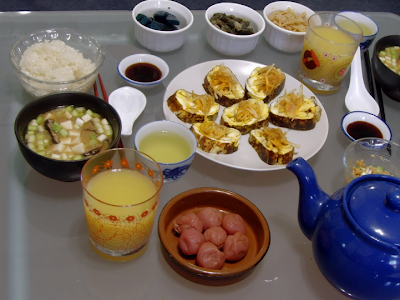
  • Rice - Short grain white rice, steamed in rice cooker
  • Miso Soup - Many miso soup recipes exist online. We feel no need to add to the clutter. A useful technique in Japanese Cooking that is worth passing along is to mix the miso with half as much stock to break up lumps, before mixing it into the soup.
  • Dashi-maki Tamago (Rolled Omelet) - Making a rolled omelet is difficult to describe after a single attempt. We recommend the reader consult a Japanese cookbook for illustrations of the techniques. The basic idea of the Japanese omelet is to roll an omelet and then pour another omelet and let the uncooked egg attach to the base of the rolled omelet and then roll them together. The process is repeated until you use up all of your egg mixture. The omelet is then shaped in a bamboo mat and allowed to cool for a minute. It is them sliced and served topped with shredded daikon that has been marinated in soy sauce.
    Making this omelet is an acquired skill. First, the pan used to make the omelet is a special pan that shapes the omelet. Mistakes I made in this attempt were over cooking the egg. A four egg omelet may also have been too large for the pan. In future attempts I would use 2 or 3 eggs. I anticipate making several more attempts before I get the hang of it.
  • Natto - We got advice for preparing natto from Natto Land.
  • Nori
  • Tsukemono (Pickles) - cucumbers, bamboo shoots, eggplants, and plums (umeboshi)
  • Green tea and orange juice

Results and Discussion
This breakfast very easy with the exception of the omelet. Purchasing all of the pickled dishes saves a lot of time (but costs a lot of money). The miso soups goes together very quickly. Only rice takes time to prepare.
The omelet is not difficult to do if you have made omelets before. The difficulty lies in combining the rolls into a single continuous piece. Messing this part up only affects the cook's pride but not the taste.
I was very neutral about the natto. The texture was slimy but nothing gross. The taste is a little sour and salty but nothing really special. I will probably not seek out natto again but I would eat it if someone served it to me. The pickled plums had a very strong taste that came in short tart burst. The pickled cucumbers tasted like regular pickles but much crunchier. We were planning on having guests so we invested a little more in this meal. In the future we would skip the sides and just have the omelet, rice, and soup.