Showing posts with label East Africa. Show all posts

Sunday, January 16, 2011

Uganda - Ugali and Chapati


Background
Ugandan cuisine has an East African base, modified by the influence of the conquering Arabs and English. The biggest influence the English brought to our breakfast was really Indian influence. I always had a scope of the British Empire in my mind but I never realized how much influence the Indian citizens of the Empire had as they migrated out.
The biggest problem searching for information on Ugandan breakfast is that President Obama made an appearance at a prayer breakfast about Uganda's proposed anti-homosexual laws. This made it impossible to search by "Ugandan breakfast" and we had to get more creative with our query.
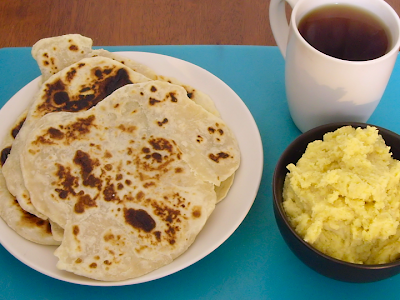
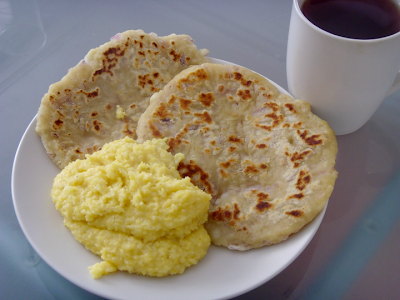
We found that Ugandan breakfast consists of ugali and chapati. It is basically the same as Tanzania. I was unable to find a Ugandan cookbook so I used online resources to try and find recipes specific to Uganda. The ugali recipe can be found here and the chapati recipe we used is here. The chapati recipe is a little free form our more detailed interpretation is follows.

Chapati
  • 2 cups flour
  • 1 tsp salt
  • 2 cloves garlic, minced
  • 1/4 red onion, finely diced
  • 1/2 cup warm water
  • oil for frying
  1. Mix dry ingredients, onion, and garlic in a bowl.
  2. Slowly add the warm water (I would start with 1/4 cup) and mix it into a doughy consistency.
  3. Add more water as needed—the onions and garlic are going to contribute some moisture to the dough, so add the water slowly.
  4. Knead until you have a tough doughy consistency.
  5. Let the dough rest for 30 minutes.
  6. Break the dough into tangerine-sized balls, then roll the dough into pancakes 6 inches in diameter. (Put flour in between the chapatis when stacking them to prevent sticking.)
  7. Heat a frying pan and spray a thin layer of oil into the pan.
  8. Fry one side of the chapati until it starts to brown, then apply oil to the uncooked side of the chapati, flip it, and cook the other side.
Serve with the ugali on top of the chapati

Results and Discussion
This breakfast was very filling and pretty easy. The only really involved part was constantly stirring the ugali while it cooked. I am not a big fan of ugali. The first taste is really nice; it has a good salty taste and is a little creamy. As I eat more of it it just becomes bland and thick. For Tanzania I thought it might have been undercooked, but I know that was not the case here. Ugali is food for quick energy and not for taste.
The chapatis were very dense and chewy. The red onion and garlic were nice additions and added some subtle flavors. I would like to try it cooking the onions and garlic prior to putting them in to the dough to enhance this.

Monday, December 13, 2010

Kenya - Maandazi and Chai


Background
Like most East African countries, Kenya's cuisine is a product of migrating tribes, exchange with Arab nations via the spice trade, and European colonial powers. English rule brought the influence of Indian servants.
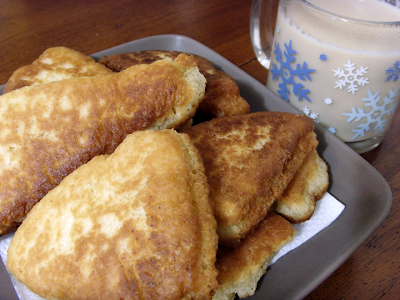
Kenyan breakfast has several major staples. The first is ugali, which we made for Tanzania (and, according to our new cookbook, is meant to be bland and take on the flavor of accompanying dishes). Another option was uji, which is a porridge made from millet. We decided to go with maandazi which is fried dough flavored with cardamom and cinnamon. They are usually accompanied by the local version of chai.
Our book for this breakfast was Foods of Kenya from the series A Taste of Culture. It is a very thin book, written for schoolchildren. It gives a succinct overview of the cuisine framed in terms of major ingredients and when they are eaten. This book does not have a lot of recipes but it includes the cultural and contextual uses of the foods in more detail. We will probably consider using children's cookbooks again in the future based on the usefulness of this little book.

Maandazi (24 pieces)
  • 2 cups flour
  • 2 tsp baking powder
  • 2/3 cup sugar
  • 1 tsp cinnamon
  • 2 cardamom seed pods, shelled and ground
  • pinch of salt
  • 1 beaten egg
  • ½ cup milk
  • 2 tbsp melted butter
  • oil
  1. Mix flour, sugar, baking powder, cinnamon, cardamom, and salt.
  2. Mix egg, milk, and butter in a separate bowl.
  3. Slowly add the wet ingredients to the flour while mixing.
  4. Knead the dough until it is smooth. Slowly add more flour if the dough is too sticky.
  5. Cover the dough in a bowl and let it rest for 30 minutes.
  6. Roll the dough out on a floured surface until it is at most ½ inch thick.
  7. Cut the dough into small triangles or squares as you desire.
  8. Heat the oil in a medium pan on medium.
  9. When the oil is hot add the dough and fry until it is golden. Then flip and cook the other side.
  10. Place of a paper towel lined plate to drain.

Chai
  • 1 cup water
  • 2 cups milk
  • 4 tsp black tea
  • 8 tsp sugar or to taste
  • 1/2 cinnamon stick
  • 2 cardamom pods
  1. Bring the water to a boil, then stir in remaining ingredients.
  2. Reduce heat to medium, and return mixture to the boil.
  3. Turn off heat and let steep to desired strength.  Strain before serving.

Results and Discussion
These were really good doughnuts—a nice crispy outside with a moist inside. The cardamom was a really good flavor. It was subtle but it added to the taste and aroma. Dipping them into the chai lets you increase the sweetness as desired.
One problem we encountered was an occasionally uncooked middle. I think this problem came from the dough being too thick. In the future I would treat the ½ inch thickness as an upper limit and go with ¼ inch in the future. Rolling the dough thinner would also give a larger yield. I think I cut the piece too large as I got only half of the anticipated 24 pastries.
The book recommends eating them hot, and as a fan of Krispy Kreme I cannot argue with this approach to the doughnut family, but these are just as tasty cold and would make a great dessert.

Sunday, November 21, 2010

Tanzania - Ugali and Chapati


Background
Tanzania was founded in 1964 when the states of Tanganyika and Zanzibar merged. Zanzibar consisted of two islands off the eastern coast and Tanganyika was on the mainland. Zanzibar has a history as a trading port which gave it contact with cultures from all over the Indian Ocean. Its major assets were spices and slaves. Zanzibar's cuisine is based around rice, and coconut and seems very similar to Indian food. The mainland diet is based around bean, cassava, and corn which is closer to its neighbors.
I was surprised when I came across Tanzania Traditional Cookery in the library. It is basically a pamphlet bound in card-stock. The pages are inconsistently photocopied and the table of contents is only a rough guide on where to find the recipes. It also provided an entire section of breakfast food. Upon further examination all of the meals were listed under breakfast. This made me doubt the credibility of the categories given.
The second book we found was Tanzania Cookbook which had a far more credible table of contents. It fails to provide any information about when the dishes are usually served or the cultural heritage of the dishes. What makes this even stranger is that the blurb on the back of the book says that the book is for educational purposes. One of the major annoyances I have encountered in this project is books that purport to extol the virtues of a country's cuisine but give no cultural context about the dishes.
Given the absence of contextual and cultural information I went to the Internet. The Tanzanian Embassy webpage provided us with contextual information and a list of breakfast dishes. Once we had a list of dishes the cookbooks became useful.
We decided to go with ugali and chapatis served with chai tea. Ugali is a corn porridge that was compared to polenta in many recipes that I read. The chapatis use coconut milk which is different from past recipes.

Coconut Chapatis
  • 8 oz flour
  • ½ cup coconut milk
  • 1½ oz ghee or oil
  • ¼ tsp salt
  1. Mix flour and salt in a bowl.
  2. Add coconut milk and mix until it is doughy. Slowly add more coconut milk if required.
  3. Add ½ tablespoon of ghee to the dough and knead until it is smooth.
  4. Divide the dough into 6 evenly sized balls.
  5. Roll out a ball into a large flat circle.
  6. Cover circle with ½ tsp of ghee/oil.
  7. Make a slit along the radius of the dough and roll it into a cone.
  8. Seal the edges of the cone and squash it flat.
  9. Let them rest for 20 minutes.
  10. Heat a non-stick pan.
  11. Roll out the dough flat until it is about 1//8 of an inch thick.
  12. Melt some ghee in the pan put the flattened dough into the heated pan.
  13. As the uncooked side starts to puff spread some ghee and flip it.

Ugali
  • 120 g fine corn meal
  • ½ cup milk
  • ½ cup water
  • ½ tbsp butter (optional)
  • salt (optional)
  1. Make a paste with the corn meal and milk.
  2. Bring the water to a boil, add the butter and salt.
  3. Stir in paste and then add the remaining maize flour.
  4. Continue to stir until it becomes stiff.
  5. Serve on top of warm chapatis.

Results and Discussion
The coconut milk in the chapatis gave the dough a much softer texture than previous recipes we had used. The layering technique used in making them gave them a flaky texture and the oil kept them very soft.
The ugali was very simple and a little bland. We also think it might have been under done. We halved the recipe from the one given in the cookbook and quantity of water and milk may have been too small to properly cook it. Another problem might have been our choice of corn meal. The recipe called for maize flour which according to my research is corn meal. Many recipes for ugali compare it to polenta for its texture. Fine corn flour may be too fine for our needs and using polenta might be a better substitute in the future.

Sunday, June 27, 2010

Ethiopia - Qinch'e


Background
We were fortunate to find the very comprehensive Exotic Ethiopian Cooking by D.J. Mesfin, which had an entire section dedicated to breakfast. This book gave us several options, such as genfo, which is a porridge made with barley or wheat flour. Genfo frequently came up when we searched online and is probably the best known breakfast meal. But we decided against making this because we were afraid we would end up with glue if we messed it up.
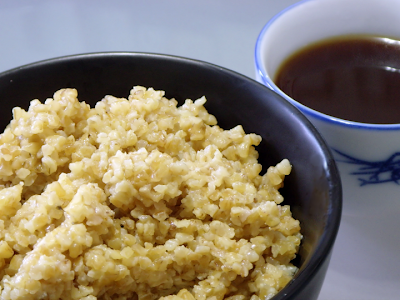
We chose instead to make qinch'e (kinche), which is a cracked wheat porridge with spiced butter.  We had to substitute bulgur wheat for cracked wheat, as we were unable to find it, and one store manager told me that it was no longer available(!). Bulgur wheat is an appropriate substitute, since the only difference between the two is that bulgur wheat is steamed and toasted prior to the cracking.  This also makes it cook faster!
The flavor of the qinch'e came from the nit'ir qibe, which is a spiced butter. The recipe in the book is for twelve pounds of butter, and they ask you clarify the butter before you flavor it. We had about four ounces of ghee on hand, so we started with that and scaled down the spices.

Nit'ir Qibe (Micro Batch)
  • 4 oz of ghee (clarified butter)
  • 1 tbsp minced ginger
  • 1 small clove of garlic, chopped
  • 1 small shallot, chopped
  • 1/4 tsp fenugreek seeds
  • 1/4 tsp cumin seeds
  • 1/4 tsp oregano
  • 2 small cardamom pods
  • dash of turmeric
  1. Melt ghee at low heat.
  2. Add all the remaining ingredients and cook at low heat for 15 minutes, stirring frequently.
  3. Strain the nit'ir qibe before using or storing.
Qinch'e
  • 1 cup milk
  • 1/2 cup water
  • pinch salt
  • 1 cup bulgur wheat
  • 4 oz nit'ir qibe
  1. Bring the water, milk, and salt to a boil, stirring to ensure they do not separate.
  2. Add bulgur wheat and strained nit'ir qibe; continue to stir frequently.
  3. The butter will separate and be on the surface at the beginning. As the wheat cooks the butter will suddenly be absorbed.
  4. Once the butter has been absorbed continue to cook the qinch'e until it reaches the desired consistency.
We also prepared coffee in the Ethiopian style. Coffee preparation in Ethiopia as an entire ceremony. The preparation method used involved boiling the coffee, which is about the exact opposite of most modern coffee experts' advice.  But the coffee turned out fine and the results were not much different than normal brewing. It would be worth trying in a drip maker to see if there is really a difference, but the boil method really isn't any more inconvenient and is more traditional.

Ethiopian-Style Coffee

  • 1 cup coffee beans (the original recipe asks you to roast your own)
  • 1/4 cinnamon stick
  • 1/4 tsp cloves
  • 28 oz water
  1. Grind the coffee and spices to a fine powder.
  2. Bring the water to a boil, add the coffee, and continue to boil for five minutes.
  3. Strain coffee, and serve in small cups (such as Chinese teacups or demitasse cups).
Results and Discussion
This breakfast was very successful. The most complicated part was making the nit'ir qibe, which could easily be made in large quantities beforehand. It should be noted that making good nit'ir qibe is vital to this dish since it is most of the flavor. In our case it was a nice subtle flavor that was a little cheesy and buttery.