Showing posts with label East Asia. Show all posts

Monday, April 25, 2011

North Korea - We have No Idea, so here is some Breakfast Sausage instead

How hard do you think it is to research food habits in North Korea?
Answer: very hard. There is not much at all in English, and though Kitty's Korean skills are nowhere near up to this task, there didn't seem to be much useful information in that language either. What little information we could find suggested that it was either very similar to the South Korean breakfast, or nothing at all (probably much dependent on whether you are in the army or an otherwised privileged member of society).
In light of our research fail, we present instead a sample of Whit's other food project, sausage-making. Kim Jong-il probably has sausage for breakfast every day anyway...
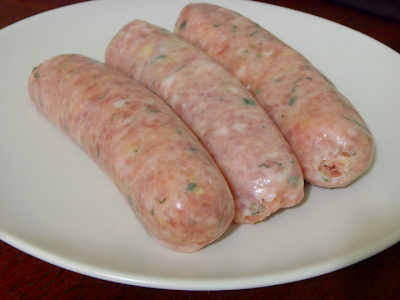

Breakfast Sausage with Sage and Ginger
The following is an overview of the sausage making intended to make the process less intimidating with the hope that the reader will be inspired to give it a go. For an amazing book on sausage making and other meat-related topics with much more detail get Charcuterie by Michael Ruhlman and Brian Polcyn.

Tools
  • Meat grinder or grinder attachment for a stand mixer
  • Meat funnels
  • Ruler
  • Kitchen scale
Ingredients
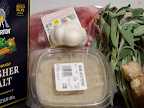
  • 5 lbs boneless pork shoulder, diced
  • 40g kosher salt
  • 50g peeled ginger, finely chopped (or 8g ground dried ginger)
  • 18g minced ginger
  • 6g black or white pepper
  • 1 cup chilled water
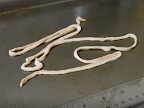
  • 10 ft hog casings
Preparation
Soak the hog casings in room-temperature water for at least 30 minutes prior to stuffing. Place your grinder and any bowls you plan on using in the refrigerator or freezer prior to starting. Keeping the ingredients cool prevents the fat and meat from separating and improves the texture.

Grinding
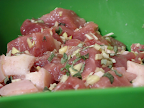
Mix all the ingredients into a cold bowl, excluding the water. Grind the mixture using the fine grind/small die plate into chilled bowl.

The Primary Bind
This step makes the ground meat stick together and ensures a more uniform texture.  Add the water and mix well for 1 minute. The paddle attachment and the metal bowl of a Kitchen Aid mixer are excellent for this step. Place the bound mixture back into the refrigerator until it is needed.

Stuffing the Sausages
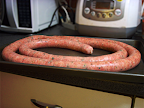
  1. Put the bound sausage filling into the stuffing machine or back into the grinder.
  2. Fill the casing (use any leftover fillings to make patties)
  3. Twist the casing into links of the desired length
  4. Roast or saute the sausages (wrap any uncooked sausages in freezer paper and save them for later or give them away to friends in order to be showy)
Discussion
Homemade sausage differs greatly from what is found in most grocery stores. The texture and flavor are amazing. There is a freshness one is not accustomed to in most sausages. The natural casings have an excellent snap and aroma as they brown on the outside.
The start up costs of making sausages are not too bad. The Kitchen Aid grinding and stuffing attachments are less then $100 and the grinder has uses beyond sausage making. However, stuffing with the grinder is not optimal. It is slow and you encounter problems with air pockets when loading the grinder. Stuffing machines are rather expensive and only do one thing. (But they do this one thing very well, and I look at pictures of them in catalogs and covet because they are so much faster.)
A video on the process can be found here, and a video of the process starting with an entire pig can be found here.

Monday, April 11, 2011

Taiwan - Baozi


Background
Taiwan has only been separate from mainland China for a little over 60 years. It's cuisine is greatly influenced by middle China. Japanese influence is also prevalent as it was a Japanese possession for the first half of the 20th century.
Our research for Taiwan was a little backwards. I started by emailing my former Wing Chun instructor and asked him what he ate when he lived there. His response was you tiao served with hot soy milk. You tiao are deep-fried dough, very similar to a cruller in appearance. Unfortunately they require real deep-frying and we lack the equipment to that as safely as we would like. We then had the idea of dim sum, which seemed to be backed up by the general blogosphere, so we began looking for dim sum dishes specific to Taiwan. This search yielded no results, but we found several general books on dim sum. We decided to use Dim Sum: The Art of the Chinese Tea Lunch for our recipes and techniques about refrigeration and reheating. In the end we decided to make two different styles of steamed buns, known as baozi. The first bun is filled with ground pork, onion, and spinach. The second bun is filled with adzuki bean paste.
Adzuki is our novel ingredient for this breakfast. It is a legume that is grown through out eastern Asia. It is usually sweetened before it is eaten, and canned sweetened adzuki bean paste can be purchased ready-to-use from Asian groceries.
The process of making the bao dough takes at least 2 hours of rising and we determined that length of time to be prohibitive for starting from scratch in the morning. We decided to make and steam the buns the night before and reheat them in the morning.

Saturday, October 16, 2010

South Korea - Soup and Rice, Side Dishes and Kimchi


Before we start, I just want to point out that most of the time I lived in Korea, I ate something like this for breakfast:


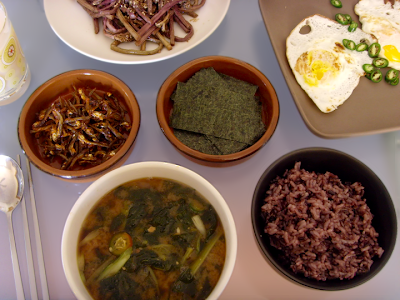
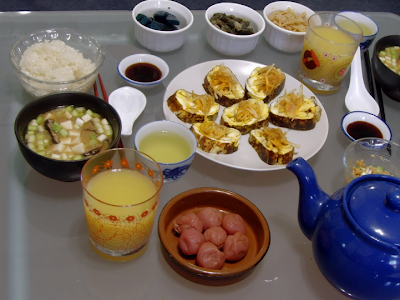
However, Corn Flakes are not really in the spirit of the Project. The traditional Korean breakfast is not really different than lunch or dinner. Rice, soup, and kimchi would suffice for a basic meal, and usually all that is hanging around from dinner so its no trouble to put together. Since we try to cook something a little more than the basic meal, we did a few more sides: fried egg, anchovies, kim (nori), and bracken salad. (This makes seven dishes total – there should always be an odd number of dishes.)

We only had to make the soup and the bracken salad from scratch; we took the recipes from Quick and Easy Korean Cooking for Everyone, a really good basic cookbook with step-by-step illustrations and pictures of all ingredients. Everything else we got at the Korean market or had in the house (also easily purchased).

The soup could really be any light soup. We had thought of doing bean-sprout soup (a traditional hangover cure!), but we've got a surplus of greens from our farm share, so it was more practical to use those.

Greens Soup
  • 1 cup frozen greens
  • 2 hot green peppers (gochu or jalapeƱo), sliced into rings
  • ½ green onion, sliced diagonally
  • 3½ cups dashima (seaweed) stock or chicken stock
  • 4 oz doenjang (miso)
  • crushed garlic, to taste (i.e. lots)
  1. Defrost greens, squeeze, and drain thoroughly.  Cut into 2" pieces.
  2. Bring stock to a boil.  Reduce heat, add greens and cook 3-4 minutes.
  3. Dissolve doenjang in stock, add garlic, and return to boil.
  4. Stir in peppers and green onion, remove from heat, and serve.
We have an excellent automatic rice cooker, all you need to do is put in washed rice and press the button. We added a few tablespoons of black rice which makes the whole pot a pretty purple color once cooked.

Our kimchi we did make ourselves, although somewhat nontraditionally using a recipe for Pickled Kimchi from the Complete Book of Picking. Real kimchi is not pickled, but if you've ever kept kimchi for an extended period of time in your regular refrigerator, you will appreciate the utility of being able to keep it vacuum-sealed in the pantry until needed! On the other hand, if you do purchase your kimchi, avoid the commercially jarred stuff; I have yet to find any brand that is very good. Hopefully your market will have house-made kimchi with the prepared food, and this will be much better and more authentic in taste.

Anyway, the kimchi was already done and in the pantry, so the only other things we had to cook were the bracken and the eggs. A fried egg is basically a fried egg anywhere (also makes a good dinner side dish and tasty hamburger topping). The salad could be any simple dressed vegetable—spinach, sprouts, whatever—but we had the bracken left over from something else so we used that.

Bracken Salad
  • 7 oz gosari (bracken), packaged/precooked type
  • 1 tbsp sesame oil
  • 2 tsp crushed garlic
  • 2 tbsp soy sauce
  • 1 tbsp minced green onion
  • 2 tsp cheongju (mirin)
  • 2 tsp rice vinegar
  • 1 tsp ground sesame seeds
  1. Rinse and drain bracken.
  2. Heat sesame oil in a large pan, add garlic and bracken, stir-fry until heated through.
  3. Add soy sauce, green onion, cheongju, and vinegar, continue cooking until sauce is thickened.
  4. Top with sesame seeds and serve warm or chilled.
Finally, we did make one concession to modern Korean prepackaged junk-foodiness with a bottle of Morning Rice, a sweetened rice milk drink. You can buy dozens of different energy/meal-replacement/probiotic/vitamin/diet/etc/etc drinks at any cornershop; most of them are kind of vile, but Morning Rice is pretty inoffensive (actually I think Whit really liked it) and it says "Morning" right on the bottle!

Sunday, May 30, 2010

Japan - Rice, Miso Soup, Tamago, and Tsukemono


Background
We found a good reference for Japanese breakfasts in a New York Times article by David Kahn from 1992. It provided a lot of ideas about what the meal should include. We chose not to include fish because we could not find any that was reasonably priced and fresh.
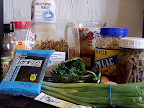
We used recipes from Japanese Cooking: A Simple Art by Shizuo Tsuji for the miso soup and rolled omelet. The pickled vegetables, plums, fresh tofu, and various other side dishes were purchased at a specialty Japanese market, though some suitable items are probably available at most Asian markets. We also added natto(1, 2) to the menu for something traditional and adventurous.

Menu
  • Rice - Short grain white rice, steamed in rice cooker
  • Miso Soup - Many miso soup recipes exist online. We feel no need to add to the clutter. A useful technique in Japanese Cooking that is worth passing along is to mix the miso with half as much stock to break up lumps, before mixing it into the soup.
  • Dashi-maki Tamago (Rolled Omelet) - Making a rolled omelet is difficult to describe after a single attempt. We recommend the reader consult a Japanese cookbook for illustrations of the techniques. The basic idea of the Japanese omelet is to roll an omelet and then pour another omelet and let the uncooked egg attach to the base of the rolled omelet and then roll them together. The process is repeated until you use up all of your egg mixture. The omelet is then shaped in a bamboo mat and allowed to cool for a minute. It is them sliced and served topped with shredded daikon that has been marinated in soy sauce.
    Making this omelet is an acquired skill. First, the pan used to make the omelet is a special pan that shapes the omelet. Mistakes I made in this attempt were over cooking the egg. A four egg omelet may also have been too large for the pan. In future attempts I would use 2 or 3 eggs. I anticipate making several more attempts before I get the hang of it.
  • Natto - We got advice for preparing natto from Natto Land.
  • Nori
  • Tsukemono (Pickles) - cucumbers, bamboo shoots, eggplants, and plums (umeboshi)
  • Green tea and orange juice

Results and Discussion
This breakfast very easy with the exception of the omelet. Purchasing all of the pickled dishes saves a lot of time (but costs a lot of money). The miso soups goes together very quickly. Only rice takes time to prepare.
The omelet is not difficult to do if you have made omelets before. The difficulty lies in combining the rolls into a single continuous piece. Messing this part up only affects the cook's pride but not the taste.
I was very neutral about the natto. The texture was slimy but nothing gross. The taste is a little sour and salty but nothing really special. I will probably not seek out natto again but I would eat it if someone served it to me. The pickled plums had a very strong taste that came in short tart burst. The pickled cucumbers tasted like regular pickles but much crunchier. We were planning on having guests so we invested a little more in this meal. In the future we would skip the sides and just have the omelet, rice, and soup.

Saturday, March 27, 2010

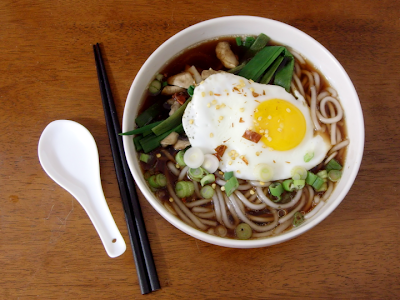
China - Hunanese Soup Noodles


Background

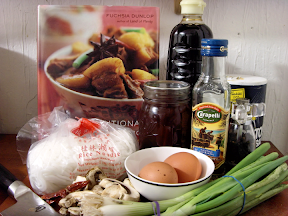
The rice pasta called fen is a specialty of the Hunan region. Fuschia Dunlop in the Revolutionary Chinese Cookbook describes its importance as " Rice fen is eaten for breakfast all over Hunan. Some people buy the freshly made fen and take it home, where they serve it in a bowl of broth, topped perhaps with a fried egg, some sliced scallions, and a dollop of chopped salted chiles" (p.252).

Ingredients (2 servings)
  • 2.5 cups vegetable broth
  • 1/2 bunch scallions
  • 1/2 cup coarsely chopped mushrooms
  • 1 tbsp soy sauce
  • 1/2 tbsp olive or peanut oil
  • Salt and pepper to taste
  • 8 oz fresh rice noodles
  • 2 eggs
  • 2 dried chiles, sliced

Procedure
  1. Start water boiling and in a separate pan heat the vegetable broth.
  2. Chop the tops off the scallions. Trimming off dead ends. Blanch in boiling water with mushrooms. Drain
  3. Thinly slice the bottom part of the scallions.
  4. Prepare the serving bowls by placing some soy sauce, oil, sliced scallions, and salt and pepper to the bottom of each serving bowl.
  5. Boil rice noodles until they are of the desired softness. This happens very quickly with fresh ones. Drain.
  6. Fry 2 eggs sunny side up.
  7. Pour vegetable broth into serving bowl. Add noodles to serving bowls. Top with mushrooms, scallions, fried egg, sliced scallions, and chiles. Serve.


Results and Discussion
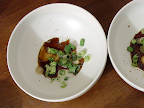
This is dish was simple and tasty. Preparation time is about 20 minutes. Making the dish look nice is also very easy. It is very spicy for breakfast but it wakes you up and is very warm. The fresh rice noodles have a very nice texture and soak up the broth's flavor. We would make this again for any meal. Dunlop discusses how this recipe has many different variations so you can top it with whatever strikes your fancy.