Showing posts with label sweet bread. Show all posts

Saturday, September 3, 2011

Kazakhstan - Nan, Baursaki, Sausage, & Tea


Background
Kazakhstan is an ethnically diverse country in central Asia. Much of this diversity is a result of Stalin's prison camps and other forced migration policies of the Soviet Union. Kazakhs are traditionally nomadic and their cuisine reflects this with lots of preserved food and protein sources that range well. The prominent protein sources are horse and lamb, and much of the dairy is preserved or fermented. The only breakfast information I found online was that Russian influence have made kasha more prevalent. I looked for Kazakh restaurants in the Boston area to get some better information. I found Cafe Assorti in Washington D.C. They got back to me immediately with information and suggestions. So if you are in the D.C. Metro area please go eat there. We are looking forward to trying them the next time we are in the area.
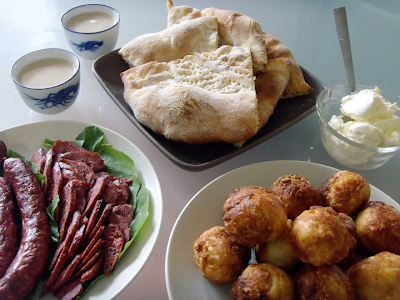
According to our source, Kazakhs are tending towards a more western breakfast as they are less nomadic. Our contact at Cafe Assorti gave us a break down of what they would consider a traditional breakfast: an assortment of thinly sliced sausages made from lamb or horse meat, served with taba-nan and/or baursak (a flat bread and a fried dough respectively). The bread is eaten with a type of sour cream called kaymak. Kaymak is also used in a tea made with cardamom and fennel.
Taba-nan requires special equipment (two oven-proof frying pans), so we adapted an Uighur flatbread from nearby western China. We chose it because it the base of the recipe was quite simple and seemed to be a good approximation of a nonspecific central Asian flatbread. We found the original recipe in Flatbreads & Flavors. We got our baursak recipe from Food by Country (originally published in Junior Worldmark Encyclopedia of Foods & Recipes of the World). We made some substitutions to reduce the size of the recipe to something two people can eat.  The tea recipe is from The World Cookbook for Students.
Kaymak is not readily available in the United States, but can be made at home by steaming a mixture of milk and cream for eight hours. Kitty tried a homemade recipe but it did not work for us. Instead, we bought clotted cream as the closest available substitute.
Even setting aside any ethical concerns, horse meat was not an option as it is simply not available in the United States. The last horse slaughterhouse closed in 2007 and it existed mostly to provide zoos with meat. We decided to purchase beef or lamb sausage instead. One of the sausages is called shuzhuk, and given the histroical Turkish influence in the region, we assume it to be related sujuk. I got the sujuk from a local halal market and proceeded to pseudo-smoke it using a 200°F oven and waiting until it got to 150°F internally. I then refrigerated it overnight. I got the technique from a summer sausage recipe that can be found here.

Basic Nan (6 pieces)
  • 2 tsp dry yeast
  • 2 ½ cups warm water (105-115°F)
  • 5-6 cups white flour
  • 2 tsp salt
  • Ceramic baking tile/pizza stone (optional)
  1. Place warm water in a mixing bowl and add yeast.
  2. Mix in 3 cups of flour one cup at a time.
  3. Stir the mixture 100 times in the same direction to develop the gluten.
  4. Add 2 teaspoons of salt, then continue to add flour until you cannot stir the dough.
  5. Flip the dough onto a floured surface and knead until it smooth and elastic.
  6. Lightly oil a bowl, put the dough in, and let it rise until it has doubled in size.
  7. Break the dough into 6 pieces. Roll out the pieces into 4-5 inch disks. Cover the disks and working one at a time roll them out into 10 inch disks (Note: Avoid making the dough too thin as it will easily burn. Think thin crust pizza for the correct thickness.)
  8. Let the disks rest for 10 minutes, then prick the dough with a fork (traditionally, a specialized bread stamp is used to apply a pricked design). Leave a two inch boundary unpricked around the edge of the dough.
  9. Place dough on a stone in a 500°F oven. Bake for 7 minutes or until golden brown on top. (Monitor it closely.) Let it cool for 5 minutes before serving.

Baursaki
  • 1 cup flour
  • 1½ tsp yeast
  • 2 tbsp water (105-115°F)
  • 2 tbsp yogurt
  • 1 egg white
  • 2 tsp butter
  • 1½ tsp salt
  • Oil for frying
  1. Mix water and yeast and wait for the yeast to bubble.
  2. Mix in the remaining ingredients, knead until it forms a dough.
  3. Let the dough rise for 30 minutes.
  4. Break off tablespoon sized pieces of dough and roll them into balls.
  5. Heat the oil in a deep skillet over high heat.
  6. Carefully add the balls and fry them until they are golden brown. Drain on a paper towel.
  7. Roll in sugar before serving, if desired.

Kazakh Tea
  • 4 cups water
  • 5 tsp black tea leaves
  • 4 cardamom pods
  • 1 tsp fennel seeds
  • 2 cups milk
  • Sugar/honey, salt, and cream to taste.
  1. Bring water to a simmer.
  2. Simmer tea and seeds for 3 minutes.
  3. Add milk and simmer for 2 minutes more.
  4. Remove from heat and strain tea.
  5. Add sugar or honey, salt, and cream as desired.

Results and Discussion
The bread had a nice crispy texture with very puffed outer crust. The puff comes from the fork pricks (or rather, the lack of them around the outer edges) and gives a pretty cool bread bowl effect. It might be fun to try this on pizza crust.
Fried dough continues to taste good. I am curious if there exists a civilization that practices agriculture that does not have some form of fried dough. This particular dough was not as fluffy as some of the recipes but it had a nice dense texture and felt more substantial. It was also a slightly drier dough which makes getting the dough from your fingers to the hot oil much safer.
The tea is basically chai with salt. I added more salt with each until I noticed its effect. I would estimate I topped out around 1/8 teaspoon with 1/2 teaspoon of sugar. As I drank it I realized the only drink I am used to tasting this much salt in is a sports drink. The clotted cream gave the tea a rich texture. (Clotted cream is nearly butter, very rich and creamy. It tastes great, but you can feel your arteries clogging.)
The suzhuk was nicely spiced with what tasted like garlic and black pepper which is matches my understanding of Kazakh version. The oven-smoking process gave decent results but it is no substitute for the flavor of a proper smoking.

Sunday, August 21, 2011

Niger - Fari Masa and Tuareg Tea


Background
Niger is the largest country in West Africa and takes its name from the Niger River running through its western region. Its population does not scale with its size because 80% of country is the Sahara Desert. Over half the population engages in agriculture, with the principal crops being millet, sorghum, and cassava.
(When searching for information on Niger it is important to get your adjective right or you find information about Nigeria. Things related to Niger are Nigerien and things from Nigeria are Nigerian.)
We are fortunate to have friends who spent a semester in Niger in college. Their recommendations included fari masa and an omelet sandwich, and they kindly offered to come to breakfast to demonstrate the preparation of traditional tuareg tea. We decided to try the fari masa, a leavened fried dough that is rolled in sugar or spices after frying. Lacking an authoritative recipe, we used a basic yeasted fried dough which met our friends' approval; those cooking at home can choose their own favorite.
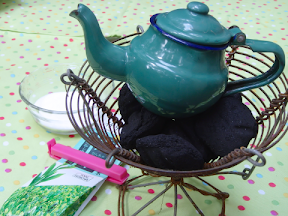
Tuareg tea is made using green tea and has a strong social component attached to it. The tea is brewed three times, with the strength of the tea diminishing with each brewing. A saying about the tea goes "the first cup is bitter like death, the second is mild like life, and the third is sweet like love." The water is traditionally heated over coals in a wire brazier. We had the brazier but we could not get the coals lit so we used the stove instead.

Tuareg Tea
  1. Fill the tea pot with green tea leaves and cover it with water.
  2. Boil for several minutes. You can tell it is ready from the smell.
  3. Pour the tea into a cup and add a small cup of sugar.
  4. Pour the tea between two cups to mix the sugar, cool it, and reduce the smell. A little foam should develop on top.
  5. Pour the tea into small glasses and serve.
  6. Repeat the process two more times using the same leaves.

Results and Discussion
Fried dough is good and hard to mess up. You get a nice brown crispy outside and a spongy warm inside. Rolling them in sugar helps too! A non-stick pan makes flipping and moving the dough much easier. The dough puffs up a great deal as you cook it and you should account for this when filling the pan. As I went along I discovered flouring my hands and spoon made dropping the dough into the oil safer.
The first brewing of the tea was frighteningly strong. I had a sip best measured in micro-liters and it hit me very hard. It is very bitter and the sugar did not lessen the bitterness. The second brewing was a bit more mellow but still very strong and bitter. (I liked it well enough –Kitty) The third brewing was finally something I would consider good. The other two brewing were just way too strong for me. The third brewing is given to children which adequately describes my caffeine tolerance.

Monday, April 11, 2011

Taiwan - Baozi


Background
Taiwan has only been separate from mainland China for a little over 60 years. It's cuisine is greatly influenced by middle China. Japanese influence is also prevalent as it was a Japanese possession for the first half of the 20th century.
Our research for Taiwan was a little backwards. I started by emailing my former Wing Chun instructor and asked him what he ate when he lived there. His response was you tiao served with hot soy milk. You tiao are deep-fried dough, very similar to a cruller in appearance. Unfortunately they require real deep-frying and we lack the equipment to that as safely as we would like. We then had the idea of dim sum, which seemed to be backed up by the general blogosphere, so we began looking for dim sum dishes specific to Taiwan. This search yielded no results, but we found several general books on dim sum. We decided to use Dim Sum: The Art of the Chinese Tea Lunch for our recipes and techniques about refrigeration and reheating. In the end we decided to make two different styles of steamed buns, known as baozi. The first bun is filled with ground pork, onion, and spinach. The second bun is filled with adzuki bean paste.
Adzuki is our novel ingredient for this breakfast. It is a legume that is grown through out eastern Asia. It is usually sweetened before it is eaten, and canned sweetened adzuki bean paste can be purchased ready-to-use from Asian groceries.
The process of making the bao dough takes at least 2 hours of rising and we determined that length of time to be prohibitive for starting from scratch in the morning. We decided to make and steam the buns the night before and reheat them in the morning.

Sunday, February 27, 2011

Afghanistan - Roht, Yogurt, Apricots, and Pistachios


Background
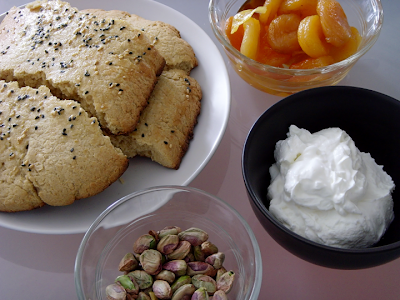
As is typical of old countries with steep terrain, Afghanistan has a wide number of ethnic groups. Its history of being along the silk road has brought in many outside spices and influences in the urban centers. Afghan breakfast, though, is very simple: roht (bread), apricots, pistachios, and yogurt. It is accompanied with tea flavored with cardamon. Roht is a sweet flat bread made chapati flour sprinkled with sesame and kalonji seeds. Kalonji is a seed from a south Asian flower. It is in the same family as buttercups, and is also called black onion seed or black cumin seed. It is not closely related to onion or cumin. We got out roht recipe from Afghan Food and Cookery.

Roht
  • 8 oz chapati flour
  • 2 oz sugar
  • 2 tsp yogurt
  • 2 fl oz milk
  • 2 oz butter
  • 2½ g dry active yeast
  • ¾ tsp baking powder
  • sesame seeds
  • kalonji seeds
  • 1 egg, beaten
  1. Melt the butter.
  2. Mix the flour, sugar, yogurt, milk, butter, yeast, and baking powder in a bowl.
  3. Mix in half the egg. Reserve the rest for glazing the bread for baking.
  4. Knead the mixture until you get a doughy consistency. Add more flour to prevent sticking.
  5. Let the dough rise for 1 hour in a warm place.
  6. Preheat the oven to 500°F.
  7. Roll the dough into a loaf shape 1-2 cm thick.
  8. Brush the dough with the remaining egg and sprinkle with seeds.
  9. Place the dough on a lightly oiled baking sheet.
  10. Bake for 5 minutes at 500°F to brown the bread.
  11. Reduce oven to 250°F and bake until it is done, about 10-15 minutes.
Eat with the yogurt, lightly chopped pistachios, and apricots.

Results and Discussion
Preparation was very simple and quick other than the bread. The roht has a crumbly, cakey quality with a slightly sweet taste. I think our yeast might have been dead as the bread did not rise as much as we expected. I think it would be fluffier and more cakelike if the rise had worked as planned. Still, it was very tasty. It could easily be served as a light desert or a snack at a coffee shop.
We used straned yogurt (often labeled Greek yogurt), which is thick, creamy and not as sour as the lebna. It serves as a nice base for the sweetness of the apricots and the salt of the pistachios.

Sunday, December 5, 2010

Spain - Magdalenas


Background
Spain is known for its highly regional cuisine, and many books have been written extolling the virtues and depth of this regional specificity. A quick internet search finds that the Spanish have very small breakfasts usually consisting of some bread and coffee. While the idea of bread and coffee is constant, the form of bread is varied. I was able to find three common types. Churros are fried dough sprinkled with sugar. They required deep frying, so we decided to look for other options. Torrijas is a bread pudding flavored with sugar and cinnamon, but we were unable to track down a recipe in a cookbook. Sobao is a muffin eaten in the north of Spain that was recommended to us by a lovely Spanish couple we met on Thanksgiving. Unfortunately, we were also unable to find a recipe. In the end we decided on another form of muffins called magdalenas. We found a recipe in The New Spanish Table which the author attributes to a master baker named Xavier Canal in Barcelona. We served the magdalenas with with cafe con leche.

Orange and Pistachio Magdalenas
  • 1 cup cake flour
    (¾ cup + 2 tbsp all purpose flour + 2 tbsp cornstarch)
  • ½ cup all purpose flour
  • pinch of salt
  • ¾ tbsp baking soda
  • 3 eggs at room temperature
  • 1 1/3 cup confectionery sugar
  • 1/3 cup whipping cream
  • ¼ cup orange juice
  • ½ cup light olive oil
  • 1/3 cup lightly toasted pistachios
  • 1 tbsp orange zest
  • butter, at room temperature (for greasing the tin)
  1. Mix flours, salt, and baking soda and set aside.
  2. Beat eggs with an electric mixer until they are fluffy, about one minute.
  3. Add the confectionery sugar and beat the mixture at high speeds until the mixture is yellow and the volume has tripled, about 5 minutes.
  4. Mix olive oil, orange juice, and cream.
  5. Add 1/3 of the flour mixture followed by 1/3 of the oil mixture.  Repeat until they are depleted.
  6. Stir in the orange zest and pistachios.
  7. Cover the mixture and let it sit at room temperature for 30 minutes.
  8. Meanwhile grease the mini-muffin tins with butter and preheat the oven to 375°F.
  9. Fill the muffin tins almost to the brim.
  10. Bake in the center rack for 20 to 23 minutes switching their positions after 10 minutes.  Pay very close attention to them towards the end as they can dry out quickly.
  11. Let them cool for 15 to 20 minutes and then sprinkle with confectionery sugar.

Results and Discussion
This breakfast was easy and tasty. Most of the time was spent waiting for baking and cooling. The magdalenas have a nice crispy exterior and a moist cakey interior. The pistachios and orange flavoring add a great flavor profile and makes them taste very refreshing. These would make a part of a larger breakfast as muffins.
I also understand why the Spanish have a large lunch.  We spent the day out Christmas shopping and both got really hungry around 3 o'clock. Carbs and coffee only go so far when you spend all day walking.

Sunday, May 23, 2010

Russia - Blinchiki, Oladushki, Sirniki, and Makivnek


For this week, we were fortunate enough to get Please to the Table, by Anya von Bremzen and John Welchman.  This is my favorite cookbook so far, not least because it has an entire chapter devoted to breakfast in Russia and the now-former Soviet states. (The book was first published in 1990, and so has a map of the USSR in the front, something I'd not seen for quite some time!).  We will probably be returning to this book later on as we get to some of the other post-USSR countries.

Before we get to the breakfast itself, take a look at the Wikipedia entry for samovar, which explains why there are two teapots on our breakfast table.

For the meal itself, the authors describe weekend brunch:
These occasions will include a variety of little pancakes or fritters (oladyi); sirniki—sweet cheese patties; blinchiki—mouthwatering filled crêpes; and freshly baked rolls and buns eaten with fruity homemade preserves. (464)
With the plan so neatly set out for us, we couldn't really leave anything out.  I have adapted all of the recipes to make a more sensible amount of food for us, but honestly we could have fed four with no problem.  We were pretty pleased with everything, with the sirniki being the big favorite.  But the thing we'll probably make again is the bread; the recipe is so adaptable, and the bit of lemon in the makes it really special.  And don't worry, Whit is saving the extra pancakes for tomorrow, and I'll take the remaining poppy-seed bread to work tonight, so nothing went to waste!