Showing posts with label greens. Show all posts

Sunday, August 14, 2011

Burkina Faso - Lemon Porridge with Peanut Sauce


Background
Burkina Faso is a landlocked country in West Africa with a predominantly agricultural economy. According to the World Cookbook for Students, the major foodstuffs are maize, sorghum, and millet, with chilies and peppers used as condiments. Meals are eaten in the morning and upon returning from work. Three meals a day is more common for wealthier families.
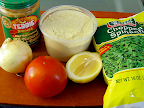
For breakfast we chose millet porridge flavored with lemon juice, from the World Cookbook for Students. The lemon juice substitutes for fermenting the millet flour, a process we have done before for corn-based porridges. The porridge is then cooled, sliced and topped with a thick sauce made of spinach and peanut butter, from the Holidays of the World Cookbook for Students.
Millet is a form of grass but it does not fit nicely into a single scientific grouping. Rather it is a functional category of crops made up of small seeded grains which are usually grown in drought-prone areas.

Lemon Porridge
  • 2 cups millet flour (may substitute fine white cornmeal)
  • 4 cups cold water
  • Juice of 1 lemon
  • 1 cup water, for cooking
  1. Mix the flour into the cold water using a whisk.
  2. Add the lemon juice and let the batter stand for 15 minutes.
  3. Bring the other cup of water to a boil.
  4. Stir in the batter using a wooden spoon, continuing to stir the porridge until it is smooth, thick, and stiff.
  5. Pour the porridge into a greased mold or loaf pan and let it rest for 30 minutes.

Africans Greens in Peanut Sauce
  • 1 tbsp vegetable oil
  • 1 onion, finely chopped
  • 1 green pepper, seeded and finely chopped
  • 1 tomato, finely chopped
  • 1 lb frozen spinach, thawed.
  • ¼ cup peanut butter
  • Salt and pepper to taste
  1. Heat oil in a saucepan over medium-high heat.
  2. Add peppers and onions, and cook until onions are soft.
  3. Add spinach and tomato, and cook until spinach is wilted (or heated through if frozen).
  4. Stir in peanut butter and serve.

Results and Discussion
The porridge had a strong lemon flavor. While fermenting gives a subtle sour taste that lingers in the background, the lemon juice brings the flavor to the front and dominates the dish. It is not necessarily a bad result, but it is a poor substitute for the flavor that comes form the fermentation process.
The peanut sauce had a nice flavor and its coarser texture goes well with the smoother porridge. The Holidays of the World Cookbook suggests serving it over rice which would make a nice lunch or dinner meal.

Saturday, October 16, 2010

South Korea - Soup and Rice, Side Dishes and Kimchi


Before we start, I just want to point out that most of the time I lived in Korea, I ate something like this for breakfast:


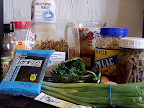
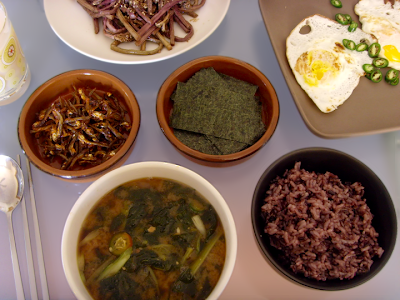
However, Corn Flakes are not really in the spirit of the Project. The traditional Korean breakfast is not really different than lunch or dinner. Rice, soup, and kimchi would suffice for a basic meal, and usually all that is hanging around from dinner so its no trouble to put together. Since we try to cook something a little more than the basic meal, we did a few more sides: fried egg, anchovies, kim (nori), and bracken salad. (This makes seven dishes total – there should always be an odd number of dishes.)

We only had to make the soup and the bracken salad from scratch; we took the recipes from Quick and Easy Korean Cooking for Everyone, a really good basic cookbook with step-by-step illustrations and pictures of all ingredients. Everything else we got at the Korean market or had in the house (also easily purchased).

The soup could really be any light soup. We had thought of doing bean-sprout soup (a traditional hangover cure!), but we've got a surplus of greens from our farm share, so it was more practical to use those.

Greens Soup
  • 1 cup frozen greens
  • 2 hot green peppers (gochu or jalapeƱo), sliced into rings
  • ½ green onion, sliced diagonally
  • 3½ cups dashima (seaweed) stock or chicken stock
  • 4 oz doenjang (miso)
  • crushed garlic, to taste (i.e. lots)
  1. Defrost greens, squeeze, and drain thoroughly.  Cut into 2" pieces.
  2. Bring stock to a boil.  Reduce heat, add greens and cook 3-4 minutes.
  3. Dissolve doenjang in stock, add garlic, and return to boil.
  4. Stir in peppers and green onion, remove from heat, and serve.
We have an excellent automatic rice cooker, all you need to do is put in washed rice and press the button. We added a few tablespoons of black rice which makes the whole pot a pretty purple color once cooked.

Our kimchi we did make ourselves, although somewhat nontraditionally using a recipe for Pickled Kimchi from the Complete Book of Picking. Real kimchi is not pickled, but if you've ever kept kimchi for an extended period of time in your regular refrigerator, you will appreciate the utility of being able to keep it vacuum-sealed in the pantry until needed! On the other hand, if you do purchase your kimchi, avoid the commercially jarred stuff; I have yet to find any brand that is very good. Hopefully your market will have house-made kimchi with the prepared food, and this will be much better and more authentic in taste.

Anyway, the kimchi was already done and in the pantry, so the only other things we had to cook were the bracken and the eggs. A fried egg is basically a fried egg anywhere (also makes a good dinner side dish and tasty hamburger topping). The salad could be any simple dressed vegetable—spinach, sprouts, whatever—but we had the bracken left over from something else so we used that.

Bracken Salad
  • 7 oz gosari (bracken), packaged/precooked type
  • 1 tbsp sesame oil
  • 2 tsp crushed garlic
  • 2 tbsp soy sauce
  • 1 tbsp minced green onion
  • 2 tsp cheongju (mirin)
  • 2 tsp rice vinegar
  • 1 tsp ground sesame seeds
  1. Rinse and drain bracken.
  2. Heat sesame oil in a large pan, add garlic and bracken, stir-fry until heated through.
  3. Add soy sauce, green onion, cheongju, and vinegar, continue cooking until sauce is thickened.
  4. Top with sesame seeds and serve warm or chilled.
Finally, we did make one concession to modern Korean prepackaged junk-foodiness with a bottle of Morning Rice, a sweetened rice milk drink. You can buy dozens of different energy/meal-replacement/probiotic/vitamin/diet/etc/etc drinks at any cornershop; most of them are kind of vile, but Morning Rice is pretty inoffensive (actually I think Whit really liked it) and it says "Morning" right on the bottle!

Sunday, August 8, 2010

Democratic Republic of the Congo - Saka-Saka


Background
The background research for this breakfast was very difficult but had an elegant solution in the end. Cookbooks about the Democratic Republic of Congo or Zaire were not easily found. The next step on our search was to find cuisine of the dominant ethnic group of the country. This ethnic group is the Bantu and they are widespread through out sub-Saharan Africa. As a result I found a very comprehensive site about Somali Bantu which I stashed away for future reference.
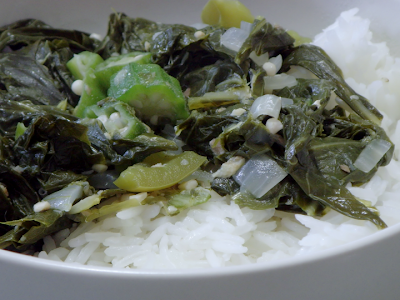
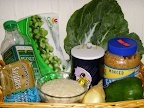
The elegant solution came via my mother who reminded me that a good friend had lived near the DRC border studying gorillas for a year. I phoned Ayres and he recommended saka-saka. The recipe is from an African recipe site called The Congo Cookbook. I had come a across it before but I was unaware it was eaten for breakfast. In Africa the leaf would be a cassava leaf and would freshly picked form the plant. We chose to use collard greens as recommended by the website. We served the saka-saka on jasmine rice.

Saka-Saka
  • 1 bunch of collard greens
  • 2 tbsp peanut oil
  • 1 onion chopped
  • 1 clove garlic minced
  • 1 bell pepper chopped
  • 1/2 lb chopped okra
  • can of sardines
  • salt to taste

  1. Tear the leaves into pieces and throw out the stemmy parts of the leaf.
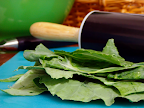
  2. Soften the leaves with a rolling pin.
  3. Bring 4 cups of water to a boil, add the leaves, and simmer for 30 minutes uncovered.
  4. Add the remaining ingredients to the pot and cook down the water.
  5. Serve on a bed of jasmine rice.
Results and Discussion
This breakfast was simple once the research was done. The major mistake we made was buying a fresh packing of sardines. They had very little salt in them and so the final dish was a little bland. This problem was quickly remedied with a salt shaker. Another problem that I added far to much water at the beginning and it took a long time to cook off. The 4 cups given in the recipe is my guess at what should be an appropriate amount of water to cook the greens and have the breakfast ready in a timely fashion.
An alternative method of mashing the leaves involves a bowl, a bottle, and bashing. We chose the rolling pin method because we live in an apartment and bashing the leaves early in the morning would be rude to the neighbors. It does sound much more fun than a rolling so somebody try it and let us know.