Showing posts with label beans. Show all posts

Sunday, June 26, 2011

Cameroon - Akara with Corn Pap


Background
Cameroon is a West African country and a former colony of Britain and France. Their major staples are corn, yams, rice, and cassava, and the major protein sources are fish, nuts, and beef
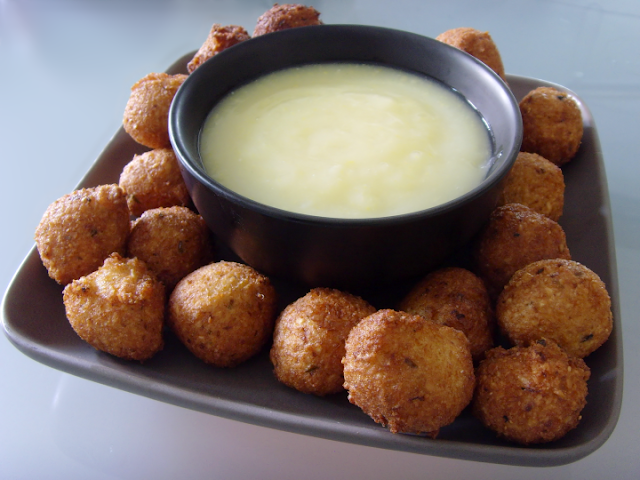
For this week's breakfast, I e-mailed my biology lab teaching assistant from my first semester in college. Chris is a native of Cameroon and is one the most genuine and nice people I have ever met. His enthusiasm and encouragement was a major reason I chose to major in biology. Chris and his wife provided us with a very detailed recipe for akara and corn pap. Akara are deep fried bean fritters made from black-eyed peas and flavored with onion and hot peppers. Corn pap is made with fermented corn starch (homemade from whole, dry corn kernels) and is used as a topping for the akara.

Akara
  • 1lb black-eyed peas, soaked overnight.
  • 1 tsp salt
  • 1 medium onion, finely chopped
  • 1 jalapeno, finely chopped (optional)
  • 3-4 cups of vegetable oil for frying
  1. Add beans to blender along with 1 cup of water.
  2. Chop beans for 30 seconds, then transfer to a large bowl of water.
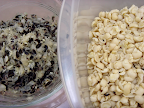
  3. Remove the seed coats by agitating the beans with your hands, letting the skins float to the top. Pour off the water and skins. Repeat as necessary.
  4. Soak for the beans for 3 hours.
  5. Blend the beans with onion and jalapeno. You want a very thick paste. Add a small amount of water if needed to get the paste consistency.
  6. Mix in the salt with a fork or mixer. As you do this, keep in mind that you want to add air to the mixture so the akara are fluffy when you fry them.
  7. Heat oil in a deep pan until moderately hot.(350°F).
  8. Spoon paste by tablespoons into the hot oil. Allow enough room for movement, doing several batches if necessary.
  9. Fry, turning frequently until they are golden brown. Ours took about 4 minutes to cook.
  10. Remove from oil and drain on paper towels.

Corn Pap
Fermenting the cornstarch
  • 1 lb whole dried corn kernels (we had good results with a package of yellow samp)
  1. Wash and soak corn kernels in water for 2-3 days.
  2. Drain and grind into a very smooth paste.
  3. Add cold water to the paste, then filter through a fine sieve to remove the husk and larger bits.
  4. Let the starch solution settle overnight
  5. The starch can either be used right away or stored in the refrigerator. If you choose to store it in a refrigerator, change the water covering it on a weekly basis.

Making corn pap
  • 5 tbsp fermented cornstarch
  • 1 cup water
  • Sugar to taste
  1. Mix water and corn starch until they are smooth.
  2. Place over medium heat and stir constantly to lumps.
  3. When the mixture starts to boil, add sugar and simmer for 30 seconds.
  4. Serve with akara.

Results and Discussion
The akara have a nice crunchy exterior and we got a fluffy interior with a falafel-like texture. The corn pap makes a great dipping sauce. It is sweet and slightly sour.
In our first attempt at these last week, our mixture was much too wet because I soaked the skinless beans overnight and added too much water. The wet paste fell apart while frying. The key to making the paste is to error on the side of too dry. We also tried to shallow fry them on our first attempt and this led to lots of sticking and crumbling. Deep oil is needed to get a nice even brown, as it completely submerges them.
Making the corn pap and extracting the corn starch was fun. When you blend the corn kernels and filter them, you get a strainer full of stuff and a white liquid. The starch is in the white liquid and it will settle out overnight. We got about half a cup of starch from a pound of dry corn. I understand why people usually make five pounds at a time if they use lots of the stuff. The fermenting gives it a slightly sour taste. I would be curious to see if you start with normal cornstarch and ferment that (as we have done with some other cereals already), if you would get a similar result with less work.

Monday, April 18, 2011

Yemen - Fasoolia and Malooga


Background
Yemen is located on the southern coast of the Arabian Pennisula, making it a key port in the spice trade. Most sources credit the Ottoman Empire as the only outside influence on the cuisine, but they do not give any specifics. The major protein sources are chicken, lamb, and beans. Dairy is not common in the diet except for ghee.
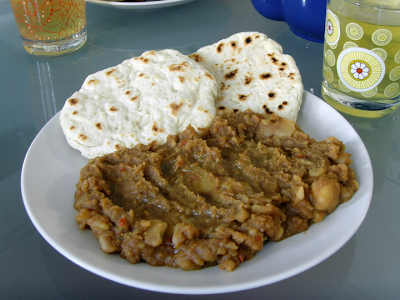
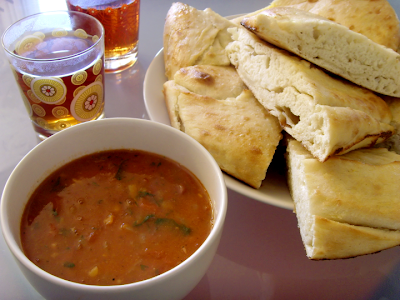
We didn't have much trouble finding out what dishes are served at breakfast, but finding recipes proved difficult as spellings are not standardized. The only book I found on Yemeni cuisine focused specifically on a small Jewish community in the country. Looking online, there are several recipes available for fasoolia, a bean and tomato dish. It is traditionally eaten with a massive piece of flat bread called malooga. The bread is made by folding semn into the dough. Semn is a darkened ghee and is easily made at home.
It is served with sweet tea flavored with cardamom.

Fasoolia
We went online for our recipes this week. The same fasoolia recipe is found all over the internet and can be found here.
Using the masher did not break up the beans very well and I would use a stick blender in future attempts.

Malooga
The malooga and semn instruction can be found here.
1 stick of butter gives you a little more than 1/3 cup of useful semn while keeping the burned pieces on the bottom.
The recipe made one piece according to the measurements suggested; we did not divide it into smaller parts as directed. When baking the malooga, be sure to use an edged cookie sheet: the semn is very lubricating, and the higher oven temperature may cause your baking sheet to warp and your malooga to slide off!

Results and Discussion
The fasoolia was a really nice dish and comes together very quickly. The combination of cumin, tomato, and cilantro is classic. It is also very warm and filling.
The real treat for this breakfast was the malooga. Most of our previous flat breads are pretty simple and created as almost an after though. The malooga was much more involved than previous flat breads. Not rolling the dough after each fold, and then making a ball leads to the creation of irregular layers. They flake off very nicely for dipping and scooping. The bread keeps well over night. I would like to use this recipe for pizza dough. (I am sure Yemenis do this already and call it something else! –Kitty)

Sunday, February 20, 2011

Nepal - Daal Bhaat


Background
Nepal is predominantly an agricultural society, so naturally food is at the center of the culture. Given its ancients roots and intense topography, it is also unsurprising that Nepal has 36 ethnic groups and many languages. The character of the cuisine is simple but made flavorful with spices.

For the cultural and menu information we found an interesting book called Enjoy Nepalese Cuisine. Its purpose is to give people an overview of food in Nepal for people who want to know about it but not cook it. The author does this while referring you to her separate recipe book.

What qualifies as breakfast is interesting in Nepal. Being an agrarian society, the Nepalese tend to be early risers. The breakfast is hot sweet tea and some biscuits. Lunch is eaten at 8AM, when westerners normally eat breakfast. We decided to do both meals. The second meal consists of daal, bhaat and tarkari. Daal is a gravy made from split beans, bhaat is rice, and tarkari is green vegetables served with achaars or chutneys. Achaars are pickled food while chutneys are fresh.

As might be expected for such a diverse culture, all of these components come in a wide variety. We used the cookbook Taste of Nepal, which contained entire chapters dedicated to each dish. There was no particular guidance on which were preferred for breakfast, so we selected the dishes that most interested us. For the daal we chose to use black urad beans, with simple steamed rice for the bhaat, and a tarkari of stir-fried cabbage. We made a radish achaar the night before so it could marinate, but you can also make it the day of. We also ordered some samples of Nepal-grown tea from Upton Tea Imports.

This meal used three spices that might be unfamiliar to our readers. The first spice is asafetida, also called devil's dung, which has a potent unpleasant smell when first encountered. I would not use it for cooking if I ran across it randomly. It is made from the resin of a root in the carrot family. Second is timur, also known as Sichuan pepper, which is not actually pepper at all, though it resembles it. We used this once before, in the Japanese breakfast. The other new ingredient is an herb called jimbu, which is related to onions and leeks. We were able to purchase it at Bombay Market along with cumin-flavored bicuits for the first breakfast.

Sunday, January 30, 2011

Iraq - Tasbreeb Bigilla


Background
Finding information on Iraqi breakfast was actually very simple. I found an article online about breakfast before the 1990 Gulf War and the subsequent embargo. It provided a fantastic list of recipes.
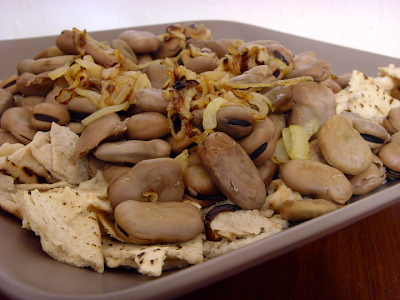
As Iraq is probably the first place wheat was domesticated, it comes as no surprise that bread is a staple of the diet. Other ideas included gaymer, a buffalo cheese sometimes served with date syrup, and kahi, a dish brought to Iraq with Babylonian Jews. It is very closely related to baklava and requires many folded layers of pastry dough. Bigilla is a fava bean dish eaten in northern and central Iraq. I located a variation of this dish called tasbreeb bigilla in The Iraqi Cookbook. It consists of fava beans served with pita bread topped with fried onion and peppermint powder, and is traditionally served on Fridays. We were unable to find peppermint powder specifically so we used crushed dried mint.

Tasbreeb Bigilla
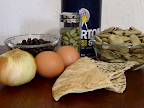
  • 1 lb fava beans
  • 1 packet of pita bread (ours had six pitas)
  • 1 medium onion, thinly sliced
  • Olive oil
  • Salt
  • Dry mint
  1. Soak fava beans overnight in cold water.
  2. Cut pita bread into pieces and leave them out overnight so they dry out. (Alternatively, put the bread pieces in an oven at 200 for 30 minutes.)
  3. Bring the beans and water to a boil at medium heat, and boil them for 45 minutes.
  4. Add salt and continue to boil for 15 minutes. Make sure there is enough liquid remaining to soak the bread.
  5. While the beans are cooking, heat oil in a pan, add the onions to the hot oil and fry them until browned.
  6. Remove the cooked beans from the water.
  7. Soak the bread pieces in the bean liquid for 1 minute. Then remove them from the water and place them in a big shallow bowl.
  8. Put the beans on top of the bread and then pour the onions and hot oil over the beans.
  9. Sprinkle the dry mint to taste over your plate.
Results and Discussion
This recipes makes a lot of food. We could have easily halved it and still had lots of food. It was suggested to serve this with fried eggs, but we had to leave them out or we would have been eating the leftovers all week!
The pita bread pieces had an interesting texture. Being soaked in the bean juice infused them with flavor. Getting the bread pieces in and out quickly lets the flavor soak in while preventing the bread from becoming soggy.
The fried onions in the oil added lots of taste and the next time I make this I am going to add more onions. The oil itself provides the same flavor enhancement and texture contrast as in the previous breakfast.
In Iraq they add cardamom to the coffee for flavor, which is probably quite good when done properly. We were not paying attention and completely screwed this up—getting the ratio of water to coffee wrong and ending up with a very weak brew. We're now on an 0-for-2 beverage streak, and will have to pay more attention from now on!

Sunday, January 23, 2011

Morocco - Beyssara


Background
Moroccan cuisine reflects its multiple interactions with different culture through trade and conquest. It is in the Mediterranean tradition. The Berbers brought influences from just west of Egypt (their best known contribution is couscous). The Moors conquered Spain and Spanish influence flowed back across the straight of Gibraltar.
We found lots of different options for breakfast. Lassida is a porridge made of semolina or couscous and flavored with honey and butter. But it is traditionally eaten to break the fast during Ramadan, which has long since past. Baghrirs are a pancake made with semolina and only cooked on one side. The batter has the consistency of a crepe. Beyssara is a spiced fava bean stew served with bread. We found a recipe for this in Mediterranean Street Food which looked simple and tasty, and so decided to make the beyssara.
The national drink is green tea with mint. Making it is considered an art and has ritual associated with it. We had some trouble with the mint tea. Though we did have an errand at the Burlington Mall yesterday and would have bought some at Teavana, it took us 40 minutes (!) to get into and out of the parking lot and so we ran out of Zipcar time. The grocery store was also out of mint of any kind, so we made regular green tea.
The one difficulty in making beyssara was finding split, peeled fava beans. The best option available were a pickled peeled bean and I did not know how they would effect the test. I give a method of peeling the beans in the recipe.

To peel dried fava beans
  • 1 cup dried fava bean
  • 3 cups water
  • 1 tbsp oil
  1. Put fava beans, water, and oil into a pressure cooker.
  2. Cook at high pressure for 15 minutes.
  3. Quick-release the pressure.
  4. Open the pressure cooker, tilting the lid to that the steam is released away from you.
  5. Drain the beans and put them into a ice water bath. Let them sit for 20 minutes.
  6. The skin around the bean should now be loose and can be removed using your finger nails or started with a paring knife.
  7. Discard the skin and keep the bean. Split the beans if you can.
  8. Refrigerate the beans until you use them.
Beyssara
  • 1 cup peeled split broad beans, soaked overnight in hot water with 1 tsp baking soda
  • 2 gloves garlic, unpeeled
  • 1½ tsp ground cumin
  • ½ tsp red pepper flakes
  • 1½ tsp paprika
  • Salt
  • Extra virgin olive oil
  1. Put the beans in a sauce pan with the garlic, cumin, red pepper flakes, and 1 quart of water.
  2. Bring to a boil on medium high heat.
  3. Cover the pan and cook for 30 minutes or until they are mush.
  4. Reduce the heat to low and simmer for 10 to 15 minutes.
  5. Add the paprika and salt to taste.
  6. Serve in a shallow bowl and garnish with a drizzle of olive oil and cumin.
  7. Eat with Moroccan bread.
Results and Discussion
This recipe takes a while, but that is in the nature of cooking dried beans. The cooking time could also be reduced by cooking them longer in the pressure cooker. Most of the water boils off or is absorbed by the beans, but you can easily control how moist the beans are by adjusting the cooking time. The end result is nicely spiced with an enjoyable rough texture. I think ours was a bit drier than it was supposed to be as we ended up with more of a paste than a soup but it still pretty good.
The drizzle of olive oil added a nice flavor. It also provided a strong contrast of textures with the beans.

Sunday, November 14, 2010

Sudan - Fool Medamas


Background
The history of Sudan is closely linked to Egypt's. Both countries have conquered one another and both were under British and Ottoman rule. I had difficulty finding a published source on the Sudan and in the end I decided to use the web site Sudan.net. This site listed fool medamas and tamayya as possible breakfasts. We made fool medamas as our breakfast for Egypt, though we spelled it differently. Tamayya is another word for falafel and it is eaten at any time of the day.
After we made our Egyptian breakfast I ran across an article in the paper listing the best dishes in Boston. One of these dishes was the fool medamas from Falafel Palace. We were not very thrilled with our recipe so I wanted to try a much different version. Falafel Palace makes a great version more like a bean salad with fresh vegetables and a yogurt dressing. It made a great light lunch and is really cheap. The new recipe is very different than the one we used for Egypt so I decided we should do a comparison.

Fool Medamas
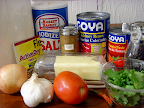
  • 1 (16 oz) can of fava beans
  • 1 large onion, chopped
  • 1 large tomato, diced
  • 1½ tbsp olive oil
  • 1 tsp ground cumin
  • ¼ cup chopped parsley,
  • 4 tbsp lemon juice
  • salt, pepper, and chili powder to taste
  • pita bread
  1. Pour fava beans and juice into a sauce pan and bring them to a boil.
  2. Mix all other ingredients—except lemon juice—in a bowl.
  3. When the bean juice has almost evaporated add the remaining ingredients to the pot along with the lemon juice.
  4. Cook uncovered for about 5 minutes, until most of the water is gone but the mixture is not dry.
  5. Eat with pita bread along with hard boiled eggs and tahini.
Results and Discussion
This recipes was much better than the one we used for Egypt. The first major improvement was the inclusion of spices so that I actually tasted something. Not mashing the fava beans was also key. When the beans are mashed they suck up all the moisture and the result is a very dry paste with some vegetables mixed into it. Not mashing the beans keeps the fool medamas moist and much more palatable.

Saturday, September 4, 2010

United Kingdom - Full English Breakfast


Background
The full English breakfast is a well-known meal, so our research was a simple Google search. The BBC Food site provided an excellent menu and a preferred sequencing of ingredients to best use the grease produced by the sausage and bacon. The basics of the English breakfast are sausage, bacon, baked beans in tomato sauce, browned mushrooms, toast, tomatoes, a fried egg, and black pudding. Naturally, you serve the breakfast with tea.

One element of the English breakfast we omitted was the black pudding (a type of blood sausage) mostly because it was by far the most difficult item to procure, and we already had enough meat for two people. Kitty has also eaten plenty of tasty blood sausages in Asia and feels that we were not shirking our duties by skipping over it here.  Should you also be unable to find black pudding, these other blood sausages are available at Asian markets; the idea being similar though the taste rather different.

(In U.K. English, the word pudding also describes a bready or milk-based dessert. I became interested in how the same word came to describe two very different dishes. Fortunately the country that posed this etymological challenge also created the solution in the Oxford English Dictionary. The word's first appearance in Latin is in the context of sausage in 1287. The first time it describes a dessert is in 1543. The shared use of the word comes from both dishes being cooked in water while encased in something.)

Recipe
Please see the BBC Food site for the recipe.

Results and Discussion
“Full” is a very accurate modifier for English breakfast. I was not really hungry again until dinner. It also covers a full range of flavors and textures. You have have the savory, dense, and flavorful sausages with the golden casing giving them a wonderful snap. We got these at Savenor's in Cambridge and they were spectacular and reasonably priced. The sweet fresh and moist tomatoes have an excellent contrast of being warm on the surface but still a little cool in the middle; the mushy beans and lightly crunchy toast provide a nice contrast
The sequencing of the elements and grease management are also important for getting the right results. Under optimal condition one would have a griddle and some slightly fattier bacon so we could spread the grease around and have more things cooking at the same time. The bacon we chose was much too lean and as a consequence we had to supplement with a lot of olive oil. The single pan approach does help cut down on dishes which is very nice.
This breakfast is very similar to the southern breakfast I learned growing up watching my grandfather. It is exactly what he would make minus the beans and mushrooms. He also taught me the importance of good grease management.
We will be making its counterpart, the full Irish breakfast, in about 2 years.