Showing posts with label pancake. Show all posts

Monday, May 23, 2011

Sri Lanka - Idappan, Pol Sambol, and Kiri Hodi


Background
Sri Lanka is located off the southeast coast of India and as a result its food is frequently misclassified as a subset of Indian Cuisine. I found a great resource for the cuisine, recipes, and history of the island in The Food of Sri Lanka. Rice and curries are foundations of the diet, with fish and chicken as the predominant proteins. Sinhalese (low country) and Kandy Sinhalese (upcountry) are the two major categories. Sinhalese uses more seafood and most meals are rice and curry. The regional “black” curry is made by roasting the spices to a brown color before cooking them. Kandian cuisine uses ingredients such as jackfruit, breadfruit, and turmeric flowers. They also tend to eat more deer and wild birds.
The Portuguese came looking for spices in order to bypass the Arab monopoly. They were displaced by the Dutch who eventually gave way to the English. Sri Lankans incorporated and changed many of aspects of those cuisines.
Information on breakfast quickly lead us to two types of hoppers (appa). Appa are three dimensional crepes made with a rice flour batter. The batter is poured into a specialized pan with a rounded bottom and steep sides similar to a very small wok. The result is nest shaped pancake and perfect for fillings. Eggs are frequently cook in the bottom and the end product looks quite cool. Appa pans are very specialized and we could not find a good substitute. We decided to move onto string hoppers (idappan).
Idappan are noodles made from rice flour dough, forced through a vermicelli press. The noodles are steamed on special trays (hopper mats) and served with a variety of toppings. Our first attempt involved a spaghetti pasta cutter. This worked very poorly, and cleaning the rice dough from the machine was annoying. We then tried a cookie press with a Christmas tree attachment that worked pretty well and the effect was probably similar to that of a traditional press. Before you attempt these at home you will need a similar device. We used parchment paper to substitute for the specialized stand. The amount of water to use while making the dough varies greatly from recipe to recipe. The important thing is to get a non-sticky, malleable dough in the end.
Toppings for idappan are pol sambol and kiri hodi. Sambol are fragrant side dishes made of a basic ingredient and then spiced up. Pol sambol is made with coconuts, lime, and dried chili. Kiri hodi is made of chicken stock, coconut milk, and a lot of spices, including “Maldive fish” which is dried, leathery tuna. It is not quite bento flakes and most internet resources say to substitute dried prawns.
This week's novel ingredients are fenugreek and curry leaves. Fenugreek is a legume that grows well in semi-arid environments, it is used as a spice. Curry leaves are a fundamental spices to South Asian cuisine. The plant is in the same family as oranges and lemons. The fresh leaves have a strong peppery smell and are used predominantly for their aromatic qualities.

Kiri Hodi
  • 1 tbsp fenugreek seeds
  • 2 cups chicken stock
  • 1 red onion, finely chopped
  • 2 sprigs of curry leaves
  • 3 cloves of garlic, finely chopped
  • 1 inch cinnamon stick
  • 4 cardamom pods, crushed
  • 2 green chile, deseeded and sliced thin
  • 1 tsp turmeric powder
  • 2 tsp powdered Maldive fish
  • 2 cups coconut milk
  • lemon juice and salt to taste
  1. Soak fenugreek in chicken stock 30 minutes.
  2. Add all the rest of the ingredients except the coconut milk and lemon juice.
  3. Bring to a boil and simmer until the onions are soft.
  4. Add the coconut milk and simmer for 5 minutes.
  5. Add lemon juice and salt to taste.

Pol Sambol
  • 1 tsp chopped dried chili
  • 1 tbsp finely chopped onion.
  • 1 tsp pepper
  • 1 tsp Maldive fish (optional)
  • 2 cups grated coconut
  • 3 tbsp lime juice
  • Salt to taste
  1. Grind together chili, onion, pepper, and Maldive fish.
  2. Add coconut, lime juice and mix well.
  3. It is recommended that this be made fresh.

Idappan (indi appa)
  • 3 cups (500g) rice floor
  • 1½ tsp salt
  • boiling water
  1. Toast the rice flour in a very low oven or sauce pan.
  2. Sieve it into a bowl.
  3. Add salt and slowly mix in just enough hot water to make a soft dough that is not sticky.
  4. Add the dough into your pressing device and press the dough out onto the parchment paper.
  5. Steam the noodles for 10 minutes.
  6. Serve hot with pol sambol and kiri hodi.

Results and Discussion
This breakfast required the most specialized equipment so far and we did a good job improvising. The cookie press was not ideal for pressing out the dough as the grip was poor. I would not do this again without a more mechanized device. The recipe also makes a lot of dough and I would make less in the future. Since you are making the dough to a consistency, it can be easily reduced.
The pol sambol has simple, classic flavors. The lime and coconut go great together, and the heat from the chilis is a nice addition. The texture of the coconut flakes is an interesting contrast when eaten with the soft noodle.
Kiri hodi smells great as you cook it. The dried prawns do have a slightly fishy smell, but they don't overpower the other ingredients. It is a great blend of spices and gives the noodles lots of flavor. We found ourselves with lots of leftover broth, which we later cooked some rice in and got something almost like biryani-risotto, very tasty.
I do want to find a pan that will let me cook appa; they look really cool and I still want to make them.

Sunday, March 20, 2011

Venezuela - Arepas de Queso


Background
Like most South American countries, Venezuelan cuisine is a blend of Native and European cuisines. The predominant European influences are Spanish, Portuguese, French, and Italian.
We had several options for breakfast. Mandoca are doughnuts made from cornmeal, eaten with butter and cheese. Caraotas is a spicy black bean dish. Perico is a scrambled egg dish with vegetables. Arepas are cornmeal pancakes which go back to pre-Colombian times. We decided to make the arepas as they were easiest to find a recipe for, plus we could compare to the Columbian arepas we made before.
We found our recipe in The South American Table, but when we got the book from the library we found the pages on arepas missing! Fortunately this section was available via Google books and contains lots of information comparing Colombian and Venezuelan arepas. The major contrast between the two is that the Venezuelan version has a softer center and is sometimes used to wrap around fillings. The recipes offered by the book were one with cheese and the other with a pork and beef filling. We chose the arepas de queso as we were making several for guests and it would be easier than stuffing the dough.
A point of interest brought up by the book was the different cornmeals used for making arepas. The book specifically mentions that one should use masarepa (another type of cornflour) instead of the masa harina we used for Colombia. A discussion of the differences in uses and preparations can be found here. Masarepa can be purchased at stores selling Goya products.

Basic Arepa Dough
  • 1 cup masarepa
  • ½ tsp salt
  • 1½ cups hot water
  1. Combine flour and salt in a bowl
  2. Add water and mix until you have a soft dough
  3. Cover and let it stand for 5 minutes.
  4. Knead for an additional 3 minutes until it is smooth.
  5. Add and little more water and continue kneading if the dough is too dry.

Arepas de Queso
  • 1 large egg yolk
  • 2 tbsp unsalted butter
  • 2 oz chihuahua or mozzarella cheese, shredded
  1. Knead the dough with the egg yolk, butter, and cheese.
  2. Shape into disks 4 inches in diameter and ¼ inch thick.
  3. Grease a skillet or pan with oil and bring to a medium heat.
  4. Slowly cook on both sides until a crust forms flipping them several times.
  5. Transfer the arepas to an ungreased baking sheet and bake for at 350 for 15 minutes.
  6. A hollow sound when tapped means they are done. Serve with butter, cream cheese, or goat cheese.

Results and Discussion
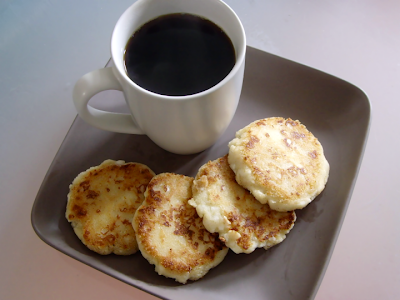
These arepas are quite good. The outside is crispy and the inside is similar to grits. The cheese and butter keep the inside moist while giving a good color on the outside. The slightly sour taste of the goat cheese goes very nicely and provides a contrast of texture.
The major difference between Venezuela and Colombia was amount of moisture in the finished arepas. The Colombian version was a bit drier on the inside and not quite a creamy.

Sunday, January 2, 2011

Canada - Sourdough Hotcakes


Background
When I started looking up information on Canadian food, I basically thought it would be English cuisine, with French influence in Quebec. I got The Canadian Cookbook from the library. As I was reading through the recipes I started to realize that this basic assumption was true but that the cuisine has also been influenced by everyone who showed up in the country (a lot like the United States in that regard). The book also had an excellent section on breakfast foods giving a wde number of choices.
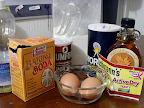
Our choices ranged from yam latkes, french toast, bannock, crepes, and sourdough hotcakes. The only dish from this I had not previously heard of were bannocks. Bannock is a quick bread brought over from Scotland and was a staple of early settles and fur traders. However, we decided to make the sourdough hotcakes. First because I never made sourdough before and I have heard people rave about how wonderful it tastes. The second reason is that I have not had pancakes in while and I really miss it.
The book gives two methods of making the starter. We chose the overnight version instead of the weeklong version, mostly because we were cooking dinner for 10 people over New Year's and had no spare mixing bowls. We will list both methods.

Sourdough Hotcakes
  • 2 cups sourdough starter (recipes follow)
  • 1½ cups unbleached or wholewheat flour
  • 2 tbsp sugar, maple syrup, or honey
  • 3 tbsp oil
  • 2 eggs
  • ½ tsp salt
  • 1 tsp baking powder
  • 1 tsp baking soda, dissolved in 1 tbsp of warm water
  1. Preheat and grease the griddle.
  2. Mix all the ingredients together except the baking soda.
  3. Gently fold in the baking soda and start cooking immediately as to not lose the leavening effect.
  4. Place a spoonful of batter on a hot griddle and shake it to get a circle like shape.
  5. Cook, turning once, until golden brown on each side and done in the middle.
Fast Sourdough Starter
  • 1 cup warm water (100–110°F)
  • 1 cup unbleached flour
  • ½ tsp active dry yeast
  1. Mix all of the ingredients in a bowl.
  2. Leave it out on the countertop overnight in a draft-free area. The optimal temperature is somewhere between 65–77°F.
  3. If you want to let the starter develop a stronger taste or keep it for future use you can let it strengthen over several days. Give the starter ¼ cup flour and ½ cup water every other day.
Old-fashoned Sourdough Starter
  • 2 large potatoes (unpeeled)
  • 3 tbsp sugar
  • 1 2/3 cups flour
  • ½ tsp active dry yeast
  1. Boil the potatoes until they fall apart.
  2. Remove the potato skins and mash them in a non-metallic bowl.
  3. Add water as needed to make a thick liquid.
  4. Add the remaining ingredients and beat the mixture smooth.
  5. Let starter stand for a week before use and feed as described above. 
Results and Discussion
Making the starter is very easy and it starts making bubbles and expanding after about 30 minutes. The sour taste was not as well developed as I had hoped and I would make the starter several days in advance next time. The batter was very thick and this makes pouring them very difficult. I checked the recipe several times to see if more liquid was needed but it was right. Shaking the pan has I poured helped a little and the results were mostly round. You are going to want to cook these on each side longer than normal pancakes because they are really thick. A stack of six was almost 6 inches tall. This thickness resulted in an under done center in a few of the pancakes.
In the end they were a beefed-up version of normal pancakes only much thicker and with a slight sourness. When paired with the maple syrup you get a nice sweet-and-sour pairing. Giving the starter a couple more days would have made this better.
It felt very good to make pancakes again. Pancakes have been a staple of my Saturday and Sunday breakfasts since I can remember. It is probably the first thing I cooked on my own. When I was little I always used Bisquick mixed in an olive green bowl with a white interior. I would mix it with the electric beater and cook it on a griddle that let me cook four at a time. When I got low on batter and I would pour all the batter into one huge pancake to see if could flip it. Results tended to be mixed. I probably left the dishes for one of my parents to clean.

Sunday, November 7, 2010

Colombia - Arepas de Queso


Background
Finding the dishes for this meal was very easy. I sent an email to a Colombian friend from high school and Javier promptly got back to me with several options and a reminder that Colombia also has coffee. Javier's list of recommendations was arepas, pan de bono, and bunuelos.
Bunuelos are deep fried fritters that looks a lot like doughnut holes. According to Wikipedia they most likely originated from Sephardic Jews or Arabs and are popular through out the Mediterranean and former Spanish colonies. We decided against these because we are reluctant to deep fry on a gas stove.
Pan de bono is a bread made of corn flour, cassava, cheese, and eggs. It is sometimes bagel-shaped and other times in little puff balls. Preparation is not difficult, but we decided to give the arepas a try because we like farmer's cheese and our cookbook, Secrets of Colombian Cooking, had many different varieties of arepas.
We made two kinds of arepas. The first was arepas de choclo and the second was arepas de queso. We will get to why we cooked two arepas in the discussion.

Arepas de Choclo
  • 1 cup plus 2 tbsp cut corn
  • 8 oz white farmer's cheese
  • 1½ tbsp melado
  • 1 tsp sugar
  • 1/8 tsp salt
  • oil or butter
  1. Put the corn in a food processor and chop for one minute.
  2. Grate a little less than 4 oz of the cheese.
  3. Mix corn, sugar, salt, melado and cheese.
  4. Cover a small non-stick skillet with oil or butter and place over medium heat.
  5. Place ½ cup of the mixture on the hot pan, flattening it out a little bit.
  6. Cook for 4 minutes.
  7. Flip it on a plate and cook the opposite side for 4 minutes.
  8. Serve with butter on the side and slices of the remaining cheese.

Melado
  • ¼ lb grated panela
  • ¾ cup water
  • 1 cinnamon stick
  1. Combine panela, cinnamon, and water.
  2. Simmer mixture until the panela dissolves completely.
  3. Boil for 5 minutes and allow the syrup to thicken.

Arepas de Queso
  • 1/3 cup instant masa
  • 1/3 cup warm water
  • 2 tsp soft butter
  • ½ tsp salt
  • ¼ lb grated farmer's cheese
  • oil or butter for cooking
  1. Mix cornmeal, water, butter, and salt for 30 seconds by hand until it has a pasty consistency. Let it stand for 5 minutes.
  2. Knead this mixture with your hands for a minute until it feels doughy.
  3. Add the grated cheese to the dough and knead again.
  4. Divide the dough into 4 balls.
  5. Shape the balls into little patties about ½ in thick.
  6. Melt a knob of butter into a frying pan over medium heat.
  7. Cook the Arepas on both sides for 2 minutes until they are a golden color.
  8. Serve with melado.

Results and Discussion
We had an extra hour this morning because of the time shift and we really needed it. The first mistake was trying to make the melado and not adding the water. This gives a very bad result and should be avoided if at all possible.
When we made the Arepas de Choclo they fell apart and stuck to the pan when we flipped them. I think the problem had a few possible causes. The one I suspect most was our failure to add enough oil. The recipe just called for a light coating but given the low amount of butter the author called on the arepas de queso I think she is stingy with the oil. Another problem might have been increased water content because we used frozen corn. I could have also failed to get the heat on the pan right. Whatever the cause they fell apart when we tried to flip them and the results looked like badly botched omelet. We snacked on them while making the arepas de queso and they were nothing really special.
The arepas de queso were very successful. I was initially worried about the ratio of cheese to masa but it worked very nicely. The outsides were crisp and cheese was well melted. The salt called for in the recipe was unneeded because the saltiness of the cheese. Dipping it in the melado cuts the salt and adds a very nice subtle sweetness. The author recommends making these as appetizers for parties and I would agree with her. I would just use much more oil or butter than she recommends.

Sunday, May 23, 2010

Russia - Blinchiki, Oladushki, Sirniki, and Makivnek


For this week, we were fortunate enough to get Please to the Table, by Anya von Bremzen and John Welchman.  This is my favorite cookbook so far, not least because it has an entire chapter devoted to breakfast in Russia and the now-former Soviet states. (The book was first published in 1990, and so has a map of the USSR in the front, something I'd not seen for quite some time!).  We will probably be returning to this book later on as we get to some of the other post-USSR countries.

Before we get to the breakfast itself, take a look at the Wikipedia entry for samovar, which explains why there are two teapots on our breakfast table.

For the meal itself, the authors describe weekend brunch:
These occasions will include a variety of little pancakes or fritters (oladyi); sirniki—sweet cheese patties; blinchiki—mouthwatering filled crêpes; and freshly baked rolls and buns eaten with fruity homemade preserves. (464)
With the plan so neatly set out for us, we couldn't really leave anything out.  I have adapted all of the recipes to make a more sensible amount of food for us, but honestly we could have fed four with no problem.  We were pretty pleased with everything, with the sirniki being the big favorite.  But the thing we'll probably make again is the bread; the recipe is so adaptable, and the bit of lemon in the makes it really special.  And don't worry, Whit is saving the extra pancakes for tomorrow, and I'll take the remaining poppy-seed bread to work tonight, so nothing went to waste!

Saturday, April 3, 2010

India - Uttappam


Background

This recipe was adapted from Julie Sahni's Classic Indian Vegetarian and Grain Cooking. Uttappam was developed using batter left over from making Indian crepes. The author credits her sister for this simplified variation.

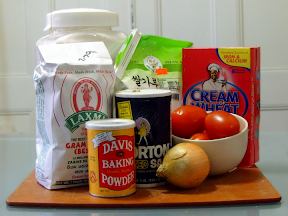
Ingredients (5 pancakes)
1/2 cup garam flour
1 cup plus 2 tbsp rice flour
1.75 cups water
1 tbsp cream of wheat
1 tbsp all purpose flour
1/8 tsp baking powder
1.5 tsp salt
1 large onion
3 plum tomtatoes
vegetable oil

Procedure
Start preparing the batter at lunch time the day before. Whisk together garam flour, rice flour, and water until the batter is smooth. Cover and set in a warm place until evening. If no warm place is available use your oven. Heat the oven to 200F, turn it off, and then place bowl inside. Check the oven periodically and re-warm as needed.
Before going to bed add cream of wheat and all purpose flour. Mix thoroughly and leave covered at room temperature overnight. The batter will develop a yogurt-like smell.
Chop onions and tomatoes and combine.
Stir in baking powder and salt. The batter should resemble pancake batter.
Heat frying pan to a temperature appropriate for cooking pancakes. Add 1 tsp of oil to the pan and coat the bottom.
Pour 1/2 cup of batter in the pan. Immediately add 2/3 cup of the tomato and onion mix pressing the mix into the batter. Once the bottom is golden sprinkle 1 tsp of oil over the vegetables and flip. Cook until batter is done. Place in warm oven until you are ready to eat. Repeat until you run out of batter.


Results and Discussion
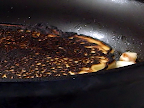
This recipe is a nice variation on pancakes. The texture is less spongy and the onions and tomatoes add some sweetness and bite. We made a simple chutney as a topping and it was a nice addition. Clearly the lead time in preparing the batter requires you to plan ahead so they are not as casual an endeavor as pancakes. As with pancakes it is a good idea to make a small test pancake when starting to ensure the pan is the right temperature. An illustration of what happens when do not test the pan is the center image.