Showing posts with label cereal. Show all posts

Sunday, September 11, 2011

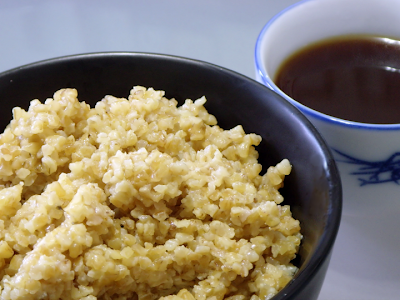
Malawi - Nshima and Tea


Background
Malawi is one of the poorest countries in southern Africa. The economy is largely agricultural and the population rural. The major crops are corn, tea, sugarcane, and sorghum. It was colonized by the British in the late 1800s and was known as Nyasaland until it gained independence in the 1960s. The country is also where Stanley presumed to find Dr. Livingston
My search for books on Malawi led me to two books in the Schlesinger Library, the The Malawi Cookbook and Nyasaland Cookery Book and Household Guide. Both books were written for missionaries and other foreigners living in the country. The Malawi Cookbook gives mostly recipes, and the Nyasaland Cookery Book also provides information about how to preserve foods, hire household staff, and avoid dangerous local insects. Neither book provided must information about what is eaten when, but the World Cookbook for Students gave us context.
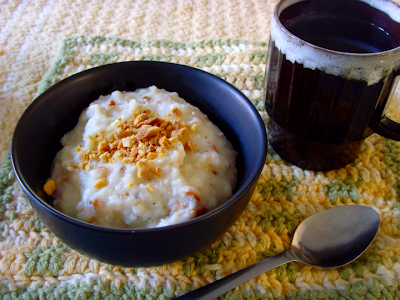
Nshima is a thick white cornmeal porridge that is a staple of the cuisine. For breakfast they eat a more dilute version of nshima flavored with peanuts and butter (we decided it needed a bit of sugar and imagine we are not the first to add some). I give a recipe for roasting your own peanuts below, since this is the primary flavor, the extra time is worth it.
Tea is a major export of Malawi, and single-estate Malawi teas can be purchased from Upton Tea Imports.  We bought a sample of Mboma Estate BOP.

Roasted Peanuts
  1. Pre-heat the oven to 350°F
  2. Spread the peanuts over an edged cookie sheet.
  3. Roast the nuts for 15 to 20 minutes until they are of the desired darkness. The color change doesn't really start until 15 minutes in.
  4. Let the peanuts cool and set aside until use. They will last several weeks on the shelf after roasting.
Nshima
  • 1 cup ufa (white cornmeal)
  • 3 cups water
  1. Heat the water in a large sauce pan until it is lukewarm.
  2. Add ¼ cup of ufa and mix in well using a whisk to avoid lumps.
  3. Bring the water to a boil and stir in the remaining ufa avoiding lumps.
  4. Mix in some of the chopped peanuts and butter to taste.
  5. Garnish with chopped nuts and add sugar as desired.

Results and Discussion
Use a larger pan than you think will be required for the nshima, as the mixture starts to foam as it boils. I would also maybe start with an additional cup of water to get a more dilute porridge. I think our result was stiffer than the usual breakfast meal. I started with too small a pot and I was not able to dilute to the desired thickness.
It is very important to use a whisk and remove lumps from the porridge as an uncooked lump is a bit unpalatable.
Again, most of the flavor comes from the roasted peanuts, so I would make sure to get a really nice dark roast on them. A little bit of sugar enhances the taste a bit.
The tea had a simple, homey, classic tea taste. Kitty thought it was rather like Lipton yellow-box tea, only much better.

Sunday, August 14, 2011

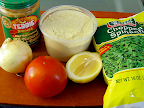
Burkina Faso - Lemon Porridge with Peanut Sauce


Background
Burkina Faso is a landlocked country in West Africa with a predominantly agricultural economy. According to the World Cookbook for Students, the major foodstuffs are maize, sorghum, and millet, with chilies and peppers used as condiments. Meals are eaten in the morning and upon returning from work. Three meals a day is more common for wealthier families.
For breakfast we chose millet porridge flavored with lemon juice, from the World Cookbook for Students. The lemon juice substitutes for fermenting the millet flour, a process we have done before for corn-based porridges. The porridge is then cooled, sliced and topped with a thick sauce made of spinach and peanut butter, from the Holidays of the World Cookbook for Students.
Millet is a form of grass but it does not fit nicely into a single scientific grouping. Rather it is a functional category of crops made up of small seeded grains which are usually grown in drought-prone areas.

Lemon Porridge
  • 2 cups millet flour (may substitute fine white cornmeal)
  • 4 cups cold water
  • Juice of 1 lemon
  • 1 cup water, for cooking
  1. Mix the flour into the cold water using a whisk.
  2. Add the lemon juice and let the batter stand for 15 minutes.
  3. Bring the other cup of water to a boil.
  4. Stir in the batter using a wooden spoon, continuing to stir the porridge until it is smooth, thick, and stiff.
  5. Pour the porridge into a greased mold or loaf pan and let it rest for 30 minutes.

Africans Greens in Peanut Sauce
  • 1 tbsp vegetable oil
  • 1 onion, finely chopped
  • 1 green pepper, seeded and finely chopped
  • 1 tomato, finely chopped
  • 1 lb frozen spinach, thawed.
  • ¼ cup peanut butter
  • Salt and pepper to taste
  1. Heat oil in a saucepan over medium-high heat.
  2. Add peppers and onions, and cook until onions are soft.
  3. Add spinach and tomato, and cook until spinach is wilted (or heated through if frozen).
  4. Stir in peanut butter and serve.

Results and Discussion
The porridge had a strong lemon flavor. While fermenting gives a subtle sour taste that lingers in the background, the lemon juice brings the flavor to the front and dominates the dish. It is not necessarily a bad result, but it is a poor substitute for the flavor that comes form the fermentation process.
The peanut sauce had a nice flavor and its coarser texture goes well with the smoother porridge. The Holidays of the World Cookbook suggests serving it over rice which would make a nice lunch or dinner meal.

Sunday, June 5, 2011

Madagascar - Mofo Gasy


Background
It is very appropriate that we follow Australia with Madagascar. Both islands are famous for having broken off from major landmasses and developing very unique fauna. Madagascar broke off from India around 80 million years ago, and did not see humans until around 2500 years ago. The first human settlers came from Borneo, which is not where one would suspect. Starting around 1000 years ago they were joined by African migrants, and even later by a wide variety of Asians and Europeans. The greatest of the European influencers were the French, who made it part of their empire in the late 19th century.
My first knowledge of Malagasy cuisine came from colleagues who had worked there collecting ants. The heart of the cuisine is rice. My sources tell me it didn't matter good a meal was, no one they worked with felt right until they had eaten rice. It then comes as no surprise the Malagasy eat the most rice per capita in the world.
I was unable to obtain a book on Malagasy cuisine, but the internet has some good resources, and searching in French gave even better results. The first option was a dish made of dried beef, cut into strips, broiled over coals, and served with a corn meal mush called kitoza. I also found the blog of an Iraqi going to school on the island, which mentioned a fritter called bemiraymofo. I could find no other mention of this dish anywhere. We decided to make a rice fritter called mofo gasy (pronounced muf gas). We got our recipe from lemurbaby on YouTube who demonstrates many Malagasy recipes.
The next challenge came in locating the correct pan. On Madagascar they have special aluminum molds. The recipe recommends using a Danish pan meant for cooking æbleskiver. These pans are very expensive and specialized, so we asked around for friends who might have one. A friend's Danish neighbor came through and we were in business.

Mofo Gasy (around 15 mofo gasy)
Yeast Starter Mix
  • ½ tsp yeast
  • ¼ cup hot water (100°C-110°C)
  • ½ tsp sugar
  1. Mix the above in a small bowl.
  2. Let it rest for around 5 minutes as the yeast activates.

Batter Mixture
  • ½ cup flour
  • ¼ cup + 2 tbsp rice semolina (Cream of Rice)
  • 4 tsp sugar
  • 9 tbsp (130 ml) hot water (100°C-110°C)
  • 1/8 tsp vanilla extract (optional)
  • 1½ tsp sweetened condensed milk (optional)
  • 1½ tsp honey (optional)
  1. Mix the ingredients above in bowl.
  2. Mix in the yeast starter and place in a warm place for 4-8 hours.
  3. Heat your æbleskiver pan over medium heat and put a small quantity of oil in each well. Coat the sides of the wells with the oil, unless using a nonstick pan.
  4. Stir the batter.
  5. Quickly fill each well of the pan with the batter to just below the lip of each well.
  6. Let the batter cook for about a minute.
  7. Flip the cakes using thin implements such as chopsticks. (See the video at the end of this section for a visual of the technique.)
  8. Reduce the heat to medium low, cover and steam for 2 minutes.
  9. Remove mofo gasy from the pan.
  10. Eat with sweet chai tea or sweet coffee.


Results and Discussion
It will definitely take several more attempts before I get the hang of making these. I would also buy a non-stick pan if I were starting from scratch. The cast iron pan we had worked great but we a little bit of sticking. I made the mistake of filling a couple too high on the second batch and ruined a great photo of golden brown ones. I will err on the side of under-filling the wells in the future. When you flip them, any liquid batter will run, so you need to find a balance of temperature that solidifies the batter at the top of the well without burning the mofo gasy.
The outsides of the mofo gasy are slightly crisp and the insides are like thick hot cereal. They have a slightly sweet taste and a little bit of a sour smell. The texture is puffy and slightly chewy. We think you could pretty easily adapt this recipe to make it work for a wide variety of grains instead of just rice.

Monday, May 16, 2011

Mozambique - Maguinha


Background
Mozambique is located on the southeast coast of Africa. It was colonized by the Portuguese in the early 1500s, and did not gain independence until 1975. The economy is mostly agrarian, and Mozambique is one of the poorest nations in Africa. Portuguese colonization left a deep impact on the cuisine including the introduction of many new world grains.
The initial search for information gave very vague results. The best I could find was a sweet bread or fish/egg sandwiches. Attempts to find books on the cuisine gave no results. Kitty had the idea to start looking for information in Portuguese. Kitty found some blogs in Portuguese that talk about cassava porridge, and she found a cookbook, Hoje Temos, which we actually found in a local library. (Thanks, Google Translate! –Kitty)
The cassava porridge is called maguinha and is served with milk and brown sugar.

Maguinha
  • 125g cassava flour.
  • ½ liter boiling water in a kettle
  1. Add ½ cup of boiling water to a small sauce pan.
  2. Stir in half the cassava flour.
  3. Add more water as needed.
  4. Add the remaining cassava flour and add more water if needed. You want a very think consistency.
  5. Serve in a bowl with some milk and brown sugar.

Results and Discussion
This breakfast was very functional. It gives you calories to get through the day. The cassava has a solid consistency and slightly jelly like texture. The cassava alone is pretty bland by itself, so the sugar and milk give the dish its taste.

Monday, May 2, 2011

Romania - Mamaliga and Goat's Milk


Background
Romanian cuisine is typical of eastern Europe with notable outside influences from the Ottoman empire. I quickly found a report on the subject of Romanian breakfast online from an environmental sustainability program in the European Union. The first breakfast mentioned is mamaliga as it is eaten by a character in Bram Stoker's Dracula on his way to be the Count's breakfast. Mamaliga is Romanian polenta. Balmos is mamaliga made with sheep's milk. Another interesting dish is called slanina. It is made of pork fat from the back or belly. The fat is sliced and pickled in salt liquor with garlic for 2-3 weeks. The fat is then smoked for 2-3 days. I am unable to to smoke for several days and I was unable to determine what salt liquor is.
I really wanted to make balmos, so I tried to get some sheep's milk. I was able to locate a Greek grocery store that makes its own sheep's milk yogurt. Unfortunately they are not allowed to sell me the raw milk and getting to New Hampshire for fresh milk was not viable. This left us with mamaliga.

Mamaliga is a staple in Romania so a wide variety of recipes exist. The two basic forms for breakfast can be broken into the categories porridge and cornbread. The cornbread variety comes in two basic forms. The first variety involves cooking the cornmeal mixture on the stove and then transferring it to a baking dish for baking. The second option involves cooking it longer on the stove and then turning the cornmeal out onto a cutting board and slice it using string. The porridge variety is made using various ratios of milk and water. Our source gave a porridge recipe so we are going with a porridge.
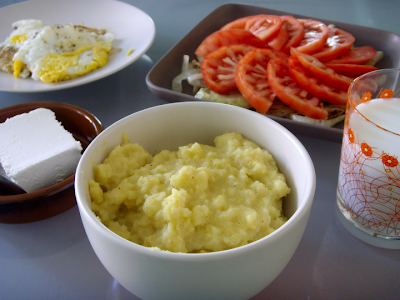
The mamaliga is served with farmer's cheese, lightly fried onion, sliced tomatoes, and fried eggs. Goat's milk is the beverage of choice so I get some variety of exotic milk.

Mamaliga cu lapte
  • 1 qt water
  • 2 tsp salt
  • 2 cups cornmeal
  1. Boil water and salt in a pot of water.
  2. Whisk in the cornmeal and mix thoroughly.
  3. Simmer for 10-15 minutes.
  4. Serve with sides mentioned above.
Results and Discussion
Mamaliga is pretty much polenta. The texture was not as porridge-like as I thought it would be. Less cornmeal is probably the solution to this. It was a little salty, but not too salty when served with other toppings; it is a nice base for the other flavors. The cheese was especially good because of the contrast of temperature and texture.
The goat's milk was very tasty. It has a subtle creaminess that is a bit richer than whole milk. (Meh. Tastes like milk, except milkier. Not a fan. –Kitty) I now need to find a use for the rest of it; I plan on making pancakes with some of it and probably just drinking the rest.

Sunday, January 16, 2011

Uganda - Ugali and Chapati


Background
Ugandan cuisine has an East African base, modified by the influence of the conquering Arabs and English. The biggest influence the English brought to our breakfast was really Indian influence. I always had a scope of the British Empire in my mind but I never realized how much influence the Indian citizens of the Empire had as they migrated out.
The biggest problem searching for information on Ugandan breakfast is that President Obama made an appearance at a prayer breakfast about Uganda's proposed anti-homosexual laws. This made it impossible to search by "Ugandan breakfast" and we had to get more creative with our query.
We found that Ugandan breakfast consists of ugali and chapati. It is basically the same as Tanzania. I was unable to find a Ugandan cookbook so I used online resources to try and find recipes specific to Uganda. The ugali recipe can be found here and the chapati recipe we used is here. The chapati recipe is a little free form our more detailed interpretation is follows.

Chapati
  • 2 cups flour
  • 1 tsp salt
  • 2 cloves garlic, minced
  • 1/4 red onion, finely diced
  • 1/2 cup warm water
  • oil for frying
  1. Mix dry ingredients, onion, and garlic in a bowl.
  2. Slowly add the warm water (I would start with 1/4 cup) and mix it into a doughy consistency.
  3. Add more water as needed—the onions and garlic are going to contribute some moisture to the dough, so add the water slowly.
  4. Knead until you have a tough doughy consistency.
  5. Let the dough rest for 30 minutes.
  6. Break the dough into tangerine-sized balls, then roll the dough into pancakes 6 inches in diameter. (Put flour in between the chapatis when stacking them to prevent sticking.)
  7. Heat a frying pan and spray a thin layer of oil into the pan.
  8. Fry one side of the chapati until it starts to brown, then apply oil to the uncooked side of the chapati, flip it, and cook the other side.
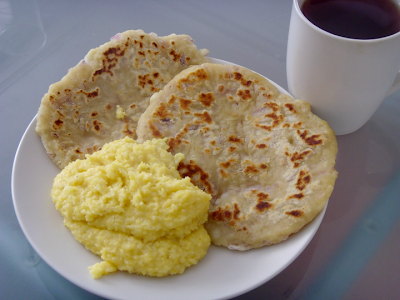
Serve with the ugali on top of the chapati

Results and Discussion
This breakfast was very filling and pretty easy. The only really involved part was constantly stirring the ugali while it cooked. I am not a big fan of ugali. The first taste is really nice; it has a good salty taste and is a little creamy. As I eat more of it it just becomes bland and thick. For Tanzania I thought it might have been undercooked, but I know that was not the case here. Ugali is food for quick energy and not for taste.
The chapatis were very dense and chewy. The red onion and garlic were nice additions and added some subtle flavors. I would like to try it cooking the onions and garlic prior to putting them in to the dough to enhance this.

Sunday, November 21, 2010

Tanzania - Ugali and Chapati


Background
Tanzania was founded in 1964 when the states of Tanganyika and Zanzibar merged. Zanzibar consisted of two islands off the eastern coast and Tanganyika was on the mainland. Zanzibar has a history as a trading port which gave it contact with cultures from all over the Indian Ocean. Its major assets were spices and slaves. Zanzibar's cuisine is based around rice, and coconut and seems very similar to Indian food. The mainland diet is based around bean, cassava, and corn which is closer to its neighbors.
I was surprised when I came across Tanzania Traditional Cookery in the library. It is basically a pamphlet bound in card-stock. The pages are inconsistently photocopied and the table of contents is only a rough guide on where to find the recipes. It also provided an entire section of breakfast food. Upon further examination all of the meals were listed under breakfast. This made me doubt the credibility of the categories given.
The second book we found was Tanzania Cookbook which had a far more credible table of contents. It fails to provide any information about when the dishes are usually served or the cultural heritage of the dishes. What makes this even stranger is that the blurb on the back of the book says that the book is for educational purposes. One of the major annoyances I have encountered in this project is books that purport to extol the virtues of a country's cuisine but give no cultural context about the dishes.
Given the absence of contextual and cultural information I went to the Internet. The Tanzanian Embassy webpage provided us with contextual information and a list of breakfast dishes. Once we had a list of dishes the cookbooks became useful.
We decided to go with ugali and chapatis served with chai tea. Ugali is a corn porridge that was compared to polenta in many recipes that I read. The chapatis use coconut milk which is different from past recipes.

Coconut Chapatis
  • 8 oz flour
  • ½ cup coconut milk
  • 1½ oz ghee or oil
  • ¼ tsp salt
  1. Mix flour and salt in a bowl.
  2. Add coconut milk and mix until it is doughy. Slowly add more coconut milk if required.
  3. Add ½ tablespoon of ghee to the dough and knead until it is smooth.
  4. Divide the dough into 6 evenly sized balls.
  5. Roll out a ball into a large flat circle.
  6. Cover circle with ½ tsp of ghee/oil.
  7. Make a slit along the radius of the dough and roll it into a cone.
  8. Seal the edges of the cone and squash it flat.
  9. Let them rest for 20 minutes.
  10. Heat a non-stick pan.
  11. Roll out the dough flat until it is about 1//8 of an inch thick.
  12. Melt some ghee in the pan put the flattened dough into the heated pan.
  13. As the uncooked side starts to puff spread some ghee and flip it.

Ugali
  • 120 g fine corn meal
  • ½ cup milk
  • ½ cup water
  • ½ tbsp butter (optional)
  • salt (optional)
  1. Make a paste with the corn meal and milk.
  2. Bring the water to a boil, add the butter and salt.
  3. Stir in paste and then add the remaining maize flour.
  4. Continue to stir until it becomes stiff.
  5. Serve on top of warm chapatis.

Results and Discussion
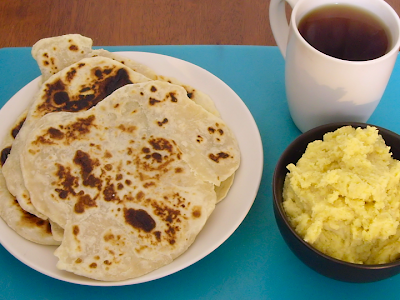
The coconut milk in the chapatis gave the dough a much softer texture than previous recipes we had used. The layering technique used in making them gave them a flaky texture and the oil kept them very soft.
The ugali was very simple and a little bland. We also think it might have been under done. We halved the recipe from the one given in the cookbook and quantity of water and milk may have been too small to properly cook it. Another problem might have been our choice of corn meal. The recipe called for maize flour which according to my research is corn meal. Many recipes for ugali compare it to polenta for its texture. Fine corn flour may be too fine for our needs and using polenta might be a better substitute in the future.

Sunday, October 31, 2010

Ukraine - Kasha Porridge


Background
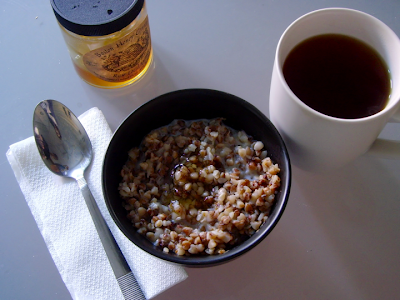
We had lots of good resources for Ukrainian cuisine. The first source was a friend who grew up in the Ukraine (and also introduced the two of us). She recommended buckwheat kasha porridge and a blintz as very traditional.

With our meal set up, I went looking for recipes. Ukrainian cookbooks were very easy to find. We got Please to the Table, which we used for Russia. It had no recipe for kasha porridge. Next we checked out The Best of Ukrainian Cuisine and also found no porridge recipe. The next book I found was Ukrainian Cuisine and this one was very interesting. First it was from Julia Child's cookbook collection which is pretty cool. The book itself was written in the USSR in the 1970s and translated a couple of years later. I am not sure if it is the translation or the actual tone of the book but this was easily the most authoritarian cookbook I have ever read. It spent a great deal of time focusing on how to space your meal throughout the day, declaring how many canned products are more readily available than in the past and frequently citing the works of Pavlov on appetite stimulation. Here are some quotes from the book: “regular meals at fixed times establish a proper pattern of reflexes” and “to arouse the appetite and ensure that meal are thoroughly enjoyed the important thing is eating at regular hours.” This book contained no kasha porridge recipes either, but it had lots of uses for tripe and lungs if you are looking for recipes.

Please to the Table provides some wonderful context about the importance of kasha in eastern Europe. Six hundred years ago kasha simply meant feast. It has a place in rituals such as funerals and weddings. The book also lists many different expressions involving kasha such as “he's got kasha in his head” (he's mixed up) and “you can't make kasha with him” (you will get nowhere with him).
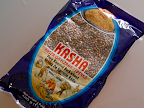
We bought our kasha from the Russian Village market, which according to the internet is actually owned by a Ukrainian.  The brand pictured has English directions on the packet, which we followed—the recipe apparently too simple to merit inclusion in cookbooks. We also had a very nice Russian tea blend from the same shop.

Basic Kasha Porridge
  • 1 cup kasha
  • 2 cups water
  • 1 tsp salt
  1. Combine all ingredients in a sauce pan and bring to a boil.
  2. Simmer for 15 to 20 minutes, stirring occasionally, adding add more water if needed.
  3. Serve with milk and sweetener in amounts of your preference.

Results and Discussion
This breakfast was very simple in every sense. The dish that it seems most appropriate to compare this one to is oatmeal (actually I think it's more like Wheatena –Kitty). The roasted seeds give a subtle smokey flavor. The kasha also feels much more substantive as you chew it and it gives resistance to your bite than oatmeal.

Sunday, October 3, 2010

South Africa - Maize Porridge with Fruit Compote


Background
South Africa is a very diverse country, and it cuisine reflects this. In addition to the numerous tribes that go back to the origins of humans, one also finds the influence of Dutch colonists, exiled French Huguenots, the British, Indians, and Malaysians. (I was unaware of the Malaysian influence prior to doing this research. They were brought as slave labor by the Dutch in the 17th century and have maintained a distinct tradition.)
Reflecting this diversity we had a large number of distinct options. The option we found first and most often is basically the full English breakfast with a regional sausage called Boerevors. Since we had recently had a full English breakfast we decided to do a little more exploring.
This sent us on a quest to find some good cookbooks. The first book were found was South African Indigenous Foods, which is a collection of recipes collected from across the country to help people make better use of local food resources. It is not very descriptive in terms of background or uses because it is written for natives. It is probably the most rawly authentic cookbook we have found so far in our project.
The books that provided our background were Rainbow Cuisine and A Taste of South Africa. A Taste of South Africa was very authentic calling for ostrich, sorghum, and springbok (a species of gazelle). Rainbow Cuisine provided the most detailed over view of breakfast and the recipes we used.
Given the broad diversity, it was difficult to find a definitively South African breakfast. We decided to sample from both the African and European influences in the cuisine, and chose to make a dried fruit compote and a maize-meal porridge.


Compote of Dried Fruit
  • 250 ml fresh squeezed orange juice, about 4 navel oranges
  • 125 g of dried fruit
  • juice and zest of ¼ lemon
  • ¾ tsp brown sugar
  • ½ cinnamon stick
  • 1 whole clove
  1. Combine all ingredients in a sauce pan.
  2. Cover and simmer for 5 minutes.
  3. Remove from heat and leave it alone for several hours while the fruit absorbs the juice.
  4. Chill in the refrigerator until ready to serve (keeps up to 5 days).

Maize Porridge
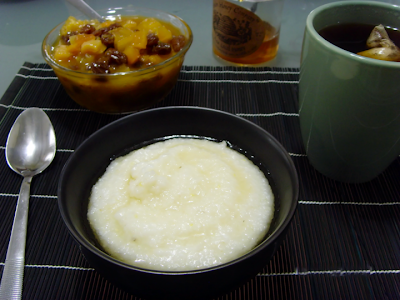
The maize meal used in South Africa is a white meal, and the easiest equivalent found is hominy grits.
  • 375 ml water
  • 125 ml hominy grits
  • ¼ tsp salt
  • ½ tbsp butter
  1. Mix grits, 125 ml water, and salt.
  2. Boil the rest of the water.
  3. Gradually stir in the grits-water mixture.
  4. Reduce the heat and simmer for 15 minutes.
  5. Mix in the butter.
  6. Serve with milk and honey.
Results and Discussion
This breakfast was simple and nice. The fruit compote is nicely sweet and smooth. It provided a nice counter point to the texture of the warm grits. It felt a bit more like a weekday breakfast than a weekend breakfast but it was very nice and it reflected more of an African influence than European.
We will be away next week but we will provide a history of the Schlesinger Library which frequently provides cookbooks for our more obscure countries.

Sunday, June 27, 2010

Ethiopia - Qinch'e


Background
We were fortunate to find the very comprehensive Exotic Ethiopian Cooking by D.J. Mesfin, which had an entire section dedicated to breakfast. This book gave us several options, such as genfo, which is a porridge made with barley or wheat flour. Genfo frequently came up when we searched online and is probably the best known breakfast meal. But we decided against making this because we were afraid we would end up with glue if we messed it up.
We chose instead to make qinch'e (kinche), which is a cracked wheat porridge with spiced butter.  We had to substitute bulgur wheat for cracked wheat, as we were unable to find it, and one store manager told me that it was no longer available(!). Bulgur wheat is an appropriate substitute, since the only difference between the two is that bulgur wheat is steamed and toasted prior to the cracking.  This also makes it cook faster!
The flavor of the qinch'e came from the nit'ir qibe, which is a spiced butter. The recipe in the book is for twelve pounds of butter, and they ask you clarify the butter before you flavor it. We had about four ounces of ghee on hand, so we started with that and scaled down the spices.

Nit'ir Qibe (Micro Batch)
  • 4 oz of ghee (clarified butter)
  • 1 tbsp minced ginger
  • 1 small clove of garlic, chopped
  • 1 small shallot, chopped
  • 1/4 tsp fenugreek seeds
  • 1/4 tsp cumin seeds
  • 1/4 tsp oregano
  • 2 small cardamom pods
  • dash of turmeric
  1. Melt ghee at low heat.
  2. Add all the remaining ingredients and cook at low heat for 15 minutes, stirring frequently.
  3. Strain the nit'ir qibe before using or storing.
Qinch'e
  • 1 cup milk
  • 1/2 cup water
  • pinch salt
  • 1 cup bulgur wheat
  • 4 oz nit'ir qibe
  1. Bring the water, milk, and salt to a boil, stirring to ensure they do not separate.
  2. Add bulgur wheat and strained nit'ir qibe; continue to stir frequently.
  3. The butter will separate and be on the surface at the beginning. As the wheat cooks the butter will suddenly be absorbed.
  4. Once the butter has been absorbed continue to cook the qinch'e until it reaches the desired consistency.
We also prepared coffee in the Ethiopian style. Coffee preparation in Ethiopia as an entire ceremony. The preparation method used involved boiling the coffee, which is about the exact opposite of most modern coffee experts' advice.  But the coffee turned out fine and the results were not much different than normal brewing. It would be worth trying in a drip maker to see if there is really a difference, but the boil method really isn't any more inconvenient and is more traditional.

Ethiopian-Style Coffee

  • 1 cup coffee beans (the original recipe asks you to roast your own)
  • 1/4 cinnamon stick
  • 1/4 tsp cloves
  • 28 oz water
  1. Grind the coffee and spices to a fine powder.
  2. Bring the water to a boil, add the coffee, and continue to boil for five minutes.
  3. Strain coffee, and serve in small cups (such as Chinese teacups or demitasse cups).
Results and Discussion
This breakfast was very successful. The most complicated part was making the nit'ir qibe, which could easily be made in large quantities beforehand. It should be noted that making good nit'ir qibe is vital to this dish since it is most of the flavor. In our case it was a nice subtle flavor that was a little cheesy and buttery.

Saturday, May 15, 2010

Nigeria - Gari Foto


Background
This recipe from the cookbook A Taste of Africa by Dorinda Hafner. It is an excellent book that provides a survey of the major cuisines of Africa. Unfortunately Kitty was unable to find a good cookbook at our local libraries; I found this one in a university library that does not let you check out books. It seems to be out of print but a few copies are available on Amazon.com.

The major ingredient in the dish is foto which is a staple in West Africa. This dish is eaten for breakfast or as a side dish in a dinner. Foto is a coarse cassava powder, which we found in the Brazilian section of a regular supermarket labeled coarse manioc flour. (This product goes under many names.) We also made some fried plantains.

Ingredients
  • 1 cup of foto
  • 1 tsp salt, dissolved in 2 cups of water
  • 1/4 cup vegetable oil
  • 2 medium onions
  • 2 red chilis
  • 1 (15 oz) can of diced tomatoes, drained
  • 1/4 cup water
  • 1/2 tbsp tomato paste
  • 1 egg, scrambled in a little oil
  • lettuce leaves
  • sliced fresh tomatoes
Procedure
  1. Soak the foto in the salted water for 10 to 15 minutes. You may need more or less liquid depending on the humidity.
  2. Finely chop the onions and chilies.
  3. Heat oil in a deep saute pan and cook the onions and chilies until the onions begin to brown.
  4. Add the diced tomatoes and cook for 2 minutes.
  5. Add the tomato paste, 1/4 cup water, salt and pepper to taste and stir constantly for 4-5 minutes.
  6. Fluff the foto, then add to the pan, along with the egg, and mix.
  7. Serve on lettuce leaves garnished with sliced tomatoes.
Fried Plantain
  • Peel and slice one plantain.
  • Fill a pot with enough oil such that the plantains will not touch the bottom.
  • Heat the oil.
  • Put plantain slices into the oil and cook until the are golden.
  • Remove from oil and place on paper towel to drain.


Results and Discussion
This breakfast was a great success. The foto has a very thick texture that makes it easy to eat with your hands. The tomatoes provide a nice sweetness and the chilies add a nice spice. The plantains are simple to make and have a very nice texture. Despite have many ingredients going at once this dish is very simple and fast. I think we will encounter foto again as we revisit west Africa and I look forward to the many variations.

Sunday, May 9, 2010

Bangladesh - Luchi, Aloor Dum, and Soojir Halvah


Honestly, I did not think we were going to have so much trouble with cookbooks this early in! But this is week three where neither the local library or the BPL were any help to us. I suppose this is inevitable given how recently Americans started eating even westernized Indian food, but still, it's cramping our style.

Anyway, we were further complicated by a scarcity of Bangladeshi recipes online. In the end, we have decided to cheat a bit and use some Indian Bengali recipes.  This isn't a perfect solution; my limited research says that there is plenty of diversity in Bengali cuisine, plus what divergence has occurred since partition, but given the lack of proper source material, we must call it close enough to our basic purpose of eating a lot of things that are not french toast.

Menu
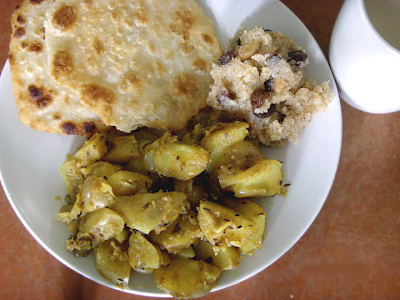
  • Aloor Dum (Spicy Potato Curry) - We cut these into smaller cubes as I was Ready To Eat before we even started cooking.  This got them cooked in about twenty minutes as we were preparing the other two dishes.  I think we used too much potato for the spices called for, but all in all very good and rather different from our breakfast potatoes last week.
  • Luchi (Deep-fried Flatbread) - My husband is becoming an expert in fry breads. :)  They do not look as pretty and white as they are supposed to; this is because we are still too scared to deep-fry our bread for breakfast!  But shallow-fried they are still rich and flaky.
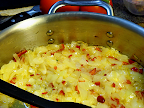
  • Soojir Halvah (Semolina Pudding) - This was definitely the star of the show!  I could eat this every day.  Very easy to put together too.  I used one cup of water where the recipe did not specify and it turned out beautifully.  I should like to try these with cranberries and pecans in the fall.

Today's recipes are by Jayashree Mandal of Spice and Curry, who we sincerely hope does not mind our culinary border-crossing here.  For our part, after tasting her Soojir Halvah, we have lost any frustration we had this week!