Showing posts with label fruit. Show all posts

Sunday, July 10, 2011

Chile - Chirimoya Alegre, Jam & Manjar Blanco on Toast


Background
Breakfast in Chile is very low key and continental. Every description we read online said it was bread, jam, and coffee. Kitty found that a usual spread is manjar blanco. It is very like dulce de leche, a type of milk caramel very popular in Latin America. I also found a recipe in The South American Table for cherimoya marinated in orange juice and rum, which the author notes is served every day when the fruit is in season.
Cherimoya is native to the Chilean highlands and can grow in colder temperatures. It belongs to the family Annonceae which includes flowering plant shrubs and trees with a mostly tropical distribution. It was domesticated around 1000 BC and has seven varieties under cultivation.

Chirimoya Alegre
  • 2 ripe but firm cherimoyas
  • Juice of 1 lemon
  • ½ cup fresh-squeezed orange juice
  • Sugar to taste (optional)
  • 2 tbsp rum (optional)
  1. Slice the cherimoyas in half, and scrape the flesh from the inside of the skin.
  2. Pick the out the large black seeds and cut the flesh into tiny pieces. (The act of picking out the seeds takes care of a lot of the shredding process.)
  3. Mix in the lemon juice, then add the orange juice, and sugar and rum to taste.
  4. Marinate until chilled and serve.

Results and Discussion
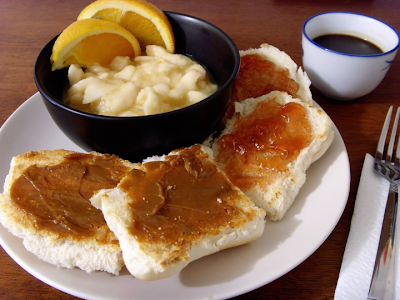
There did not seem to be much consensus on the type of jam, so we chose guava since they are also grown in Chile. But the jam was greatly overshadowed by the manjar. Though we had only dulce de leche available; from varying descriptions it is either a good substitute or exactly the same (our jar in fact had "manjar" amongst the various descriptions on the label). Either way the stuff is pure caramel goodness and delicious on toast. Our can of La Lechera brand dulce de leche also had a great recipe on the back for a flan-like desert.
The cherimoya was nice. Before we marinated it had a pulpy texture and it was slightly sweet. It also had a slight lemon flavor and a bit of a coconut aroma. But the marinade's flavor over powered the cherimoya. We had prepared it the night before and left it in the fridge until morning, which seems to be much too long. Some research into other recipes suggest a marinade time of around 2 hours. I will definitely try playing with this fruit in the future or just eat it plain. (Not so much, I don't think, they're about $5 apiece at Market Basket! –Kitty)

Monday, May 9, 2011

Syria - Ca'ak and String Cheese


Background
Syria's strategic location in the Middle East made it a prime annexation target for numerous empires. In recent times this has been part of the Ottoman Empire, and then under French control until its independence after World War II. Syria is a predominantly Muslim country.
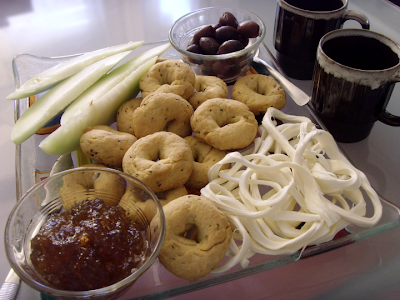
Wikipedia's article on Syrian cuisine simply notes that appetizers are eaten for breakfast, leaving a wide variety of options. A Taste of Syria focused our choices with a chapter on breakfast and by specializing on the cuisine of Aleppo, a city in the northwest of Syria near the Turkish border. The authors provide several menus. One option is sliced cucumber, lebaneh dip, cheese, olives and pita. Lebaneh is a yogurt mixed with dried mint and garnished with olive oil. Another menu is mamuneh'ya with cheese and pita. Mamuneh'ya is semolina porridge flavored with cinnamon. We chose to go with ca'ak served with Syrian cheese, fig jam, and honeydew melon. Ah'weh turkieh is Turkish coffee heavily sweetened with sugar.
The exotic ingredients for this meal are mahlab and semolina. Mahlab are black cherry pits. Semolina is the particles of wheat bran from durum wheat. It is also the only tetraploid wheat variety that is in broad use.
Syrian cheese is a string cheese is flavored with mahlab and caraway seeds. The cheese is made using goat or sheep's milk. It is often labeled "Armenian string cheese" in markets. It can be made at home but only in large quantities, so we bought it. The Armenian store we went to in Watertown was closed on Sunday, but fortunately we had the halal Al-Hoda Market near our house for the cheese and semolina.

Ca'ak
We reduced our recipe by 1/3 and got about 18 pieces. The full recipe is given below and the book estimates a yield of around 8 dozen.
  • 1 packet yeast
  • 1¼ cups warm water
  • 1 tsp sugar
  • 2 cups semolina
  • 3 sticks salted butter (4 oz each)
  • 1½ tsp baking powder
  • 1 tbsp mahlab (powdered)
  • 1 tbsp anise
  • 1 tbsp fennel seeds
  • ½ tbsp black caraway seeds (kalonji)
  1. Mix yeast, warm water, and sugar. Set the mixture aside.
  2. Put the remaining ingredients into a large bowl and mix.
  3. Add the yeast mixture and mix well.
  4. Cover the bowl with a cloth and keep in a warm place for 1 hour.
  5. Preheat the over to 350°F.
  6. Roll the dough into balls 1¼ inches in diameter. Start with 15 pieces and leave the rest of the dough covered to prevent drying.
  7. Roll the ball into a finger shape four inches long.
  8. Bring the ends together so they overlap and pinch them together.
  9. Places them ½ inch apart on a cookie sheet.
  10. Cook for 40 minutes until they are golden brown.
  11. When the cookies are done turn off the oven and leave the cookies in it for an hour to crisp.

Coffee
We still do not have an apparatus for making Turkish coffee. We approximated it by brewing espresso and putting 2 teaspoons of sugar at the bottom of the cup. Pour the espresso over the sugar but do not stir it in.

Results and Discussion
The smell of the baking ca'ak is amazing. It was an act of will to let them finish cooking. The final cookie is very crisp and can be crumbly. The cherry flavor from the mahlab is not very noticeable when the ca'ak are warm but they develop the next day when they cool. Ca'ak are savory and the fig jelly complements them nicely. The fennel and anise hit your palate a little after the other flavors, similar to the cumin cookies we had for Nepal.
The mahlab was a nice surprise. The whole cherry pits have absolutely no smell, but when you grind them they have a pure clean cherry smell. I have a lot of it leftover seeds and I look forward to experimenting with it as a flavoring agent in ice cream.
The Syrian cheese is a string cheese flavored with kalonji and mahlab. Eating string cheese was a lot of fun and eating really long string cheese is even better. The cheese also peeled into much thinner strings than American string cheese. It goes especially well with the olives.
The coffee was very strong and very sweet. The book warned that most Americans would find the amount of sugar Syrians put into their coffee much too strong. The authors were right. Each sip was a shock to my rather delicate system. (Yeah, I knew what was up and skipped the sugar altogether. Both or none, IMO. –Kitty)

Sunday, February 13, 2011

Saudi Arabia - Egg Kebab & Small Plates with Bread


Background
Tracking down information and recipes on Saudi Arabia was unexpectedly involved. Finding information on the actual menu was pretty easy, thanks to AmericanBedu, where we learned that breakfast consists of many little dishes eaten with bread.  They gave several good examples, but finding recipes for the dishes involved a trip through many books. Cookbooks dedicated to Saudi Arabia seem to be nonexistent; most of the emphasis is on Arab cuisine as a whole. Many of the books I encountered leaned toward Lebanon, but using several sources we were able to piece it together. We finally used three cookbooks to make the meal: Arabian Delights, The Arab Table, and the Arab World Cookbook.
One problem with the many-small-plates concept is that there are usually only two of us for breakfast, and it's very easy to end up with much too much food. In addition to the dishes we chose, our research suggested things like ful and chickpea dishes, honey and fruit preserves, which we decided to omit in order to have a reasonable quantity for two diners.
For our meal we prepared apricots in syrup, as a compromise of honey and fruit preserves, and we made egg kebab, fried hard-boiled eggs with cinnamon and white pepper.  To accompany these we had olives from the pantry, and purchased some lebna (yogurt cheese), bread, and halwa.  The halwa is a sweet eaten in many places throughout the Middle East and South Asia. Today we had halwa made from sesame seeds, but it is pretty much the same idea as the soojir (semolina) halwa we made for Bangladesh.
We had intended to make the bread ourselves, but finding a recipe turned out to be impossible. A flat bread called fatir seemed really good, but the only recipe we could find called for using frozen white bread dough. The reason they gave for this was the inability to find barley wheat in the states(??). What made this recipe even more frustrating was that it has been copied verbatim all over the Internet. As we read further we learned that a wide variety breads are served, so we decided to just pick a bread when we went shopping.
We shopped at Sevan Bakery, actually an Armenian grocery, but they had fresh bread and most of the other materials we needed. We expect to be visiting them often as we continue in the Middle East.
Our assumption going into this breakfast was that we would be drinking coffee, since coffee was discovered around Mecca. It turns out that coffee is not a breakfast drink and Saudis prefer tea instead, which is drunk from glasses.

Dried Apricots in Clove Syrup (Qamr din helw bil qurunfil)
  • 1½ cups sugar
  • 1 strip of lemon peel
  • 2 tsp fresh lemon juice
  • 11 oz dried apricots
  • 1 tsp whole cloves, in a spice bag
  • 1 cinnamon stick
  1. Mix sugar, ½ cup water, lemon peel, and lemon juice in a sauce pan.
  2. Dissolve sugar over medium heat.
  3. Add apricots, cloves, and cinnamon stick.
  4. Simmer the syrup for 5 minutes, or until apricots are plumped, and remove it from the heat.
  5. Let the mixture cool, remove cinnamon stick and cloves, and then transfer into a storage container.
Egg Kebab (Aijet Beythat)
  • ¾ tsp salt
  • ¾ tsp paprika
  • ¾ tsp white pepper
  • ¾ tsp cinnamon
  • 8 hard boiled eggs
  • 4 tbsp butter
  1. Mix the spices and set aside
  2. Peel the hard boiled eggs.
  3. Prick each egg a couple of times to release heat when frying.
  4. Melt the butter in a frying pan over low heat.
  5. Add the eggs and brown them on all sides.
  6. When the eggs are browned, dust them with the spices and serve.
To serve everything, we put the bread out on a platter with the various small plates on the side. The bread is eaten with the lebna which can then be topped with olive oil, olives, the eggs, or the apricots. The halwa is pretty much perfect all by itself.

Results and Discussion
This was a very nice and filling breakfast. It had a lot of parts, which can seem overwhelming, but in reality it was pretty simple. We chose to make the syrup and boil the eggs the night before to have them ready, which left only a little bit of preparation for the morning. The only tricky cooking was of the eggs, which presented a novel challenge: trying to evenly brown an egg-shaped object on a flat frying pan is pretty much impossible!
The spice mixture on the eggs tastes very familiar, with the salt and white pepper. The paprika reminds one of deviled eggs, but the cinnamon takes it in a really different direction. (I also realized a general problem that I have with hard boiled eggs: I typically eat them cold and I find the texture unpleasant. Heating the eggs improve the texture.)
The lebna is like a much smoother cream cheese, just a little more sour. It served as a lovely base for all of the other toppings.
Halwa is seriously amazing. The texture is very dense but crumbly. I would almost call it chalky but not in a dry way. The taste is a little hard to describe but it would go really well with chocolate. (Kitty says: it tastes like the center of a peanut butter cup, only sesame instead of peanut.) Learning how to make this is high on my priority list.
Sunday, October 3, 2010

South Africa - Maize Porridge with Fruit Compote


Background
South Africa is a very diverse country, and it cuisine reflects this. In addition to the numerous tribes that go back to the origins of humans, one also finds the influence of Dutch colonists, exiled French Huguenots, the British, Indians, and Malaysians. (I was unaware of the Malaysian influence prior to doing this research. They were brought as slave labor by the Dutch in the 17th century and have maintained a distinct tradition.)
Reflecting this diversity we had a large number of distinct options. The option we found first and most often is basically the full English breakfast with a regional sausage called Boerevors. Since we had recently had a full English breakfast we decided to do a little more exploring.
This sent us on a quest to find some good cookbooks. The first book were found was South African Indigenous Foods, which is a collection of recipes collected from across the country to help people make better use of local food resources. It is not very descriptive in terms of background or uses because it is written for natives. It is probably the most rawly authentic cookbook we have found so far in our project.
The books that provided our background were Rainbow Cuisine and A Taste of South Africa. A Taste of South Africa was very authentic calling for ostrich, sorghum, and springbok (a species of gazelle). Rainbow Cuisine provided the most detailed over view of breakfast and the recipes we used.
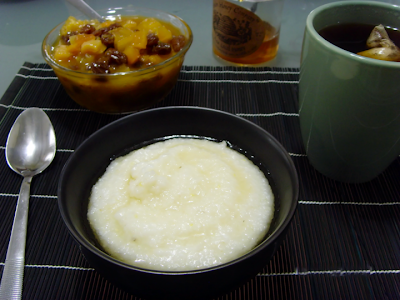
Given the broad diversity, it was difficult to find a definitively South African breakfast. We decided to sample from both the African and European influences in the cuisine, and chose to make a dried fruit compote and a maize-meal porridge.


Compote of Dried Fruit
  • 250 ml fresh squeezed orange juice, about 4 navel oranges
  • 125 g of dried fruit
  • juice and zest of ¼ lemon
  • ¾ tsp brown sugar
  • ½ cinnamon stick
  • 1 whole clove
  1. Combine all ingredients in a sauce pan.
  2. Cover and simmer for 5 minutes.
  3. Remove from heat and leave it alone for several hours while the fruit absorbs the juice.
  4. Chill in the refrigerator until ready to serve (keeps up to 5 days).

Maize Porridge
The maize meal used in South Africa is a white meal, and the easiest equivalent found is hominy grits.
  • 375 ml water
  • 125 ml hominy grits
  • ¼ tsp salt
  • ½ tbsp butter
  1. Mix grits, 125 ml water, and salt.
  2. Boil the rest of the water.
  3. Gradually stir in the grits-water mixture.
  4. Reduce the heat and simmer for 15 minutes.
  5. Mix in the butter.
  6. Serve with milk and honey.
Results and Discussion
This breakfast was simple and nice. The fruit compote is nicely sweet and smooth. It provided a nice counter point to the texture of the warm grits. It felt a bit more like a weekday breakfast than a weekend breakfast but it was very nice and it reflected more of an African influence than European.
We will be away next week but we will provide a history of the Schlesinger Library which frequently provides cookbooks for our more obscure countries.

Saturday, May 15, 2010

Nigeria - Gari Foto


Background
This recipe from the cookbook A Taste of Africa by Dorinda Hafner. It is an excellent book that provides a survey of the major cuisines of Africa. Unfortunately Kitty was unable to find a good cookbook at our local libraries; I found this one in a university library that does not let you check out books. It seems to be out of print but a few copies are available on Amazon.com.

The major ingredient in the dish is foto which is a staple in West Africa. This dish is eaten for breakfast or as a side dish in a dinner. Foto is a coarse cassava powder, which we found in the Brazilian section of a regular supermarket labeled coarse manioc flour. (This product goes under many names.) We also made some fried plantains.

Ingredients
  • 1 cup of foto
  • 1 tsp salt, dissolved in 2 cups of water
  • 1/4 cup vegetable oil
  • 2 medium onions
  • 2 red chilis
  • 1 (15 oz) can of diced tomatoes, drained
  • 1/4 cup water
  • 1/2 tbsp tomato paste
  • 1 egg, scrambled in a little oil
  • lettuce leaves
  • sliced fresh tomatoes
Procedure
  1. Soak the foto in the salted water for 10 to 15 minutes. You may need more or less liquid depending on the humidity.
  2. Finely chop the onions and chilies.
  3. Heat oil in a deep saute pan and cook the onions and chilies until the onions begin to brown.
  4. Add the diced tomatoes and cook for 2 minutes.
  5. Add the tomato paste, 1/4 cup water, salt and pepper to taste and stir constantly for 4-5 minutes.
  6. Fluff the foto, then add to the pan, along with the egg, and mix.
  7. Serve on lettuce leaves garnished with sliced tomatoes.
Fried Plantain
  • Peel and slice one plantain.
  • Fill a pot with enough oil such that the plantains will not touch the bottom.
  • Heat the oil.
  • Put plantain slices into the oil and cook until the are golden.
  • Remove from oil and place on paper towel to drain.


Results and Discussion
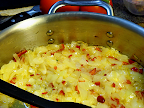
This breakfast was a great success. The foto has a very thick texture that makes it easy to eat with your hands. The tomatoes provide a nice sweetness and the chilies add a nice spice. The plantains are simple to make and have a very nice texture. Despite have many ingredients going at once this dish is very simple and fast. I think we will encounter foto again as we revisit west Africa and I look forward to the many variations.

Saturday, April 17, 2010

Brazil - Fruit, Cheese, & Ham Tray


Background
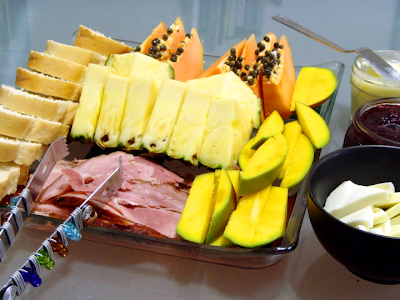
We were unable to find a cookbook that focused exclusively on Brazil. Fortunately we ran into a friend Fred Meinberg who is a native of Brazil in Harvard Square and asked him. He simply said fresh fruit, some ham, a type of farmers cheese, a french bread and some very black coffee. So we bought some fruit and already had some ham leftover from Easter.

Ingredients
1/2 of a papaya
1/4 of a pineapple sliced
1 mango sliced
1 loaf of french bread sliced
homemade butter
Queso fresco
Cooked ham
Jam

Procedure
Cut up fruit into desired sizes.
Slice ham.
Cut up bread.
Slice the cheese.
Brew coffee using the instruction on the packaging.

Results and Discussion
This breakfast was the simplest one so far. The papaya is a slightly sweeter melon but it is much more bitter towards the skin. The seeds have a somewhat peppery flavor and it is worthing eating a couple. The queso fresco is very similar in texture to mozzarella. Fred told us that it is absolutely amazing fresh but that it is very hard to find it in the states. The homemade butter was very nice on the bread and should be made the night before as it does not keep as well.