Showing posts with label pastry. Show all posts

Sunday, June 5, 2011

Madagascar - Mofo Gasy


Background
It is very appropriate that we follow Australia with Madagascar. Both islands are famous for having broken off from major landmasses and developing very unique fauna. Madagascar broke off from India around 80 million years ago, and did not see humans until around 2500 years ago. The first human settlers came from Borneo, which is not where one would suspect. Starting around 1000 years ago they were joined by African migrants, and even later by a wide variety of Asians and Europeans. The greatest of the European influencers were the French, who made it part of their empire in the late 19th century.
My first knowledge of Malagasy cuisine came from colleagues who had worked there collecting ants. The heart of the cuisine is rice. My sources tell me it didn't matter good a meal was, no one they worked with felt right until they had eaten rice. It then comes as no surprise the Malagasy eat the most rice per capita in the world.
I was unable to obtain a book on Malagasy cuisine, but the internet has some good resources, and searching in French gave even better results. The first option was a dish made of dried beef, cut into strips, broiled over coals, and served with a corn meal mush called kitoza. I also found the blog of an Iraqi going to school on the island, which mentioned a fritter called bemiraymofo. I could find no other mention of this dish anywhere. We decided to make a rice fritter called mofo gasy (pronounced muf gas). We got our recipe from lemurbaby on YouTube who demonstrates many Malagasy recipes.
The next challenge came in locating the correct pan. On Madagascar they have special aluminum molds. The recipe recommends using a Danish pan meant for cooking æbleskiver. These pans are very expensive and specialized, so we asked around for friends who might have one. A friend's Danish neighbor came through and we were in business.

Mofo Gasy (around 15 mofo gasy)
Yeast Starter Mix
  • ½ tsp yeast
  • ¼ cup hot water (100°C-110°C)
  • ½ tsp sugar
  1. Mix the above in a small bowl.
  2. Let it rest for around 5 minutes as the yeast activates.

Batter Mixture
  • ½ cup flour
  • ¼ cup + 2 tbsp rice semolina (Cream of Rice)
  • 4 tsp sugar
  • 9 tbsp (130 ml) hot water (100°C-110°C)
  • 1/8 tsp vanilla extract (optional)
  • 1½ tsp sweetened condensed milk (optional)
  • 1½ tsp honey (optional)
  1. Mix the ingredients above in bowl.
  2. Mix in the yeast starter and place in a warm place for 4-8 hours.
  3. Heat your æbleskiver pan over medium heat and put a small quantity of oil in each well. Coat the sides of the wells with the oil, unless using a nonstick pan.
  4. Stir the batter.
  5. Quickly fill each well of the pan with the batter to just below the lip of each well.
  6. Let the batter cook for about a minute.
  7. Flip the cakes using thin implements such as chopsticks. (See the video at the end of this section for a visual of the technique.)
  8. Reduce the heat to medium low, cover and steam for 2 minutes.
  9. Remove mofo gasy from the pan.
  10. Eat with sweet chai tea or sweet coffee.


Results and Discussion
It will definitely take several more attempts before I get the hang of making these. I would also buy a non-stick pan if I were starting from scratch. The cast iron pan we had worked great but we a little bit of sticking. I made the mistake of filling a couple too high on the second batch and ruined a great photo of golden brown ones. I will err on the side of under-filling the wells in the future. When you flip them, any liquid batter will run, so you need to find a balance of temperature that solidifies the batter at the top of the well without burning the mofo gasy.
The outsides of the mofo gasy are slightly crisp and the insides are like thick hot cereal. They have a slightly sweet taste and a little bit of a sour smell. The texture is puffy and slightly chewy. We think you could pretty easily adapt this recipe to make it work for a wide variety of grains instead of just rice.

Monday, December 13, 2010

Kenya - Maandazi and Chai


Background
Like most East African countries, Kenya's cuisine is a product of migrating tribes, exchange with Arab nations via the spice trade, and European colonial powers. English rule brought the influence of Indian servants.
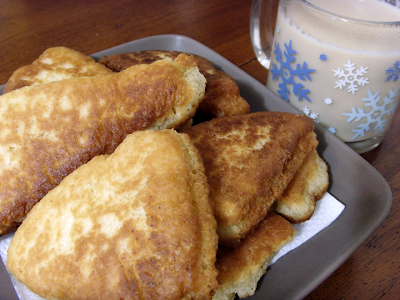
Kenyan breakfast has several major staples. The first is ugali, which we made for Tanzania (and, according to our new cookbook, is meant to be bland and take on the flavor of accompanying dishes). Another option was uji, which is a porridge made from millet. We decided to go with maandazi which is fried dough flavored with cardamom and cinnamon. They are usually accompanied by the local version of chai.
Our book for this breakfast was Foods of Kenya from the series A Taste of Culture. It is a very thin book, written for schoolchildren. It gives a succinct overview of the cuisine framed in terms of major ingredients and when they are eaten. This book does not have a lot of recipes but it includes the cultural and contextual uses of the foods in more detail. We will probably consider using children's cookbooks again in the future based on the usefulness of this little book.

Maandazi (24 pieces)
  • 2 cups flour
  • 2 tsp baking powder
  • 2/3 cup sugar
  • 1 tsp cinnamon
  • 2 cardamom seed pods, shelled and ground
  • pinch of salt
  • 1 beaten egg
  • ½ cup milk
  • 2 tbsp melted butter
  • oil
  1. Mix flour, sugar, baking powder, cinnamon, cardamom, and salt.
  2. Mix egg, milk, and butter in a separate bowl.
  3. Slowly add the wet ingredients to the flour while mixing.
  4. Knead the dough until it is smooth. Slowly add more flour if the dough is too sticky.
  5. Cover the dough in a bowl and let it rest for 30 minutes.
  6. Roll the dough out on a floured surface until it is at most ½ inch thick.
  7. Cut the dough into small triangles or squares as you desire.
  8. Heat the oil in a medium pan on medium.
  9. When the oil is hot add the dough and fry until it is golden. Then flip and cook the other side.
  10. Place of a paper towel lined plate to drain.

Chai
  • 1 cup water
  • 2 cups milk
  • 4 tsp black tea
  • 8 tsp sugar or to taste
  • 1/2 cinnamon stick
  • 2 cardamom pods
  1. Bring the water to a boil, then stir in remaining ingredients.
  2. Reduce heat to medium, and return mixture to the boil.
  3. Turn off heat and let steep to desired strength.  Strain before serving.

Results and Discussion
These were really good doughnuts—a nice crispy outside with a moist inside. The cardamom was a really good flavor. It was subtle but it added to the taste and aroma. Dipping them into the chai lets you increase the sweetness as desired.
One problem we encountered was an occasionally uncooked middle. I think this problem came from the dough being too thick. In the future I would treat the ½ inch thickness as an upper limit and go with ¼ inch in the future. Rolling the dough thinner would also give a larger yield. I think I cut the piece too large as I got only half of the anticipated 24 pastries.
The book recommends eating them hot, and as a fan of Krispy Kreme I cannot argue with this approach to the doughnut family, but these are just as tasty cold and would make a great dessert.

Sunday, November 28, 2010

Argentina - Medialunas and Yerba Mate


Background
Argentine cuisine is a blend of French, Spanish, Italian, and Andean influences. This split of European and native influences is found in the differences between the cities and rural areas.
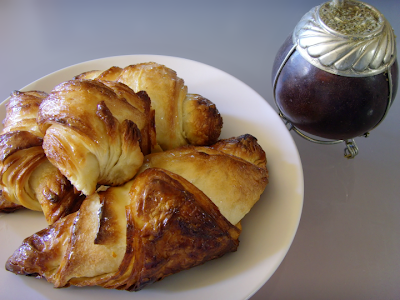
I found lots of information on Argentine cuisine is and its regional variations. All of the books basically mention breakfast as “minimal,” which I interpret as very simple. Looking online I learned that breakfast is either bread covered with dulce de leche, or medialunas, a croissant-shaped pastry. I chose to make medialunas because I wanted to try a variation on the croissant.  The drink is either cafe con leche or a tea made from the leaves of the yerba mate plant called mate. Yerba mate is traditionally served from a hollowed gourd, which we conveniently had in the apartment.

Recipe
For this weeks recipe we refer you to the blog of an American ex-patriate living in Necochea, Argentina, who did a wonderful job describing the process. I had to make a substitution for the yeast. Her recipe uses 0.9 oz of fresh yeast which expires quickly because the yeast is active when purchased. We do not bake enough to keep this on hand so I used a substitution of 1½ packages of active dry yeast. Another issue created by this substitution is the need of warm water to activate the yeast. I heated up the milk used in the recipe to serve this purpose. We also chose to put the vanilla extract in the glaze and not in the dough.

Yerba Mate Video


Results and Discussion
The medialunas came out great despite some reservations about the dough I will discuss later. They smelled fantastic while baking and bled butter as they puffed and browned. The vanilla sugar glaze added a nice texture and sweetness. While they were flaky on the outside, the inside felt meatier and solid—a nice contrast.
I was not a fan of the yerba mate. It was bitter and very overpowering. The taste changed with each sip as continued to steep and preferred the earlier sips to the later ones. In the second brewing of the leaves the bitterness was greatly reduced but still pretty strong. Some people add sugar to help with this problem but we were drinking it out of a gourd my mother-in-law gave my wife after her trip to Argentina and putting sugar into these is ill-advised. I should also mention that the bombilla conducts heat so sip carefully if it has been sitting in the water for a long time.
I was initially concerned because the dough was very dry. I checked this against the croissant recipe we used for France and based on the ratios the dryness seemed reasonable. With a dryer dough, cold rising, and my impatience to let the dough get up to room temperature, working the dough was difficult.  Kitty came up with a good solution to this on the final turn and I wrapped the dough in a damp warm rag for 10 minutes. Letting the dough rest for an hour outside the fridge in the morning reduced this problem.
I was also nagged by a feeling that the yeast had not fully activated and that this inhibited the rising. I saw the yeast bubbling in the milk before I added it to the mixture so I know it activated.
I would also like to compare the writing of the recipe in this breakfast to the French croissant. This recipe was much more free form in its approach giving the essential guidelines but allowing the cook to shape and size the final item. The French recipe was much more highly detailed with exact dimensions and more information about resting times and other details. It was a gift to a cook trying something intimidating for the first time. The medialunas recipe was great for a second pass at this type of pastry because more awareness of basic techniques are placed on the cook. It demonstrates the importance of understanding why something is done versus following instructions.

Sunday, September 26, 2010

Italy - Caffè e Sfogliatelle


Background
Finding Italian breakfast was very interesting. In America, Italian cuisine is heavily influenced by immigrants adapting to local custom and available ingredients. A book that exemplifies this fusion is Buongiorno! by Norman Koplas. It has some great looking recipes in it but they are ideas in Italian cuisine adapted to breakfast with a few authentic dishes mixed in here and there.

This blog post discusses the difference between the two countries. Her assertion is that Italians mostly eat grains, breads, and, cakes in the morning and that meat is for the evening. This clue started us looking books of Italian baking and desserts. We found two fantastic books in The Southern Italian Table and Desserts and Sweet Snacks: Rustic Italian Style. Both of these volumes have some excellent recipes. The Southern Italian Table provided provided confirmation of these assertion and offered a long list of breakfast treats. The author provided us with the information that most Italians buy these from bakeries.

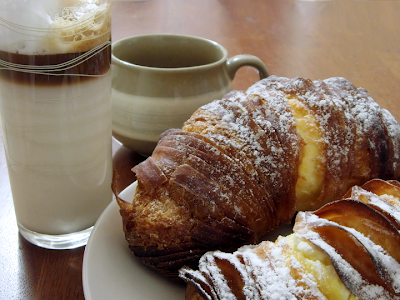
Our first stop was Sessa's, an Italian deli in Davis Square.  Not being a bakery, they did not have exactly what we were looking for, though they are well-stocked in other Italian foodstuffs.  The next idea was to try Modern Pastry up in Medford Square. Kitty had forgotten her forgot bus pass, so we decided to walk over. Serendipitously we passed Lyndell's Bakery during our wander and went inside. We were lucky enough to find and recognize sfogliatelle, aka lobster tails, a specialty of Naples recommended by our book.

The next quest was for the appropriate coffee. We decided on two drinks that are almost ying and yang to one another: caffellatte and latte macchiato. Caffellatte is milk added to espresso and latte macchiato is espresso added to milk that is foamed on top.  To make both, we used our brand-new Moka pot, and about 1 cup of milk frothed by the mason-jar method.  For the caffellatte, just pour one demitasse of coffee, then one of milk (save the foam for the macchiato).  The latte macchiato is a little more involved: pour the rest of the milk and foam into glass, and then gently pour in, over the back of a spoon, about ½ demitasse of coffee, which should settle between the milk and the foam.

Results and Discussion
The sfogliatelle was great. The custard filled center is surrounded by a bready pastry. This pastry is then surrounded by a thin flaky pastry wrapped around in single stands that pull off the pastry in a continuous spiral. It was quite fun to pull off and I would have had someone hold one end and run across the room to watch it unwind, but I was told this was not allowed. I would like to try making these from scratch because they are tasty and showy.

The Moka pot makes a nice strong coffee, good for espresso drinks without needing all the complicated machinery.  The latte macchiato was very nice. I like coffee flavor but I find espresso overpowering. Blending the espresso with mostly milk cuts the strength and leaves the flavor. The presentation also looks complicated and this will impress your guests.