Showing posts with label Southern Africa. Show all posts

Sunday, September 11, 2011

Malawi - Nshima and Tea


Background
Malawi is one of the poorest countries in southern Africa. The economy is largely agricultural and the population rural. The major crops are corn, tea, sugarcane, and sorghum. It was colonized by the British in the late 1800s and was known as Nyasaland until it gained independence in the 1960s. The country is also where Stanley presumed to find Dr. Livingston
My search for books on Malawi led me to two books in the Schlesinger Library, the The Malawi Cookbook and Nyasaland Cookery Book and Household Guide. Both books were written for missionaries and other foreigners living in the country. The Malawi Cookbook gives mostly recipes, and the Nyasaland Cookery Book also provides information about how to preserve foods, hire household staff, and avoid dangerous local insects. Neither book provided must information about what is eaten when, but the World Cookbook for Students gave us context.
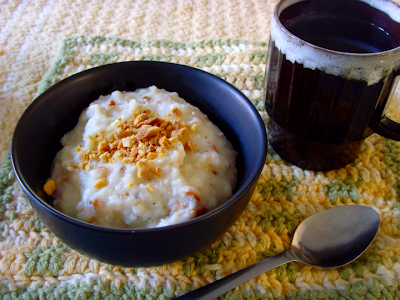
Nshima is a thick white cornmeal porridge that is a staple of the cuisine. For breakfast they eat a more dilute version of nshima flavored with peanuts and butter (we decided it needed a bit of sugar and imagine we are not the first to add some). I give a recipe for roasting your own peanuts below, since this is the primary flavor, the extra time is worth it.
Tea is a major export of Malawi, and single-estate Malawi teas can be purchased from Upton Tea Imports.  We bought a sample of Mboma Estate BOP.

Roasted Peanuts
  1. Pre-heat the oven to 350°F
  2. Spread the peanuts over an edged cookie sheet.
  3. Roast the nuts for 15 to 20 minutes until they are of the desired darkness. The color change doesn't really start until 15 minutes in.
  4. Let the peanuts cool and set aside until use. They will last several weeks on the shelf after roasting.
Nshima
  • 1 cup ufa (white cornmeal)
  • 3 cups water
  1. Heat the water in a large sauce pan until it is lukewarm.
  2. Add ¼ cup of ufa and mix in well using a whisk to avoid lumps.
  3. Bring the water to a boil and stir in the remaining ufa avoiding lumps.
  4. Mix in some of the chopped peanuts and butter to taste.
  5. Garnish with chopped nuts and add sugar as desired.

Results and Discussion
Use a larger pan than you think will be required for the nshima, as the mixture starts to foam as it boils. I would also maybe start with an additional cup of water to get a more dilute porridge. I think our result was stiffer than the usual breakfast meal. I started with too small a pot and I was not able to dilute to the desired thickness.
It is very important to use a whisk and remove lumps from the porridge as an uncooked lump is a bit unpalatable.
Again, most of the flavor comes from the roasted peanuts, so I would make sure to get a really nice dark roast on them. A little bit of sugar enhances the taste a bit.
The tea had a simple, homey, classic tea taste. Kitty thought it was rather like Lipton yellow-box tea, only much better.

Sunday, June 5, 2011

Madagascar - Mofo Gasy


Background
It is very appropriate that we follow Australia with Madagascar. Both islands are famous for having broken off from major landmasses and developing very unique fauna. Madagascar broke off from India around 80 million years ago, and did not see humans until around 2500 years ago. The first human settlers came from Borneo, which is not where one would suspect. Starting around 1000 years ago they were joined by African migrants, and even later by a wide variety of Asians and Europeans. The greatest of the European influencers were the French, who made it part of their empire in the late 19th century.
My first knowledge of Malagasy cuisine came from colleagues who had worked there collecting ants. The heart of the cuisine is rice. My sources tell me it didn't matter good a meal was, no one they worked with felt right until they had eaten rice. It then comes as no surprise the Malagasy eat the most rice per capita in the world.
I was unable to obtain a book on Malagasy cuisine, but the internet has some good resources, and searching in French gave even better results. The first option was a dish made of dried beef, cut into strips, broiled over coals, and served with a corn meal mush called kitoza. I also found the blog of an Iraqi going to school on the island, which mentioned a fritter called bemiraymofo. I could find no other mention of this dish anywhere. We decided to make a rice fritter called mofo gasy (pronounced muf gas). We got our recipe from lemurbaby on YouTube who demonstrates many Malagasy recipes.
The next challenge came in locating the correct pan. On Madagascar they have special aluminum molds. The recipe recommends using a Danish pan meant for cooking æbleskiver. These pans are very expensive and specialized, so we asked around for friends who might have one. A friend's Danish neighbor came through and we were in business.

Mofo Gasy (around 15 mofo gasy)
Yeast Starter Mix
  • ½ tsp yeast
  • ¼ cup hot water (100°C-110°C)
  • ½ tsp sugar
  1. Mix the above in a small bowl.
  2. Let it rest for around 5 minutes as the yeast activates.

Batter Mixture
  • ½ cup flour
  • ¼ cup + 2 tbsp rice semolina (Cream of Rice)
  • 4 tsp sugar
  • 9 tbsp (130 ml) hot water (100°C-110°C)
  • 1/8 tsp vanilla extract (optional)
  • 1½ tsp sweetened condensed milk (optional)
  • 1½ tsp honey (optional)
  1. Mix the ingredients above in bowl.
  2. Mix in the yeast starter and place in a warm place for 4-8 hours.
  3. Heat your æbleskiver pan over medium heat and put a small quantity of oil in each well. Coat the sides of the wells with the oil, unless using a nonstick pan.
  4. Stir the batter.
  5. Quickly fill each well of the pan with the batter to just below the lip of each well.
  6. Let the batter cook for about a minute.
  7. Flip the cakes using thin implements such as chopsticks. (See the video at the end of this section for a visual of the technique.)
  8. Reduce the heat to medium low, cover and steam for 2 minutes.
  9. Remove mofo gasy from the pan.
  10. Eat with sweet chai tea or sweet coffee.


Results and Discussion
It will definitely take several more attempts before I get the hang of making these. I would also buy a non-stick pan if I were starting from scratch. The cast iron pan we had worked great but we a little bit of sticking. I made the mistake of filling a couple too high on the second batch and ruined a great photo of golden brown ones. I will err on the side of under-filling the wells in the future. When you flip them, any liquid batter will run, so you need to find a balance of temperature that solidifies the batter at the top of the well without burning the mofo gasy.
The outsides of the mofo gasy are slightly crisp and the insides are like thick hot cereal. They have a slightly sweet taste and a little bit of a sour smell. The texture is puffy and slightly chewy. We think you could pretty easily adapt this recipe to make it work for a wide variety of grains instead of just rice.

Monday, May 16, 2011

Mozambique - Maguinha


Background
Mozambique is located on the southeast coast of Africa. It was colonized by the Portuguese in the early 1500s, and did not gain independence until 1975. The economy is mostly agrarian, and Mozambique is one of the poorest nations in Africa. Portuguese colonization left a deep impact on the cuisine including the introduction of many new world grains.
The initial search for information gave very vague results. The best I could find was a sweet bread or fish/egg sandwiches. Attempts to find books on the cuisine gave no results. Kitty had the idea to start looking for information in Portuguese. Kitty found some blogs in Portuguese that talk about cassava porridge, and she found a cookbook, Hoje Temos, which we actually found in a local library. (Thanks, Google Translate! –Kitty)
The cassava porridge is called maguinha and is served with milk and brown sugar.

Maguinha
  • 125g cassava flour.
  • ½ liter boiling water in a kettle
  1. Add ½ cup of boiling water to a small sauce pan.
  2. Stir in half the cassava flour.
  3. Add more water as needed.
  4. Add the remaining cassava flour and add more water if needed. You want a very think consistency.
  5. Serve in a bowl with some milk and brown sugar.

Results and Discussion
This breakfast was very functional. It gives you calories to get through the day. The cassava has a solid consistency and slightly jelly like texture. The cassava alone is pretty bland by itself, so the sugar and milk give the dish its taste.

Sunday, October 3, 2010

South Africa - Maize Porridge with Fruit Compote


Background
South Africa is a very diverse country, and it cuisine reflects this. In addition to the numerous tribes that go back to the origins of humans, one also finds the influence of Dutch colonists, exiled French Huguenots, the British, Indians, and Malaysians. (I was unaware of the Malaysian influence prior to doing this research. They were brought as slave labor by the Dutch in the 17th century and have maintained a distinct tradition.)
Reflecting this diversity we had a large number of distinct options. The option we found first and most often is basically the full English breakfast with a regional sausage called Boerevors. Since we had recently had a full English breakfast we decided to do a little more exploring.
This sent us on a quest to find some good cookbooks. The first book were found was South African Indigenous Foods, which is a collection of recipes collected from across the country to help people make better use of local food resources. It is not very descriptive in terms of background or uses because it is written for natives. It is probably the most rawly authentic cookbook we have found so far in our project.
The books that provided our background were Rainbow Cuisine and A Taste of South Africa. A Taste of South Africa was very authentic calling for ostrich, sorghum, and springbok (a species of gazelle). Rainbow Cuisine provided the most detailed over view of breakfast and the recipes we used.
Given the broad diversity, it was difficult to find a definitively South African breakfast. We decided to sample from both the African and European influences in the cuisine, and chose to make a dried fruit compote and a maize-meal porridge.


Compote of Dried Fruit
  • 250 ml fresh squeezed orange juice, about 4 navel oranges
  • 125 g of dried fruit
  • juice and zest of ¼ lemon
  • ¾ tsp brown sugar
  • ½ cinnamon stick
  • 1 whole clove
  1. Combine all ingredients in a sauce pan.
  2. Cover and simmer for 5 minutes.
  3. Remove from heat and leave it alone for several hours while the fruit absorbs the juice.
  4. Chill in the refrigerator until ready to serve (keeps up to 5 days).

Maize Porridge
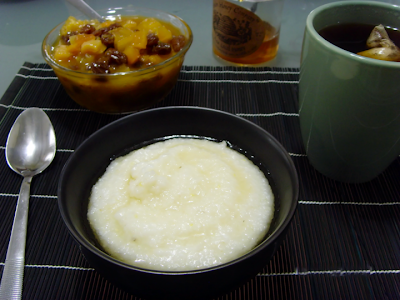
The maize meal used in South Africa is a white meal, and the easiest equivalent found is hominy grits.
  • 375 ml water
  • 125 ml hominy grits
  • ¼ tsp salt
  • ½ tbsp butter
  1. Mix grits, 125 ml water, and salt.
  2. Boil the rest of the water.
  3. Gradually stir in the grits-water mixture.
  4. Reduce the heat and simmer for 15 minutes.
  5. Mix in the butter.
  6. Serve with milk and honey.
Results and Discussion
This breakfast was simple and nice. The fruit compote is nicely sweet and smooth. It provided a nice counter point to the texture of the warm grits. It felt a bit more like a weekday breakfast than a weekend breakfast but it was very nice and it reflected more of an African influence than European.
We will be away next week but we will provide a history of the Schlesinger Library which frequently provides cookbooks for our more obscure countries.