Showing posts with label spicy. Show all posts

Monday, May 23, 2011

Sri Lanka - Idappan, Pol Sambol, and Kiri Hodi


Background
Sri Lanka is located off the southeast coast of India and as a result its food is frequently misclassified as a subset of Indian Cuisine. I found a great resource for the cuisine, recipes, and history of the island in The Food of Sri Lanka. Rice and curries are foundations of the diet, with fish and chicken as the predominant proteins. Sinhalese (low country) and Kandy Sinhalese (upcountry) are the two major categories. Sinhalese uses more seafood and most meals are rice and curry. The regional “black” curry is made by roasting the spices to a brown color before cooking them. Kandian cuisine uses ingredients such as jackfruit, breadfruit, and turmeric flowers. They also tend to eat more deer and wild birds.
The Portuguese came looking for spices in order to bypass the Arab monopoly. They were displaced by the Dutch who eventually gave way to the English. Sri Lankans incorporated and changed many of aspects of those cuisines.
Information on breakfast quickly lead us to two types of hoppers (appa). Appa are three dimensional crepes made with a rice flour batter. The batter is poured into a specialized pan with a rounded bottom and steep sides similar to a very small wok. The result is nest shaped pancake and perfect for fillings. Eggs are frequently cook in the bottom and the end product looks quite cool. Appa pans are very specialized and we could not find a good substitute. We decided to move onto string hoppers (idappan).
Idappan are noodles made from rice flour dough, forced through a vermicelli press. The noodles are steamed on special trays (hopper mats) and served with a variety of toppings. Our first attempt involved a spaghetti pasta cutter. This worked very poorly, and cleaning the rice dough from the machine was annoying. We then tried a cookie press with a Christmas tree attachment that worked pretty well and the effect was probably similar to that of a traditional press. Before you attempt these at home you will need a similar device. We used parchment paper to substitute for the specialized stand. The amount of water to use while making the dough varies greatly from recipe to recipe. The important thing is to get a non-sticky, malleable dough in the end.
Toppings for idappan are pol sambol and kiri hodi. Sambol are fragrant side dishes made of a basic ingredient and then spiced up. Pol sambol is made with coconuts, lime, and dried chili. Kiri hodi is made of chicken stock, coconut milk, and a lot of spices, including “Maldive fish” which is dried, leathery tuna. It is not quite bento flakes and most internet resources say to substitute dried prawns.
This week's novel ingredients are fenugreek and curry leaves. Fenugreek is a legume that grows well in semi-arid environments, it is used as a spice. Curry leaves are a fundamental spices to South Asian cuisine. The plant is in the same family as oranges and lemons. The fresh leaves have a strong peppery smell and are used predominantly for their aromatic qualities.

Kiri Hodi
  • 1 tbsp fenugreek seeds
  • 2 cups chicken stock
  • 1 red onion, finely chopped
  • 2 sprigs of curry leaves
  • 3 cloves of garlic, finely chopped
  • 1 inch cinnamon stick
  • 4 cardamom pods, crushed
  • 2 green chile, deseeded and sliced thin
  • 1 tsp turmeric powder
  • 2 tsp powdered Maldive fish
  • 2 cups coconut milk
  • lemon juice and salt to taste
  1. Soak fenugreek in chicken stock 30 minutes.
  2. Add all the rest of the ingredients except the coconut milk and lemon juice.
  3. Bring to a boil and simmer until the onions are soft.
  4. Add the coconut milk and simmer for 5 minutes.
  5. Add lemon juice and salt to taste.

Pol Sambol
  • 1 tsp chopped dried chili
  • 1 tbsp finely chopped onion.
  • 1 tsp pepper
  • 1 tsp Maldive fish (optional)
  • 2 cups grated coconut
  • 3 tbsp lime juice
  • Salt to taste
  1. Grind together chili, onion, pepper, and Maldive fish.
  2. Add coconut, lime juice and mix well.
  3. It is recommended that this be made fresh.

Idappan (indi appa)
  • 3 cups (500g) rice floor
  • 1½ tsp salt
  • boiling water
  1. Toast the rice flour in a very low oven or sauce pan.
  2. Sieve it into a bowl.
  3. Add salt and slowly mix in just enough hot water to make a soft dough that is not sticky.
  4. Add the dough into your pressing device and press the dough out onto the parchment paper.
  5. Steam the noodles for 10 minutes.
  6. Serve hot with pol sambol and kiri hodi.

Results and Discussion
This breakfast required the most specialized equipment so far and we did a good job improvising. The cookie press was not ideal for pressing out the dough as the grip was poor. I would not do this again without a more mechanized device. The recipe also makes a lot of dough and I would make less in the future. Since you are making the dough to a consistency, it can be easily reduced.
The pol sambol has simple, classic flavors. The lime and coconut go great together, and the heat from the chilis is a nice addition. The texture of the coconut flakes is an interesting contrast when eaten with the soft noodle.
Kiri hodi smells great as you cook it. The dried prawns do have a slightly fishy smell, but they don't overpower the other ingredients. It is a great blend of spices and gives the noodles lots of flavor. We found ourselves with lots of leftover broth, which we later cooked some rice in and got something almost like biryani-risotto, very tasty.
I do want to find a pan that will let me cook appa; they look really cool and I still want to make them.

Saturday, February 5, 2011

Peru - Chicharrones Sandwich with Salsa Criolla


Background
The major influences on Peruvian cuisine are the Inca and the Spanish. Japanese and Chinese influence came later, a result of immigration in the 19th century. Potatoes are native to this region (1,000 varieties) and are a cornerstone of the cuisine. Quinoa is the other major starch contributed by this region. The Spanish conquest brought in European flora and fauna, greatly increasing the variety in the diet. The collapse of the Spanish Empire and Peru's independence resulted in an open immigration policy and growth in diversity in metropolitan areas. In addition to the ethnic diversity, Peru has a large quantity of regional variation.

Finding recipes Peruvian recipes was very easy. We found three fantastic books that provide great recipes and information. The Art of Peruvian Cuisine has great background reading and a wonderful section explaining and showing novel ingredients. Eat Smart in Peru is a compact guide to the cuisine with a balance of information and recipes. We ended up using The Exotic Kitchens of Peru because it had the recipes we needed.

None of the books mentioned breakfast directly, so I asked a Peruvian friend for her advice. She recommended a few dishes, and we settled on sandwiches of chicharrones served with salsa criolla. Chicharrones are fried pork, and salsa criolla contains hot peppers and aji amarillo chilies. We were unable to locate whole aji amarillos, but we found them as jarred paste which we could substitute. I was not able to find any specific information on the sandwich bread but photos I saw online had rolls with thick crusts. The drink for breakfast is coffee.

Chicharrones de Chancho (Crispy Pork Cubes)
  • 1 lb pork spare ribs, cut into 2 inch sections
  • 1 tsp salt
  • ½ tsp ground cumin
  • 1 tbsp lime juice
  • 1 tsp oil
  1. Mix all ingredients except oil in a bowl and let marinate for 15 minutes.
  2. Heat oil in a skillet on low.
  3. Add the pork and fry at low temperatures for about 30 minutes.
  4. The pork is done then the meat is brown and crisp with all of the fat cooked off.
  5. Drain pieces over paper towels and serve as soon as possible.
Salsa Criolla
  • 2 cups red onion, coarsely chopped
  • 1 tsp chopped/paste aji amarillo, remove seeds if chopping.
  • 3-4 tbsp lime juice
  • 1 tsp salt
  • 1 tbsp chopped cilantro
  1. Combine all ingredients by hand, or
  2. Pulse all ingredients in a food processor to make a coarse salsa.
  3. Serve immediately.
Results and Discussion
The red onions give the salsa a very sharp taste. The lime adds a sour flavor and the cilantro gives a nice accent. The heat and sweet flavor from the aji amarillo were subtle but nice. The peppers added less heat than I expected. The paste eaten raw packs real punch.
And fried pork is plain good. Pork fried to the point that the fat becomes really crispy and has that concentrated blast of salt is even better. In the future I might cook them at a slightly higher heat as some of the fat did not get as crispy as it could have been. We used pork spare ribs but pork roast was another option. I would use pork roast in the future since it was much easier to cut up. (OK, again, Kitty totally disagrees, rib meat is way better than pork roast for this.) Getting meat off the ribs was a little annoying. (Whatever.)

Sunday, June 6, 2010

Mexico - Tamales de Anis, Salsa de Cacahuate, Atole


Background
Today's breakfast was brought to you by masa, corn flour, a staple of Mexican cooking. The main course of our breakfast were sweet anise-seed tamales with peanut and chipotle salsa. These recipes were taken from Culinary Mexico by Daniel Hoyer. Our drink was raspberry atole based on a recipe from Zarela's Veracruz by Zarela Martinez.

Tamales de Anis
  • 12 cornhusks
  • 1½ cups instant masa mix (e.g. Maseca)
  • 1½ cups warm water (110-130° F)
  • 2 tbsp butter
  • 2 tbsp lard
  • 3 tbsp water
  • 1 tbsp anise seeds, toasted
  • 1 tsp salt
  • 2 tbsp sugar
  • 1/4 cup chopped prunes
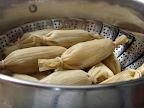
  1. Cover corn husks with hot water and soak for 1 hour.  Drain and pat dry.
  2. Mix masa and warm water stir until you get a crumbly texture. The amount of water to achieve this texture varies so add water slowly.  Let sit for 30 minutes, then weigh out 12 ounces of this mixture (reserve the rest for atole).
  3. Whip butter and lard in a mixing bowl until they are fluffy.
  4. Gradually add masa alternating with the three tablespoons of water.
  5. Mix in anise seeds, salt, sugar, and prunes and beat for 2 minutes until smooth.
  6. Put 2 tbsp of the mixture on the edge of a corn husk and roll it up.
  7. Tie the ends with kitchen twine, trimming any excess.
  8. Steam for 1 hour and 15 minutes, making sure that the steamer does not go dry.
  9. Let cool for 10 minutes before serving.

Salsa de Cacahuate
  • ½ cup unsalted dry roasted peanuts
  • 1 small onion
  • 3 garlic cloves, peeled
  • 1 medium tomato
  • 2 chipotles in adobo
  • 1½ tsp apple vinegar
  • 3 tbsp chopped cilantro
  1. Slice onions and tomatoes.
  2. Roast onions, tomatoes, and garlic under a broiler.
  3. Mix all ingredients, except cilantro, in a blender leaving a coarse texture.
  4. Stir in cilantro and salt to taste just before serving.

Raspberry Atole
  • 1 cup of raspberries
  • 4½ cups of water
  • ¼ cup masa left over from tamales (use more for thicker atole)
  • ¼ cup grated piloncillo sugar
  1. Boil 4 cups of water.
  2. Puree the raspberries and masa with the remaining ½ cup of water.
  3. Push the raspberry puree through a sieve into the boiling water (this removes the seeds).
  4. Add the piloncillo and stir.
  5. Maintain a low boil for 30 minutes as the drink thickens.

Results and Discussion
This breakfast easily took the longest of any of the others. Most of the time was spend making and steaming the tamales. The tamales were firm and moist with the plum providing a sweetness that was an excellent counter point to the heat of salsa. Roasting the vegetables prior to making the salsa provided additional flavor and really enhanced the taste. The recommendation of leaving the salsa "gritty" also gives an excellent texture to the salsa. The raspberry atole was a tasty drink and could be flavored with any berry of your choosing.
For advice on how to roll tamales we consulted How To Cook Everything by Mark Bittman which has excellent illustration.
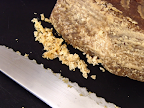
Cutting the piloncillo presented a special challenge. The block of sugar is very hard and it is impossible to break of parts. We resorted to using a serrated knife to shave off the sugar as needed. In Columbia a stone is common used to break the block apart but we live in an apartment.

Saturday, March 27, 2010

China - Hunanese Soup Noodles


Background

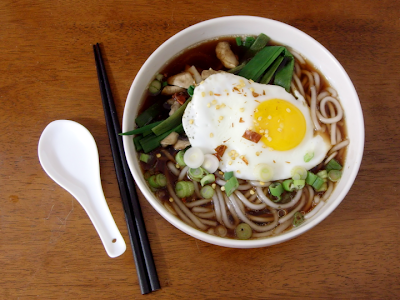
The rice pasta called fen is a specialty of the Hunan region. Fuschia Dunlop in the Revolutionary Chinese Cookbook describes its importance as " Rice fen is eaten for breakfast all over Hunan. Some people buy the freshly made fen and take it home, where they serve it in a bowl of broth, topped perhaps with a fried egg, some sliced scallions, and a dollop of chopped salted chiles" (p.252).

Ingredients (2 servings)
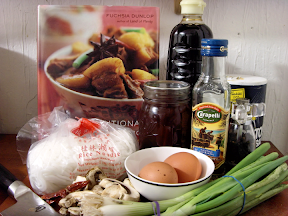
  • 2.5 cups vegetable broth
  • 1/2 bunch scallions
  • 1/2 cup coarsely chopped mushrooms
  • 1 tbsp soy sauce
  • 1/2 tbsp olive or peanut oil
  • Salt and pepper to taste
  • 8 oz fresh rice noodles
  • 2 eggs
  • 2 dried chiles, sliced

Procedure
  1. Start water boiling and in a separate pan heat the vegetable broth.
  2. Chop the tops off the scallions. Trimming off dead ends. Blanch in boiling water with mushrooms. Drain
  3. Thinly slice the bottom part of the scallions.
  4. Prepare the serving bowls by placing some soy sauce, oil, sliced scallions, and salt and pepper to the bottom of each serving bowl.
  5. Boil rice noodles until they are of the desired softness. This happens very quickly with fresh ones. Drain.
  6. Fry 2 eggs sunny side up.
  7. Pour vegetable broth into serving bowl. Add noodles to serving bowls. Top with mushrooms, scallions, fried egg, sliced scallions, and chiles. Serve.


Results and Discussion
This is dish was simple and tasty. Preparation time is about 20 minutes. Making the dish look nice is also very easy. It is very spicy for breakfast but it wakes you up and is very warm. The fresh rice noodles have a very nice texture and soak up the broth's flavor. We would make this again for any meal. Dunlop discusses how this recipe has many different variations so you can top it with whatever strikes your fancy.