Showing posts with label user error. Show all posts

Sunday, January 30, 2011

Iraq - Tasbreeb Bigilla


Background
Finding information on Iraqi breakfast was actually very simple. I found an article online about breakfast before the 1990 Gulf War and the subsequent embargo. It provided a fantastic list of recipes.
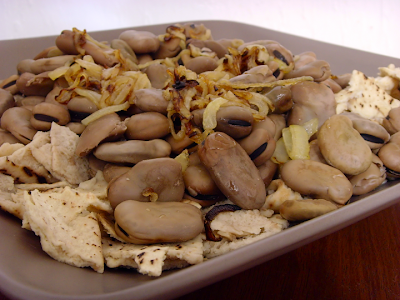
As Iraq is probably the first place wheat was domesticated, it comes as no surprise that bread is a staple of the diet. Other ideas included gaymer, a buffalo cheese sometimes served with date syrup, and kahi, a dish brought to Iraq with Babylonian Jews. It is very closely related to baklava and requires many folded layers of pastry dough. Bigilla is a fava bean dish eaten in northern and central Iraq. I located a variation of this dish called tasbreeb bigilla in The Iraqi Cookbook. It consists of fava beans served with pita bread topped with fried onion and peppermint powder, and is traditionally served on Fridays. We were unable to find peppermint powder specifically so we used crushed dried mint.

Tasbreeb Bigilla
  • 1 lb fava beans
  • 1 packet of pita bread (ours had six pitas)
  • 1 medium onion, thinly sliced
  • Olive oil
  • Salt
  • Dry mint
  1. Soak fava beans overnight in cold water.
  2. Cut pita bread into pieces and leave them out overnight so they dry out. (Alternatively, put the bread pieces in an oven at 200 for 30 minutes.)
  3. Bring the beans and water to a boil at medium heat, and boil them for 45 minutes.
  4. Add salt and continue to boil for 15 minutes. Make sure there is enough liquid remaining to soak the bread.
  5. While the beans are cooking, heat oil in a pan, add the onions to the hot oil and fry them until browned.
  6. Remove the cooked beans from the water.
  7. Soak the bread pieces in the bean liquid for 1 minute. Then remove them from the water and place them in a big shallow bowl.
  8. Put the beans on top of the bread and then pour the onions and hot oil over the beans.
  9. Sprinkle the dry mint to taste over your plate.
Results and Discussion
This recipes makes a lot of food. We could have easily halved it and still had lots of food. It was suggested to serve this with fried eggs, but we had to leave them out or we would have been eating the leftovers all week!
The pita bread pieces had an interesting texture. Being soaked in the bean juice infused them with flavor. Getting the bread pieces in and out quickly lets the flavor soak in while preventing the bread from becoming soggy.
The fried onions in the oil added lots of taste and the next time I make this I am going to add more onions. The oil itself provides the same flavor enhancement and texture contrast as in the previous breakfast.
In Iraq they add cardamom to the coffee for flavor, which is probably quite good when done properly. We were not paying attention and completely screwed this up—getting the ratio of water to coffee wrong and ending up with a very weak brew. We're now on an 0-for-2 beverage streak, and will have to pay more attention from now on!

Sunday, August 15, 2010

Iran - Khiyar with Kateh


Background
Information on Iranian breakfast was much easier to find than last week's country. The books Treasury of Persian Cuisine and A Taste of Persia provided excellent information and a variety of choices.
Archeology of Persian cooking goes back to 2000 BCE and a cookbook from the 1200s is known to exist. The 13th century cookbook focuses on combinations of sweet tasting meets with different syrups and fruits. Rice is mentioned in this text but it is not yet given any special attention. Treasury of Persian Cuisine provides an interesting aside on how Persian cuisine in the 17th century was based around balancing the humors with foods that fall into the categories of hot, cold, wet, and dry. Hot and cold foods refer to the food's energy content. The book did not mention what was meant by wet and dry.
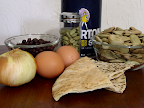
Our options for this meal were plentiful. One was a soup with bulgur wheat and lamb called haleem, and it is served during Ramadan which has just started.  But it also takes 2-3 hours to make. The next entree I came across was khiyar which is cucumbers with feta or honey that is eaten during the spring. We have some nice cucumbers from our farm share so we decided to make this.
For our carb we had to choose between nan-e barbari and kateh. Nan-e barbari is a baked flat bread. Kateh is a rice dish where the rice is baked into a cake shape. The bread is traditionally eaten with the khiyar, but I chose the kateh because we have had flatbreads with previous breakfasts and this dish was a new challenge.

Kateh
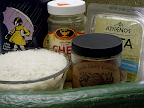
  • 2 cups jasmine rice
  • 3 1/2 cups water
  • 2 tsp salt
  • 1/3 cup ghee
  1. Wash the rice.
  2. Combine water, rice, and salt and bring it to a boil on high heat.
  3. Simmer on medium until all the water absorbed and stir to prevent rice from sticking.
  4. Stir in ghee
  5. Cover pan with a paper towel to absorb condensation and place the lid on top to secure it.
  6. Cook for 30 minutes at low heat.
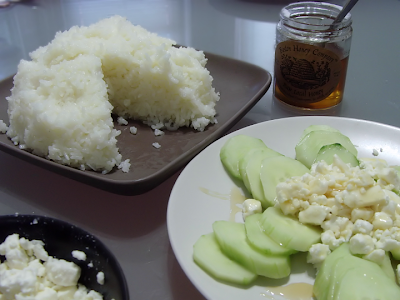
  7. Invert rice onto a platter and serve as a golden cake
Khiyar
  • Sliced cucumber with feta crumbled on top drizzled in honey

Results and Discussion
The khiyar was simple, quick, and tasty. The flavors go together really well and are nice on a warm summer morning. The cucumbers were very moist and this goes well with the dryness of the feta. The honey's sweetness compliments the feta's salty taste.
The kateh could have come out better. The basic taste was very simple and nice. (Ghee makes things taste good.) The major issue in preparation was probably not getting the ghee distributed evenly into the pan and along the sides. As a result the golden brown shell was left on the side of the pan. Looking online I found advice that I should use a non-stick pan. Follow this advice. I also think that melting the ghee before mixing it into the rice would also help to ensure a better distribution and hopefully lead to less sticking.

Saturday, April 10, 2010

Indonesia - Tinutuan


Background

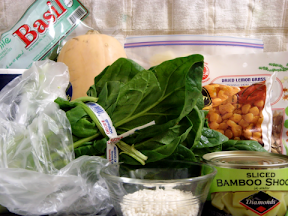
This recipe is adapted from the book Indonesian Regional Cooking by Sri Owen. The recipe is from the city of Manado which is on the north east tip of Sulawesi. We had to vary to recipe at several points. The original recipe called for water spinach instead of kale and fresh lemongrass instead of dried. We omitted the turmeric leaf. The effect of these substitutions on the final product are discussed in the results section.

Ingredients
1/4 cup white rice
3/4 cup of frozen sweet corn
10 oz of peeled and cubed butternut squash
2/3 cups bamboo shoots
1 tsp salt
2 cups of boiled frozen yuca, cubed.
1 tbsp of dried lemon grass
8 oz of fresh spinach
8 oz of fresh kale
20 fresh basil leaves
1 turmeric leaf (optional)

Procedure
Soak rice in cold water for 30 minutes
Bring 5 cups of water to a boil and add rice.
Add corn, squash, bamboo, and salt. Simmer for 20-25 minutes.
Add yuca and simmer for a few minutes.
Refrigerate the soup over night
Reheat soup until hot
Soak lemon grass in 1/4 cup hot water for a few minutes and add to soup.
Add spinach and kale and simmer for 5 minutes.
Add basil leaves, season, and serve hot.


Results and Discussion

The preparation was very straight forward and can be easily done the night before which is what we did. We made several poor choices in our substitutions. Kale was a poor choice for young spinach as it is very chewy and tough. I have not chewed this much at breakfast ever, but I have met my daily fiber requirement. The dried lemongrass was also not a good substitution for fresh. As a result the basil taste of the soup was very strong and lacked a counterpoint. I believe the turmeric leaf would also help with this problem. The texture of the broth was very nice and had subtle sweetness. I would like to try this recipe again with better lemon grass and a green softer than kale.