Sunday, September 26, 2010

Italy - Caffè e Sfogliatelle


Background
Finding Italian breakfast was very interesting. In America, Italian cuisine is heavily influenced by immigrants adapting to local custom and available ingredients. A book that exemplifies this fusion is Buongiorno! by Norman Koplas. It has some great looking recipes in it but they are ideas in Italian cuisine adapted to breakfast with a few authentic dishes mixed in here and there.

This blog post discusses the difference between the two countries. Her assertion is that Italians mostly eat grains, breads, and, cakes in the morning and that meat is for the evening. This clue started us looking books of Italian baking and desserts. We found two fantastic books in The Southern Italian Table and Desserts and Sweet Snacks: Rustic Italian Style. Both of these volumes have some excellent recipes. The Southern Italian Table provided provided confirmation of these assertion and offered a long list of breakfast treats. The author provided us with the information that most Italians buy these from bakeries.

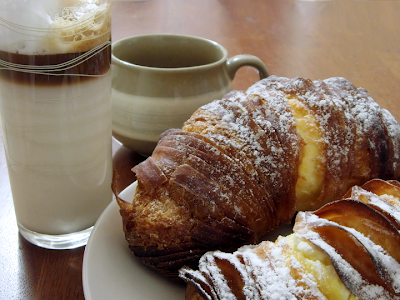
Our first stop was Sessa's, an Italian deli in Davis Square.  Not being a bakery, they did not have exactly what we were looking for, though they are well-stocked in other Italian foodstuffs.  The next idea was to try Modern Pastry up in Medford Square. Kitty had forgotten her forgot bus pass, so we decided to walk over. Serendipitously we passed Lyndell's Bakery during our wander and went inside. We were lucky enough to find and recognize sfogliatelle, aka lobster tails, a specialty of Naples recommended by our book.
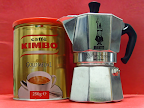
The next quest was for the appropriate coffee. We decided on two drinks that are almost ying and yang to one another: caffellatte and latte macchiato. Caffellatte is milk added to espresso and latte macchiato is espresso added to milk that is foamed on top.  To make both, we used our brand-new Moka pot, and about 1 cup of milk frothed by the mason-jar method.  For the caffellatte, just pour one demitasse of coffee, then one of milk (save the foam for the macchiato).  The latte macchiato is a little more involved: pour the rest of the milk and foam into glass, and then gently pour in, over the back of a spoon, about ½ demitasse of coffee, which should settle between the milk and the foam.

Results and Discussion
The sfogliatelle was great. The custard filled center is surrounded by a bready pastry. This pastry is then surrounded by a thin flaky pastry wrapped around in single stands that pull off the pastry in a continuous spiral. It was quite fun to pull off and I would have had someone hold one end and run across the room to watch it unwind, but I was told this was not allowed. I would like to try making these from scratch because they are tasty and showy.

The Moka pot makes a nice strong coffee, good for espresso drinks without needing all the complicated machinery.  The latte macchiato was very nice. I like coffee flavor but I find espresso overpowering. Blending the espresso with mostly milk cuts the strength and leaves the flavor. The presentation also looks complicated and this will impress your guests.

Saturday, September 4, 2010

United Kingdom - Full English Breakfast


Background
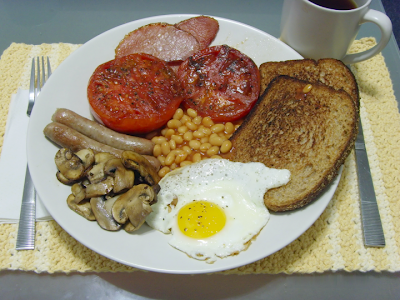
The full English breakfast is a well-known meal, so our research was a simple Google search. The BBC Food site provided an excellent menu and a preferred sequencing of ingredients to best use the grease produced by the sausage and bacon. The basics of the English breakfast are sausage, bacon, baked beans in tomato sauce, browned mushrooms, toast, tomatoes, a fried egg, and black pudding. Naturally, you serve the breakfast with tea.

One element of the English breakfast we omitted was the black pudding (a type of blood sausage) mostly because it was by far the most difficult item to procure, and we already had enough meat for two people. Kitty has also eaten plenty of tasty blood sausages in Asia and feels that we were not shirking our duties by skipping over it here.  Should you also be unable to find black pudding, these other blood sausages are available at Asian markets; the idea being similar though the taste rather different.

(In U.K. English, the word pudding also describes a bready or milk-based dessert. I became interested in how the same word came to describe two very different dishes. Fortunately the country that posed this etymological challenge also created the solution in the Oxford English Dictionary. The word's first appearance in Latin is in the context of sausage in 1287. The first time it describes a dessert is in 1543. The shared use of the word comes from both dishes being cooked in water while encased in something.)

Recipe
Please see the BBC Food site for the recipe.

Results and Discussion
“Full” is a very accurate modifier for English breakfast. I was not really hungry again until dinner. It also covers a full range of flavors and textures. You have have the savory, dense, and flavorful sausages with the golden casing giving them a wonderful snap. We got these at Savenor's in Cambridge and they were spectacular and reasonably priced. The sweet fresh and moist tomatoes have an excellent contrast of being warm on the surface but still a little cool in the middle; the mushy beans and lightly crunchy toast provide a nice contrast
The sequencing of the elements and grease management are also important for getting the right results. Under optimal condition one would have a griddle and some slightly fattier bacon so we could spread the grease around and have more things cooking at the same time. The bacon we chose was much too lean and as a consequence we had to supplement with a lot of olive oil. The single pan approach does help cut down on dishes which is very nice.
This breakfast is very similar to the southern breakfast I learned growing up watching my grandfather. It is exactly what he would make minus the beans and mushrooms. He also taught me the importance of good grease management.
We will be making its counterpart, the full Irish breakfast, in about 2 years.

Sunday, August 29, 2010

France - Croissants


Background
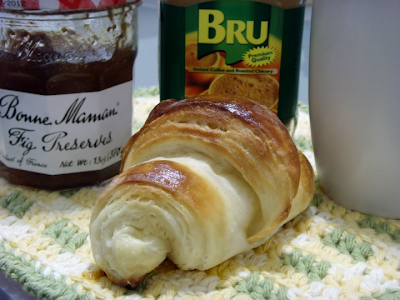
Clearly France is a country whose culinary credentials require no introduction. This reputation left us quite surprised when we realized that breakfast was simply bread, jam, and maybe a soft-boiled egg. The two best known bread products of France are the baguette and the croissant. The home recipes we found for the baguette were pretty simple, but as baguette is not really the same without a real baker's oven, we decided to attempt the croissants. A French friend recommended the Bonne Maman preserves, which are available in supermarkets. Our breakfast guest Stacy brought the French-influenced chicory coffee.
For our recipe source we chose Paris Boulangeries-Patisserie by Linda Dannenberg. This book gives the recipes from her favorite bakers all across Paris. The croissant recipe comes from Marcel Haupis, whose shop is on Ile-St-Louis in the middle of the Seine River. My first impression of the recipe was that is was very scary. In total it involves 6+ hours of rising and an intimidating amount of butter. We recommend starting the night before, so you don't have to get up at 3 AM.

Croissants
  • 2 tbsp + 1 tsp of yeast
  • 1/3 cup warm water
  • 3 1/2 cups flour + 1/2 cup corn starch (or 4 cups cake flour, which we didn't have)
  • 1/4 cup sugar
  • 1 tbsp salt
  • 1 cup milk
  • 2 sticks of butter (barely malleable)
  • 1 egg, beaten
Note: This process is long and involved. Read through the entire recipes and make sure you plan ahead. We have included many photos of the process to better illustrate the process.
Combine yeast and warm water. Let it sit for 5 minutes while the yeast activates.
Mix all the remaining ingredients except the egg with a wooden spoon.
Then mix using an electric mixer and a dough hook until you can form it into a ball. Err on the side of under-working the dough.
Knead the dough on a lightly floured surface until the dough is smooth but still soft.
Work the dough into a ball.
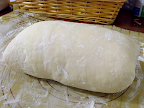
Place the dough in a greased bowl and let it rise for 1 hour. Then refrigerate the dough for 30 minutes.
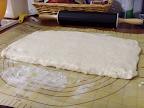
Roll out the dough until it is 9 x 15 inches and 3/8 inch thick and let  rest for 5 minutes.
As the dough is rising take two sticks of butter out to soften.
Put the butter on a piece of wax paper.
The butter should malleable but not too soft.
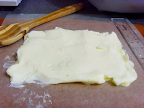
Work the butter in a square that is 5 x 7 inches and 1/2 inch thick.
Place the butter on the bottom third of the dough.
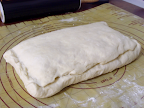
Fold the top third of dough over the middle third and then fold this over the bottom third like a business letter.
Seal the edges of the dough.
Roll out the dough lengthwise until it is 9x16 inches.
Repeat the folding process and refrigerate the dough for 10 minutes. This completes the second fold.
Repeat this process for a third fold, refrigerate again for 10 minutes.
After a fourth fold, seal the edges dust the surface with flour.
Wrap in plastic and refrigerate over night.
(This folding process creates layers of butter that help to create the pockets and flakes in the croissant. See if you can calculate how many layers of butter this will create.)
The next morning unwrap the dough and let it rest for a few minutes at room temperature.
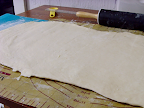
Roll the dough into a rectangle 12 x 30 inches.
Cut the dough down the middle using a chef's knife.
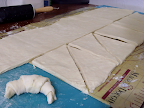
Square off the edges of the two strips and cut the strips into 5 x 6 inch rectangles.
Then cut along the diagonal starting in the bottom corner and moving up.
Starting at the 5 inch side of the triangle, roll the dough into the appropriate shape with the tip of triangle coming into the middle.
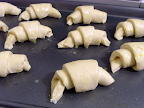
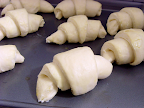
Shape it into a crescent and place onto a dampened cookie sheet. Make sure the tip is under the croissant to keep it from unfolding during baking.
Brush with the egg and let rise for 2 more hours.
20 minutes before you put the croissants in the oven pre-heat it to 400 F.
Put on a final brush of eggs and place in the oven for 10 minutes.
Monitor them as they cook and take them out if they start to burn.
Results
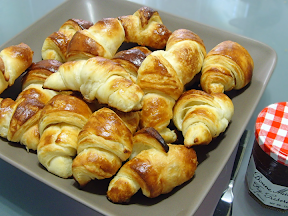
These turned out really well. Really, really well. They smelled great as they cooked and the smell lingered for a long time. They were warm, soft, flaky, and tasted great with the fig preserves. They oozed butter as they cooked so we highly recommend a baking tray with edges.
It felt really awesome that these work. After completing this meal I want to try to bake more things. The book we got this recipes from has lots of other challenges that look great and I want to try.
We should also say that this recipe produces lots croissants. You should bring the leftovers to work to show how much cooler you are because you made croissants from scratch.

The answer is 27.