Monday, May 9, 2011

Syria - Ca'ak and String Cheese


Background
Syria's strategic location in the Middle East made it a prime annexation target for numerous empires. In recent times this has been part of the Ottoman Empire, and then under French control until its independence after World War II. Syria is a predominantly Muslim country.
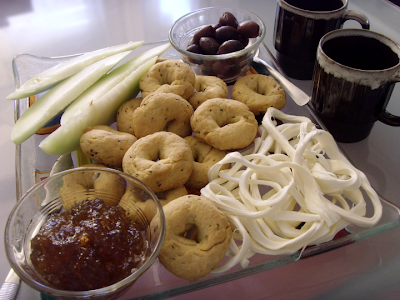
Wikipedia's article on Syrian cuisine simply notes that appetizers are eaten for breakfast, leaving a wide variety of options. A Taste of Syria focused our choices with a chapter on breakfast and by specializing on the cuisine of Aleppo, a city in the northwest of Syria near the Turkish border. The authors provide several menus. One option is sliced cucumber, lebaneh dip, cheese, olives and pita. Lebaneh is a yogurt mixed with dried mint and garnished with olive oil. Another menu is mamuneh'ya with cheese and pita. Mamuneh'ya is semolina porridge flavored with cinnamon. We chose to go with ca'ak served with Syrian cheese, fig jam, and honeydew melon. Ah'weh turkieh is Turkish coffee heavily sweetened with sugar.
The exotic ingredients for this meal are mahlab and semolina. Mahlab are black cherry pits. Semolina is the particles of wheat bran from durum wheat. It is also the only tetraploid wheat variety that is in broad use.
Syrian cheese is a string cheese is flavored with mahlab and caraway seeds. The cheese is made using goat or sheep's milk. It is often labeled "Armenian string cheese" in markets. It can be made at home but only in large quantities, so we bought it. The Armenian store we went to in Watertown was closed on Sunday, but fortunately we had the halal Al-Hoda Market near our house for the cheese and semolina.

Ca'ak
We reduced our recipe by 1/3 and got about 18 pieces. The full recipe is given below and the book estimates a yield of around 8 dozen.
  • 1 packet yeast
  • 1¼ cups warm water
  • 1 tsp sugar
  • 2 cups semolina
  • 3 sticks salted butter (4 oz each)
  • 1½ tsp baking powder
  • 1 tbsp mahlab (powdered)
  • 1 tbsp anise
  • 1 tbsp fennel seeds
  • ½ tbsp black caraway seeds (kalonji)
  1. Mix yeast, warm water, and sugar. Set the mixture aside.
  2. Put the remaining ingredients into a large bowl and mix.
  3. Add the yeast mixture and mix well.
  4. Cover the bowl with a cloth and keep in a warm place for 1 hour.
  5. Preheat the over to 350°F.
  6. Roll the dough into balls 1¼ inches in diameter. Start with 15 pieces and leave the rest of the dough covered to prevent drying.
  7. Roll the ball into a finger shape four inches long.
  8. Bring the ends together so they overlap and pinch them together.
  9. Places them ½ inch apart on a cookie sheet.
  10. Cook for 40 minutes until they are golden brown.
  11. When the cookies are done turn off the oven and leave the cookies in it for an hour to crisp.

Coffee
We still do not have an apparatus for making Turkish coffee. We approximated it by brewing espresso and putting 2 teaspoons of sugar at the bottom of the cup. Pour the espresso over the sugar but do not stir it in.

Results and Discussion
The smell of the baking ca'ak is amazing. It was an act of will to let them finish cooking. The final cookie is very crisp and can be crumbly. The cherry flavor from the mahlab is not very noticeable when the ca'ak are warm but they develop the next day when they cool. Ca'ak are savory and the fig jelly complements them nicely. The fennel and anise hit your palate a little after the other flavors, similar to the cumin cookies we had for Nepal.
The mahlab was a nice surprise. The whole cherry pits have absolutely no smell, but when you grind them they have a pure clean cherry smell. I have a lot of it leftover seeds and I look forward to experimenting with it as a flavoring agent in ice cream.
The Syrian cheese is a string cheese flavored with kalonji and mahlab. Eating string cheese was a lot of fun and eating really long string cheese is even better. The cheese also peeled into much thinner strings than American string cheese. It goes especially well with the olives.
The coffee was very strong and very sweet. The book warned that most Americans would find the amount of sugar Syrians put into their coffee much too strong. The authors were right. Each sip was a shock to my rather delicate system. (Yeah, I knew what was up and skipped the sugar altogether. Both or none, IMO. –Kitty)

Monday, May 2, 2011

Romania - Mamaliga and Goat's Milk


Background
Romanian cuisine is typical of eastern Europe with notable outside influences from the Ottoman empire. I quickly found a report on the subject of Romanian breakfast online from an environmental sustainability program in the European Union. The first breakfast mentioned is mamaliga as it is eaten by a character in Bram Stoker's Dracula on his way to be the Count's breakfast. Mamaliga is Romanian polenta. Balmos is mamaliga made with sheep's milk. Another interesting dish is called slanina. It is made of pork fat from the back or belly. The fat is sliced and pickled in salt liquor with garlic for 2-3 weeks. The fat is then smoked for 2-3 days. I am unable to to smoke for several days and I was unable to determine what salt liquor is.
I really wanted to make balmos, so I tried to get some sheep's milk. I was able to locate a Greek grocery store that makes its own sheep's milk yogurt. Unfortunately they are not allowed to sell me the raw milk and getting to New Hampshire for fresh milk was not viable. This left us with mamaliga.

Mamaliga is a staple in Romania so a wide variety of recipes exist. The two basic forms for breakfast can be broken into the categories porridge and cornbread. The cornbread variety comes in two basic forms. The first variety involves cooking the cornmeal mixture on the stove and then transferring it to a baking dish for baking. The second option involves cooking it longer on the stove and then turning the cornmeal out onto a cutting board and slice it using string. The porridge variety is made using various ratios of milk and water. Our source gave a porridge recipe so we are going with a porridge.
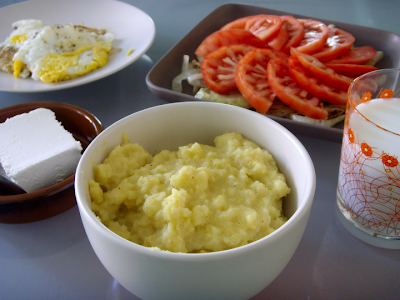
The mamaliga is served with farmer's cheese, lightly fried onion, sliced tomatoes, and fried eggs. Goat's milk is the beverage of choice so I get some variety of exotic milk.

Mamaliga cu lapte
  • 1 qt water
  • 2 tsp salt
  • 2 cups cornmeal
  1. Boil water and salt in a pot of water.
  2. Whisk in the cornmeal and mix thoroughly.
  3. Simmer for 10-15 minutes.
  4. Serve with sides mentioned above.
Results and Discussion
Mamaliga is pretty much polenta. The texture was not as porridge-like as I thought it would be. Less cornmeal is probably the solution to this. It was a little salty, but not too salty when served with other toppings; it is a nice base for the other flavors. The cheese was especially good because of the contrast of temperature and texture.
The goat's milk was very tasty. It has a subtle creaminess that is a bit richer than whole milk. (Meh. Tastes like milk, except milkier. Not a fan. –Kitty) I now need to find a use for the rest of it; I plan on making pancakes with some of it and probably just drinking the rest.

Monday, April 25, 2011

North Korea - We have No Idea, so here is some Breakfast Sausage instead

How hard do you think it is to research food habits in North Korea?
Answer: very hard. There is not much at all in English, and though Kitty's Korean skills are nowhere near up to this task, there didn't seem to be much useful information in that language either. What little information we could find suggested that it was either very similar to the South Korean breakfast, or nothing at all (probably much dependent on whether you are in the army or an otherwised privileged member of society).
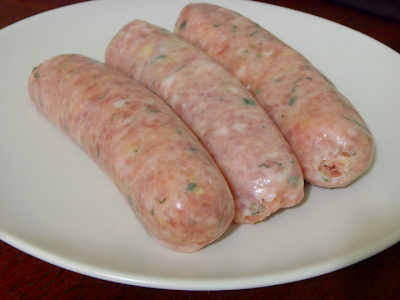
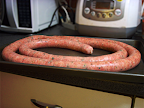
In light of our research fail, we present instead a sample of Whit's other food project, sausage-making. Kim Jong-il probably has sausage for breakfast every day anyway...


Breakfast Sausage with Sage and Ginger
The following is an overview of the sausage making intended to make the process less intimidating with the hope that the reader will be inspired to give it a go. For an amazing book on sausage making and other meat-related topics with much more detail get Charcuterie by Michael Ruhlman and Brian Polcyn.

Tools
  • Meat grinder or grinder attachment for a stand mixer
  • Meat funnels
  • Ruler
  • Kitchen scale
Ingredients
  • 5 lbs boneless pork shoulder, diced
  • 40g kosher salt
  • 50g peeled ginger, finely chopped (or 8g ground dried ginger)
  • 18g minced ginger
  • 6g black or white pepper
  • 1 cup chilled water
  • 10 ft hog casings
Preparation
Soak the hog casings in room-temperature water for at least 30 minutes prior to stuffing. Place your grinder and any bowls you plan on using in the refrigerator or freezer prior to starting. Keeping the ingredients cool prevents the fat and meat from separating and improves the texture.

Grinding
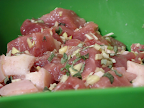
Mix all the ingredients into a cold bowl, excluding the water. Grind the mixture using the fine grind/small die plate into chilled bowl.

The Primary Bind
This step makes the ground meat stick together and ensures a more uniform texture.  Add the water and mix well for 1 minute. The paddle attachment and the metal bowl of a Kitchen Aid mixer are excellent for this step. Place the bound mixture back into the refrigerator until it is needed.

Stuffing the Sausages
  1. Put the bound sausage filling into the stuffing machine or back into the grinder.
  2. Fill the casing (use any leftover fillings to make patties)
  3. Twist the casing into links of the desired length
  4. Roast or saute the sausages (wrap any uncooked sausages in freezer paper and save them for later or give them away to friends in order to be showy)
Discussion
Homemade sausage differs greatly from what is found in most grocery stores. The texture and flavor are amazing. There is a freshness one is not accustomed to in most sausages. The natural casings have an excellent snap and aroma as they brown on the outside.
The start up costs of making sausages are not too bad. The Kitchen Aid grinding and stuffing attachments are less then $100 and the grinder has uses beyond sausage making. However, stuffing with the grinder is not optimal. It is slow and you encounter problems with air pockets when loading the grinder. Stuffing machines are rather expensive and only do one thing. (But they do this one thing very well, and I look at pictures of them in catalogs and covet because they are so much faster.)
A video on the process can be found here, and a video of the process starting with an entire pig can be found here.